Kaempferol 98%

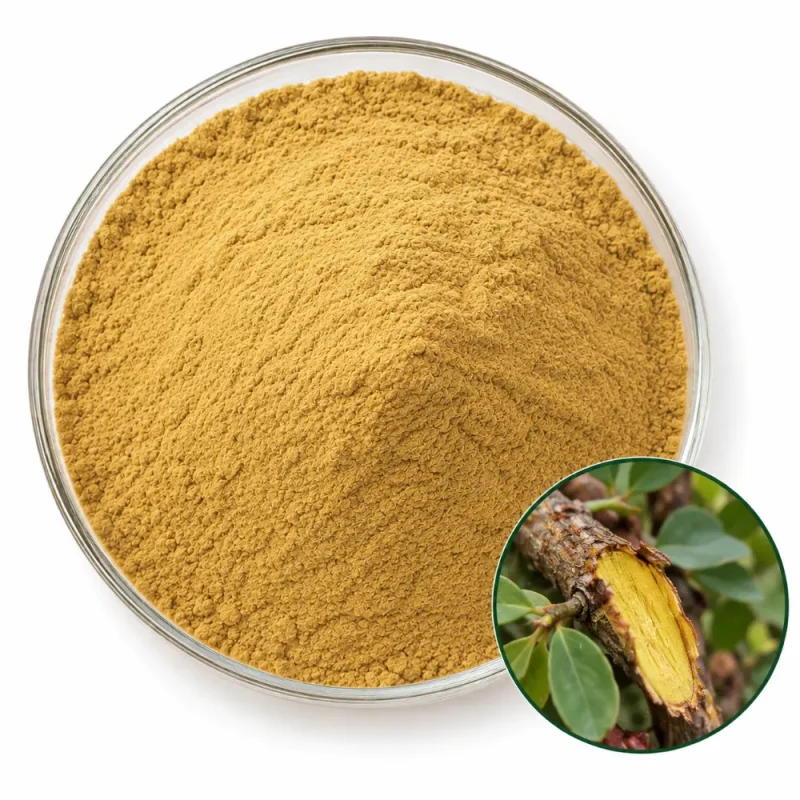
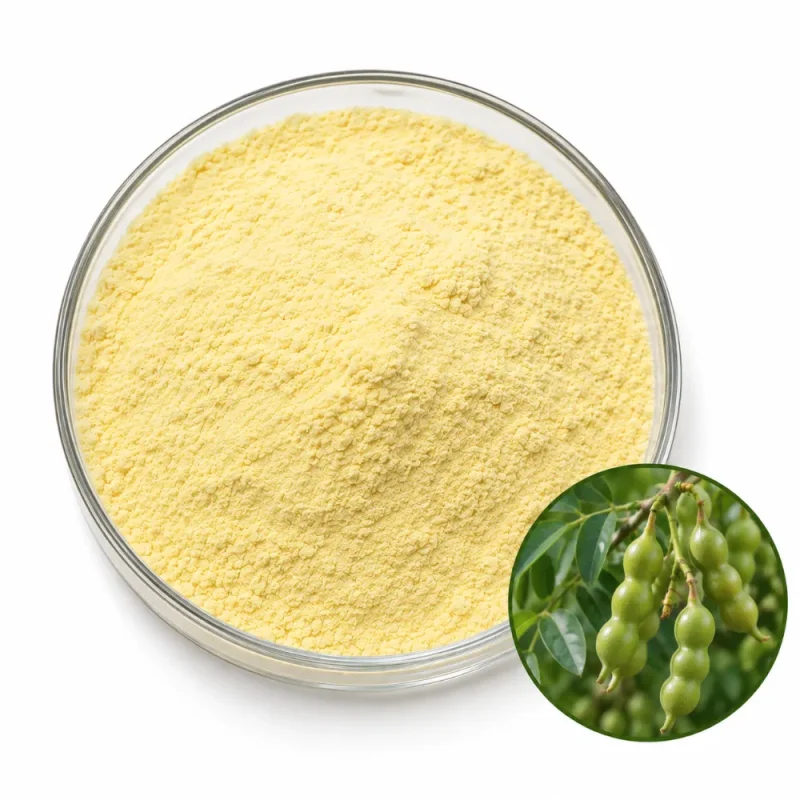
Freed from its sugar-bound forms, kaempferol is isolated here from the flower bud of Sophora japonica by ethanol extraction and purification. It is a yellow flavonol with four hydroxyl groups, and unlike its better-known relative quercetin it has only one hydroxyl on the B-ring.

The primary grade is 98% kaempferol by HPLC, in Food / Dietary Supplement Grade. The yellow powder is insoluble in water. It is used where the single flavonol aglycone, not a glycoside such as rutin and not a mixed Sophora extract, is the defined ingredient.

Kaempferol Chemical Identity

Kaempferol has the molecular formula C15H10O6 and a molecular weight of 286.2. It is a flavonol, a flavone with a hydroxyl at position 3, with further hydroxyls at positions 5 and 7 on the A-ring and at 4′ on the B-ring. The single hydroxyl on the B-ring is the feature that separates it from quercetin, which has two. That difference makes kaempferol less polar, less reactive toward oxidation and less strongly metal-binding than the catechol-bearing flavonol.

The formula and weight are shared by other flavones. Fisetin and luteolin have the same C15H10O6 and differ in where the hydroxyls sit, so retention time and the ultraviolet spectrum are what separate them, not the mass. The natural source is the flower bud of Sophora japonica L., a tree that GBIF now lists under the name Styphnolobium japonicum, and the bud is the established commercial source of flavonols. In the bud the main flavonoid is rutin, a quercetin glycoside, and the kaempferol sugar-bound forms are minor, which is why the free aglycone is produced by hydrolysis and purification. Related products are Quercetin 98%, Quercetin Dihydrate 99% and Rutin 98%.

Typical Specifications

Specification ItemProduct Information
Natural SourceSophora japonica flower bud
Plant PartFlower
ProcessingEthanol Extraction & Purification
Compound ClassFlavonoids, Polyphenols
Chemical Name (IUPAC)3,5,7-trihydroxy-2-(4-hydroxyphenyl)chromen-4-one
CAS Number520-18-3
Molecular FormulaC15H10O6
Molecular Weight286.24
PubChem CID5280863
InChIKeyIYRMWMYZSQPJKC-UHFFFAOYSA-N
SMILESC1=CC(=CC=C1C2=C(C(=O)C3=C(C=C(C=C3O2)O)O)O)O
Purity98% (HPLC)
GradeFood / Dietary Supplement Grade
AppearanceYellow powder
Solubility / DispersibilityInsoluble in Water
Quality Parameters
Moisture (LOD)≤5.0%
Total Ash≤5.0%
Heavy MetalsLead ≤2 ppm · Arsenic ≤1 ppm · Cadmium ≤1 ppm · Mercury ≤0.1 ppm
MicrobiologyTPC ≤1,000 cfu/g · Yeast & Mold ≤100 cfu/g · E. coli Negative · Salmonella Negative/25 g
Shelf Life24 months in unopened original packaging, cool and dry storage

Kaempferol Purity Grades & Impurities

The 98% figure is an HPLC result that compares the kaempferol peak with the other detected peaks, with detection near the wavelength where the flavonol band absorbs. It leaves out water, ash and components without absorbance, so moisture and ash limits are listed separately. There is no second grade for this product, and the single level is the primary grade.

The related substances of flower bud kaempferol are the other flavonol aglycones that share the hydrolysis step. Quercetin is the main neighbor, because the bud is rich in its glycoside, and it elutes just before kaempferol on a reversed-phase column. Isorhamnetin, the methylated form of quercetin, and the trace aglycone of other flavonoids may appear. A good trace shows kaempferol well resolved from quercetin, since the two are the pair most likely to be confused in the supply chain.

Glycosides that survive hydrolysis are the other class of impurity. Kaempferol glycosides are more polar and elute early, and their presence points to incomplete conversion. Oxidation products of the flavonol are minor in kaempferol compared with quercetin, since the B-ring lacks the catechol, though prolonged heat and alkali still darken the powder. A clean lot is a bright yellow powder, and a brown tone means oxidation or residual pigment.

The B-ring hydroxyl pattern makes kaempferol more stable than quercetin, yet it still darkens in alkaline solution and in strong light, so stability testing of a finished blend should include a light-exposure arm and a high-humidity arm. A change of color from bright yellow toward olive or brown, or a fall in the main peak area of a retained sample, is the first sign of degradation and a reason to review the storage conditions.

Plant-derived and synthetic kaempferol share the same main peak. The source statement therefore matters, and the impurity profile of a hydrolysate from a quercetin-rich bud differs from that of a synthetic route, which leaves reaction by-products and not related flavonols.

Kaempferol Solubility & Delivery

Kaempferol is practically insoluble in water and dissolves in ethanol, acetone, ethyl acetate and dimethyl sulfoxide. The planar structure and the hydrogen bonding of the hydroxyl groups give a stable crystal, so dissolution is slow even in good solvents. The molecule is more lipophilic than quercetin, and it partitions into oil-phase and emulsion systems somewhat more readily than the more hydroxylated flavonol.

Delivery depends on dispersion. Fine milling, wetting agents, oil-based suspensions and complexes with cyclodextrin or phospholipid are the approaches in the literature. The aglycone is also less soluble than its glycosides, so a formulator who switches from rutin-type ingredients to the free flavonol should expect slower dissolution. In dry blends, the main task is weighing a small amount of fine, cohesive powder accurately, and anti-static tools and a two-stage premix with a dry carrier help. Strong alkali opens the heterocyclic ring and darkens the material, so alkaline bases are avoided.

Application Areas

Capsule Fills of the Flavonol Aglycone

Capsules take kaempferol at low inclusion with a flow agent. The fine yellow powder clings to scoops through static, so anti-static tools and a two-step dilution in a dry carrier give an even fill weight.

Softgel Oil Suspensions

Softgels carry milled kaempferol in oil with an emulsifier and a protective antioxidant. Settling is checked before encapsulation, and the fill tank is kept stirred and shaded so the yellow color stays clean from the first shell to the last.

Flavonol Comparison Blends

Formulators comparing flavonols use kaempferol beside quercetin and rutin to see how hydroxylation changes dissolution and color. Each ingredient is weighed separately, and the HPLC trace of the blend confirms that the ratio has not shifted during mixing or storage.

Dry Premixes for Sticks

Sticks hold kaempferol only at high dilution in a masking base, since the solid does not dissolve and leaves yellow specks. Sieve the premix, add it to opaque flavored mixes, and avoid contact with alkaline minerals.

Tablet Blends at Low Inclusion

Tablets press kaempferol with a dry binder and a lubricant at low inclusion. The abrasive crystals can wear tooling, so a compression trial checks punch condition, and a short disintegration test shows whether the hydrophobic solid releases at the intended rate.

Packaging & Commercial Supply

Essencefield supports product evaluation, formulation trials, commercial orders, and ongoing ingredient supply. Packaging, storage, and shipping arrangements are determined by product characteristics, order quantity, stability requirements, and destination-market needs.

Supply ItemGeneral Information
SampleAvailable upon request for formulation, testing, and supplier evaluation
Order Quantities100 g · 1 kg · 5 kg · 25 kg · 100 kg · 500 kg · Bulk
Sample Lead TimeTypically 5–7 days after sample confirmation
Production Lead TimeTypically 15–30 days after order and specification confirmation
PackagingSuitable protective inner packaging with bags, cartons, drums, or other appropriate outer packaging
StorageStore in tightly sealed, suitable protective packaging in a cool, dry environment. Protect from moisture, heat, and direct sunlight. Specific storage conditions follow the approved product specification.
DocumentationCOA · Product Specification · TDS · SDS · Applicable declarations (as applicable)

Final order quantities, lead times, packaging, documentation, and shipping arrangements are confirmed according to the selected product and commercial requirements.

Request Ingredient Specifications & Quote

Share your target specification, application, quantity, and documentation needs. We’ll help confirm suitable options, samples, and commercial supply details.