3,4-Dihydroxybenzoic Acid 98%

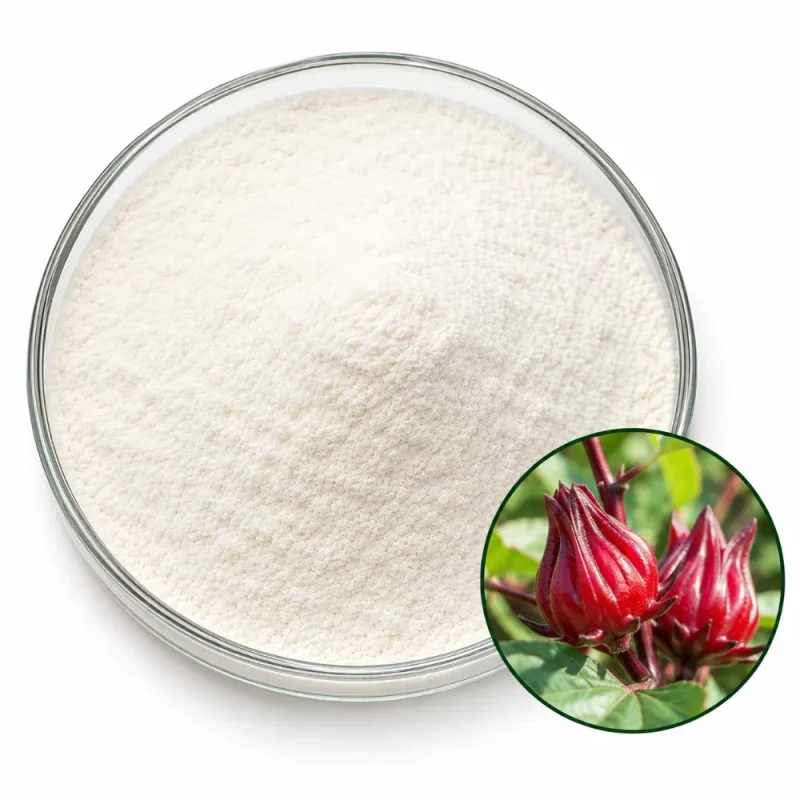
A simple catechol acid that plants make and that anthocyanins release as they break down, 3,4-dihydroxybenzoic acid is isolated here from the flower of Hibiscus sabdariffa by ethanol extraction and purification. It is better known as protocatechuic acid, and it is a water soluble, off-white powder.

The primary grade is 98% 3,4-dihydroxybenzoic acid by HPLC, in Food / Dietary Supplement Grade. Six dihydroxybenzoic acids share one formula, so the locants 3,4 are the identity of this product, and they describe the catechol arrangement that governs its reactivity.

3,4-Dihydroxybenzoic Acid Chemical Identity

3,4-Dihydroxybenzoic acid has the formula C7H6O4 and a molecular weight of 154.1. A benzoic acid ring carries hydroxyl groups at positions 3 and 4, side by side, which forms a catechol. This pair of adjacent hydroxyls binds metal ions and oxidizes easily to a quinone, and it explains both the usefulness and the instability of 3,4-dihydroxybenzoic acid. The 2,4-isomer, in contrast, has a resorcinol arrangement and an internal hydrogen bond to the acid group, so the two isomers differ in acidity, solubility and reactivity despite the shared formula. The 2,4-isomer is supplied as 2,4-Dihydroxybenzoic Acid 98%.

The natural source is the flower of Hibiscus sabdariffa L., roselle, which in trade usage means the red calyx. Protocatechuic acid forms there as a breakdown product of cyanidin-type anthocyanins, and it also occurs widely in other plants, including fruit and grain, so the botanical source and part belong beside the name. Roselle is supplied in other forms: Hibiscus Extract 5–25% Anthocyanins, the 10:1 Hibiscus (Roselle) Extract Powder and the milled Hibiscus Flower Powder. Those are red, pigment-based materials, whereas this acid is a colorless, single compound.
Typical Specifications

Specification ItemProduct Information
Natural SourceHibiscus sabdariffa flower
Plant PartFlower
ProcessingEthanol Extraction & Purification
Compound ClassPolyphenols
Chemical Name (IUPAC)3,4-dihydroxybenzoic acid
CAS Number99-50-3
Molecular FormulaC7H6O4
Molecular Weight154.12
PubChem CID72
InChIKeyYQUVCSBJEUQKSH-UHFFFAOYSA-N
SMILESC1=CC(=C(C=C1C(=O)O)O)O
Purity98% (HPLC)
GradeFood / Dietary Supplement Grade
AppearanceOff-White powder
Solubility / DispersibilityWater Soluble
Quality Parameters
Moisture (LOD)≤5.0%
Total Ash≤5.0%
Heavy MetalsLead ≤2 ppm · Arsenic ≤1 ppm · Cadmium ≤1 ppm · Mercury ≤0.1 ppm
MicrobiologyTPC ≤1,000 cfu/g · Yeast & Mold ≤100 cfu/g · E. coli Negative · Salmonella Negative/25 g
Shelf Life24 months in unopened original packaging, cool and dry storage

3,4-Dihydroxybenzoic Acid Purity Grades & Impurities

An HPLC assay for a small phenolic acid reads the 3,4-dihydroxybenzoic acid peak against a reference standard at a wavelength near 260 nm, and the percentage compares it with the other detected peaks. It leaves out water, ash and anything that does not absorb, so the limits for moisture and ash in the table are needed beside it. A single grade is offered.

The related substances of a roselle-derived acid are other phenolic acids from the calyx. Gallic acid, vanillic acid and the 4-hydroxybenzoic acid are the usual neighbors, and chlorogenic and caffeic acids elute differently and are easy to separate. Isomers of dihydroxybenzoic acid are the more demanding impurities, and a method must resolve the 2,3, 2,4, 2,5, 3,5 and 2,6 isomers from 3,4-dihydroxybenzoic acid. Hibiscus acid and its lactone are organic acids of the calyx that are removed in purification and that can appear at trace level in a poorly purified lot.

Because the catechol oxidizes, color is the most sensitive indicator. A clean lot is white to off-white, and a pink, tan or brown tone points to quinone formation, which is accelerated by alkaline conditions, by light and by traces of iron or copper. The HPLC peak may fall only a little while the color changes, and it is therefore read together with appearance. Moisture and ash are limited separately, and the powder is stored dry in a closed, opaque container.

Plant-derived and synthetic 3,4-dihydroxybenzoic acid share the same main peak. Which route a lot took shows in its impurity profile and in its stated source.

3,4-Dihydroxybenzoic Acid Solubility & Delivery

3,4-Dihydroxybenzoic acid dissolves in water, more readily when warm, and in ethanol, methanol and acetone. The solution is slightly acidic and colorless when fresh. The catechol and the carboxyl group make the molecule polar and give a low logP, so it remains in the water phase and does not dissolve in oil.

Delivery of 3,4-dihydroxybenzoic acid is simple in principle, and stability is the real task. At neutral to alkaline pH the catechol oxidizes and the liquid browns within hours, so drink bases are kept mildly acidic, headspace is limited and a chelating agent counters iron and copper. The acid also reacts with some excipients through its carboxyl group. In dry blends the powder is stable if kept sealed and dry, and it flows moderately, though a small weight is easier to handle as a premix with a dry carrier. Light accelerates darkening, so amber glass or opaque packs are used for solutions and stored powder.

Dissolution of the dry powder is quick, but wetting can be uneven when the crystals are fine. Adding 3,4-dihydroxybenzoic acid slowly to vortexing water avoids floating clumps, and a short sonication or stir step finishes the job. Ready solutions should be used within a defined period, and the time between preparation and filling is recorded in the batch record, because an aged stock behaves differently from a fresh one in color and assay.

Application Areas

Acidified Shots and Concentrates

Dissolved in cool water and held at a mildly acidic pH, 3,4-dihydroxybenzoic acid gives a clear shot. Fill into amber bottles with little headspace, add a chelating agent where hard water is used, and compare the color with a control after a week.

Capsule Fills of the Catechol Acid

Capsules take 3,4-dihydroxybenzoic acid at low to moderate inclusion. The powder is slightly cohesive, so a flow agent and a sieved premix give an even fill weight, and opaque capsules slow darkening of the powder during storage and shipping.

Dry Sachet Premixes

Sachets hold 3,4-dihydroxybenzoic acid in a dry premix with sweetener and fruit acid. Mineral supplements containing iron are kept out of the same premix, because the catechol forms colored complexes with the metal and the powder darkens.

Hibiscus Blend Components

Blends with roselle extracts combine the colorless acid with the red anthocyanin material. The two are weighed on their own and premixed in steps, and the color of the blend is checked after a week, since the acid can darken in the presence of pigment.

Isomer Standards for Method Work

Analytical teams use the 98% 3,4-dihydroxybenzoic acid grade to test whether a column resolves the dihydroxybenzoic acid isomers, and to document the retention window of the 3,4 form. The standard is stored dry and dark, and a retained sample of each lot keeps a record of the retention time.

Packaging & Commercial Supply

Essencefield supports product evaluation, formulation trials, commercial orders, and ongoing ingredient supply. Packaging, storage, and shipping arrangements are determined by product characteristics, order quantity, stability requirements, and destination-market needs.

Supply ItemGeneral Information
SampleAvailable upon request for formulation, testing, and supplier evaluation
Order Quantities100 g · 1 kg · 5 kg · 25 kg · 100 kg · 500 kg · Bulk
Sample Lead TimeTypically 5–7 days after sample confirmation
Production Lead TimeTypically 15–30 days after order and specification confirmation
PackagingSuitable protective inner packaging with bags, cartons, drums, or other appropriate outer packaging
StorageStore in tightly sealed, suitable protective packaging in a cool, dry environment. Protect from moisture, heat, and direct sunlight. Specific storage conditions follow the approved product specification.
DocumentationCOA · Product Specification · TDS · SDS · Applicable declarations (as applicable)

Final order quantities, lead times, packaging, documentation, and shipping arrangements are confirmed according to the selected product and commercial requirements.

Request Ingredient Specifications & Quote

Share your target specification, application, quantity, and documentation needs. We’ll help confirm suitable options, samples, and commercial supply details.