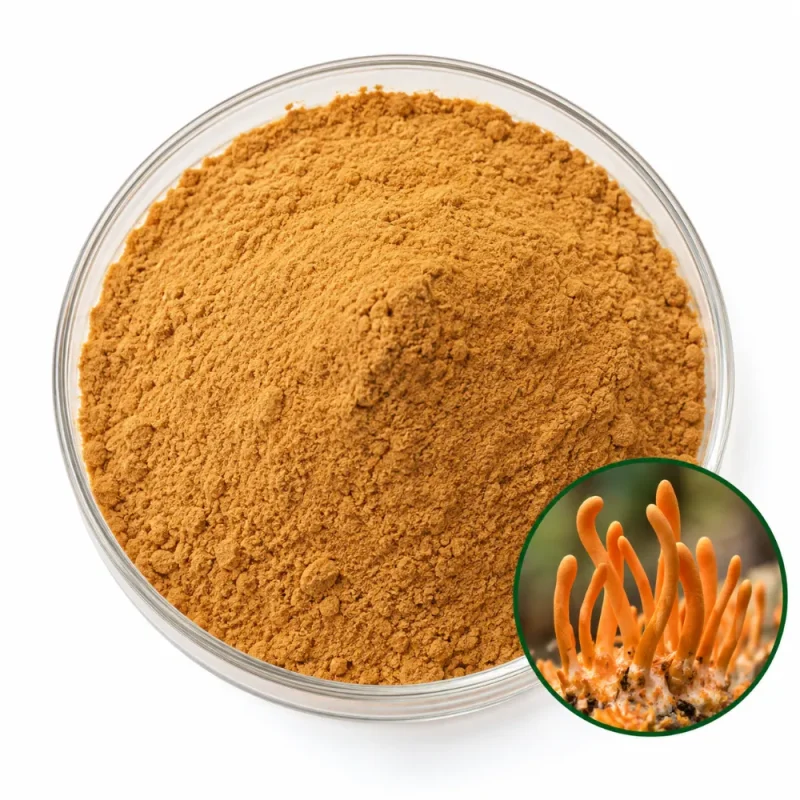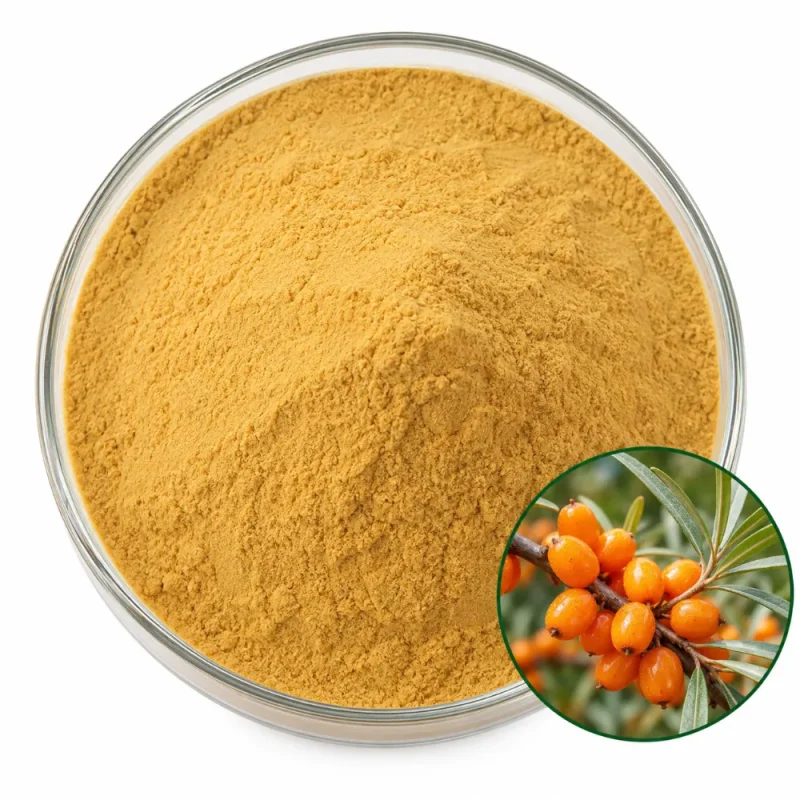
Sea Buckthorn Polysaccharide Powder

Berries of Hippophae rhamnoides L. are extracted in hot water, and the ethanol-precipitated carbohydrate fraction is purified, dried and milled into this sea buckthorn polysaccharide powder. The yellow-orange powder dissolves in water without the oil, acids and pigments that dominate the whole fruit.

Polysaccharide content is ≥30% by UV-Vis (phenol–sulfuric, as glucose), moisture and total ash are each ≤5.0%, and particle size is 80 mesh. The percentage is stated with its method, and the powder is a purified fraction, not a ground fruit.

Sea Buckthorn Polysaccharide Identity

The source is the berry of Hippophae rhamnoides L., a thorny shrub of the family Elaeagnaceae that grows in cold, dry and coastal regions. The fruit is a small orange drupe-like berry, sour and aromatic. The part used is the whole berry, and the leaf and seed are not part of this powder. The seed oil and the pulp oil are separate raw materials that belong to other product lines.

Sea buckthorn berries are rich in organic acids, mainly malic and quinic acid, together with sugars, carotenoids, flavonols such as isorhamnetin glycosides and a lipid fraction rich in palmitoleic acid. Hot-water extraction brings out the polar part of this mix, and ethanol precipitation keeps the large polymers while the acids and small sugars stay in the supernatant. Sea buckthorn polysaccharide is described as a heteropolysaccharide fraction with pectic character.

The lipid and carotenoid fractions are fat-soluble, so they are left in the pomace and do not appear in the powder. That separation is why sea buckthorn polysaccharide is lighter and more soluble than the pulp products.

Berries are small, fragile and acidic, and fruit that is stored warm ferments quickly. Raw material handling therefore starts with prompt drying or freezing after harvest, and the resulting extract is clearer when the fruit is processed fresh. Cultivars of the species differ in sugar and acid levels, and none is named for this product.

Related sea buckthorn materials are different in nature. Sea Buckthorn Berry Extract Powder and Sea Buckthorn Extract Powder are whole water extracts, and Sea Buckthorn Powder is a fruit powder.
Polysaccharide Content & Test Method

UV-Vis here means the phenol–sulfuric assay, which reports the sum of all acid-releasable sugar as glucose equivalents. The reading cannot tell a pectic polymer from a free sugar, so polysaccharides ≥30% describes the total carbohydrate of the finished powder and nothing narrower.

Sea buckthorn is a sugar-and-acid berry, and that makes the method sensitive to purification. Free glucose and fructose, and oligosaccharides, react exactly like polymer-bound sugar, so a crude water extract of the berry can read high even if the polymer content is modest. Ethanol precipitation removes most of the small sugars before drying, and the 30% value applies to the finished powder.

Uronic acids, which are common in pectic polymers, give a weaker color than neutral sugars in the same reaction. A pectin-rich fraction can therefore read lower than its true carbohydrate mass. Enzymatic β-glucan assays do not apply to this fraction, and gravimetric precipitate weights would include protein and tannin.

For these reasons, the figure should be compared only with other UV-Vis results that use glucose as the reference. It is a lot-to-lot control measure for one process and not a mass of pectin.

Buyers sometimes expect a sea buckthorn polysaccharide figure to reflect the oil, flavonoid or vitamin content of the fruit. It does not. Those components sit in other fractions and are measured by other methods, and a sea buckthorn polysaccharide powder at 30% by UV-Vis says nothing about them.

Typical Specifications

Specification ItemProduct Information
Latin NameHippophae rhamnoides
Plant PartFruit & Berry
ProcessingWater Extraction & Purification
Common NameSea buckthorn
Ingredient TypePolysaccharide Extract
Polysaccharide TypePectic-type heteropolysaccharides
ContentPolysaccharides ≥30% (UV-Vis, as glucose)
AppearanceYellow-Orange powder
Solubility / DispersibilityWater Soluble
Quality Parameters
Moisture≤5.0% (LOD)
Total Ash≤5.0%
Particle Size80 mesh
Heavy MetalsLead ≤2 ppm · Arsenic ≤1 ppm · Cadmium ≤1 ppm · Mercury ≤0.1 ppm
MicrobiologyTPC ≤1,000 cfu/g · Yeast & Mold ≤100 cfu/g · E. coli Negative · Salmonella Negative/25 g
Shelf Life24 months in unopened original packaging, cool and dry storage

Sea Buckthorn Polysaccharide Solution Behavior

The powder dissolves in water into a yellow to light orange solution that is clear to slightly hazy. The pectic chains hydrate into a moderate viscosity that rises with concentration and is highest at slightly acidic pH, where the carboxyl groups are partly protonated and neighboring chains associate. Warm water shortens dissolution, and sifting into a vortex keeps lumps from forming.

Sea buckthorn polysaccharide solutions taste faintly tart and fruity at higher concentrations. Calcium has the strongest effect on the polymer. Divalent cations bridge the galacturonic acid groups of pectin and can thicken the solution, cloud it, or in a concentrated system form a soft gel, so mineral-fortified bases need a trial. Juice and fruit-acid bases are compatible and often give a smoother body than neutral ones.

Standard pasteurization leaves the backbone intact, while long boiling at low pH breaks the pectin down and thins the liquid. Heating with amino compounds drives Maillard browning, and the yellow-orange tone deepens toward amber with heat, light and trace iron.

The aroma is faint, slightly tart and fruity. The dry powder is hygroscopic and cakes in open air. Viscosity is not specified for this grade.

Application Areas

Fruit-Flavored Drink Powders

Sea buckthorn polysaccharide dissolves into a golden solution and suits fruit drink powders and stick packs. Acidic fruit bases give a smooth body, and hot holding is kept short because residual sugars encourage browning. The drink is checked for color after a week in the cold.

Syrup and Concentrate Formulas

Added to syrups and shots, the powder contributes soluble solids and gentle viscosity to the formula. Dairy-based versions need a trial for calcium-driven haze, and viscosity is compared with a control after a week of storage at room temperature.

Capsule and Tablet Formats

The purified powder fills capsules more cleanly than milled berry, which is sticky and rich in acids. Tablets need dry granulation or a controlled drying endpoint, because the pectic surface turns tacky on wetting, and hardness is checked across the run.

Fruit Jelly and Gummy Systems

In fruit jellies and gummy bases, the pectic polymer integrates with the gelling system and adds body. Texture is governed by calcium and pH, which are fixed before the polysaccharide level is chosen, and a trial batch confirms the set time.

Dry Sachet Blends with Fruit Powders

Dry sachets that pair the polysaccharide with fruit powders disperse evenly and dissolve without lumps. A moisture-barrier laminate prevents caking in the sachet, and dose weight is verified on samples from the start, middle and end of the run.

Packaging & Commercial Supply

Essencefield supports product evaluation, formulation trials, commercial orders, and ongoing ingredient supply. Packaging, storage, and shipping arrangements are determined by product characteristics, order quantity, stability requirements, and destination-market needs.

Supply ItemGeneral Information
SampleAvailable upon request for formulation, testing, and supplier evaluation
Order Quantities100 g · 1 kg · 5 kg · 25 kg · 100 kg · 500 kg · Bulk
Sample Lead TimeTypically 5–7 days after sample confirmation
Production Lead TimeTypically 15–30 days after order and specification confirmation
PackagingSuitable protective inner packaging with bags, cartons, drums, or other appropriate outer packaging
StorageStore in tightly sealed, suitable protective packaging in a cool, dry environment. Protect from moisture, heat, and direct sunlight. Specific storage conditions follow the approved product specification.
DocumentationCOA · Product Specification · TDS · SDS · Applicable declarations (as applicable)

Final order quantities, lead times, packaging, documentation, and shipping arrangements are confirmed according to the selected product and commercial requirements.

Request Ingredient Specifications & Quote

Share your target specification, application, quantity, and documentation needs. We’ll help confirm suitable options, samples, and commercial supply details.