Schisandra chinensis Polysaccharide Powder

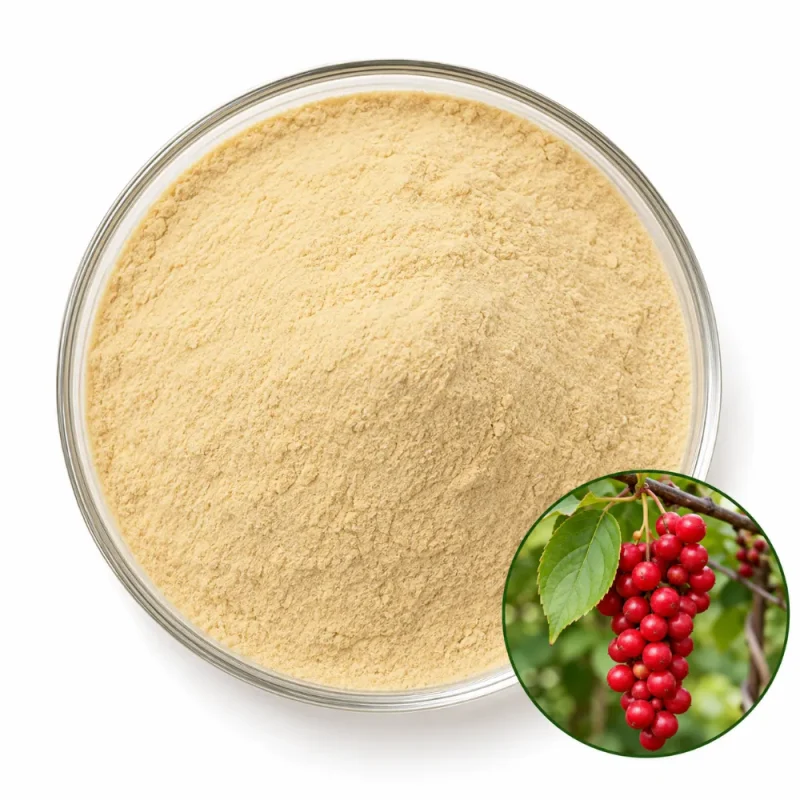
The ethanol-precipitated carbohydrate fraction of the ripe berry of Schisandra chinensis (Turcz.) Baill. is dried and milled into this Schisandra chinensis polysaccharide powder. Hot-water extraction and purification separate the water-soluble polymers from the sour acids, pigments and lipophilic lignans that give the whole berry its flavor.

Polysaccharide content is ≥30% by UV-Vis (phenol–sulfuric, as glucose), moisture and total ash are each ≤5.0%, and particle size is 80 mesh. The red powder dissolves in water and is supplied for supplements, drinks and functional foods, with the percentage always stated beside its method.

Schisandra chinensis Polysaccharide Identity

The source is the ripe berry of Schisandra chinensis (Turcz.) Baill., northern schisandra, a woody vine of the family Schisandraceae. The berry is the only plant part used. The related southern species, Schisandra sphenanthera, is a separate raw material with a different composition, and the leaves, stems and seeds are not part of this powder. The name wuweizi, meaning five-flavor fruit, refers to the mix of sour, sweet, salty, bitter and pungent tastes in the berry.

Hot-water extraction brings out the water-soluble matter of the berry: organic acids, sugars, pigments and polysaccharides. Ethanol precipitation then keeps the large polymers and leaves the small acids and sugars in the supernatant. Schisandra chinensis polysaccharide is described as a mixture of neutral and acidic heteropolysaccharides built from arabinose, galactose, glucose and uronic acid residues.

Berries are harvested ripe in autumn and dried before extraction, and drying conditions affect how much pigment and organic acid reach the extract. Schisandra chinensis polysaccharide is therefore controlled by the washing and precipitation steps as much as by the raw berry, and each lot is judged against the same reference process.

The lignans for which the berry is best known, such as schisandrin, are lipophilic and barely water-soluble, so they do not carry into this fraction. A buyer who wants those markers is served by Schisandra Extract 1–20% Schisandrins/Lignans, while Schisandra Berry Extract Powder is the whole water extract and Schisandra Berry Powder is the milled berry.

Polysaccharide Content & Test Method

Polysaccharides ≥30% by UV-Vis is a total-carbohydrate reading. The phenol–sulfuric reaction counts every sugar that hot acid can free from the sample and reports it as glucose, whatever polymer it came from, so the number describes the powder as a whole and not one named molecule.

Schisandra chinensis berries carry two features that affect the reading. The first is a high share of free sugars and organic acids, which react like polymer-bound sugar and make a crude extract read high, so ethanol precipitation before drying matters. The second is pigment: berry anthocyanins absorb light near the wavelength used to read the assay, and residual color can shift the result if purification is incomplete.

For that reason, the 30% value applies to the finished powder and not to the extract before precipitation. Gravimetric ethanol-precipitate weights would include protein and tannin, and an enzymatic assay exists only for β-glucan, so neither is used for this grade.

The figure should be compared only with other UV-Vis results that use glucose as the reference sugar. It is not comparable with a lignan assay by HPLC, which measures a different analyte in a different fraction of the berry.

A practical consequence follows for buyers who compare quotations. A Schisandra chinensis polysaccharide powder at 30% by UV-Vis and a schisandra extract at 2% schisandrins describe two unrelated materials, and neither number can be used to judge the other. The method column in the table above is the only safe basis for comparing one polysaccharide powder with another.

Typical Specifications

Specification ItemProduct Information
Latin NameSchisandra chinensis
Plant PartFruit & Berry
ProcessingWater Extraction & Purification
Common NameSchisandra (northern schisandra, five-flavor berry)
Ingredient TypePolysaccharide Extract
Polysaccharide TypeNeutral and acidic heteropolysaccharides
ContentPolysaccharides ≥30% (UV-Vis, as glucose)
AppearanceRed powder
Solubility / DispersibilityWater Soluble
Quality Parameters
Moisture≤5.0% (LOD)
Total Ash≤5.0%
Particle Size80 mesh
Heavy MetalsLead ≤2 ppm · Arsenic ≤1 ppm · Cadmium ≤1 ppm · Mercury ≤0.1 ppm
MicrobiologyTPC ≤1,000 cfu/g · Yeast & Mold ≤100 cfu/g · E. coli Negative · Salmonella Negative/25 g
Shelf Life24 months in unopened original packaging, cool and dry storage

Schisandra chinensis Polysaccharide Solution Behavior

The powder dissolves in cold or warm water into a red to pink solution that is clear to slightly hazy. Viscosity stays low to moderate at normal use levels, because Schisandra chinensis polysaccharide is a branched heteropolysaccharide and not a gelling gum. Warm water shortens dissolution, and sifting into a stirred vortex prevents the surface clumps that form when the powder is dumped in.

Schisandra chinensis polysaccharide solutions also carry a mild sour taste from residual fruit acids. Color follows pH. Residual anthocyanins are redder in acidic drinks and shift toward violet and gray as the pH rises, so a neutral or alkaline base looks duller than a juice-type base. Light and heat fade the tone slowly, and a clear bottle in a bright store will lose color faster than an opaque pack.

The Schisandra chinensis polysaccharide itself is stable through normal pasteurization and in mildly acidic to neutral systems. Prolonged boiling at low pH can cleave glycosidic bonds and thin the solution, and heating with amino compounds causes Maillard browning. Divalent cations such as calcium can cloud the acidic fraction at higher levels.

The aroma is faint, slightly sour and berry-like. Dry powder is hygroscopic and cakes in open air, so drums are resealed after each draw. The grade carries no stated viscosity value.

Application Areas

Berry-Style Drink Powders and Sticks

Schisandra chinensis polysaccharide dissolves into a red solution and suits dry drink mixes and stick packs. Acidic fruit bases keep the color brighter, and hot holding is kept short because residual sugars encourage browning in a warm vessel.

Capsules and Tablet Cores

The purified powder fills capsules cleanly and is much less sticky than the milled berry. Tablets need dry granulation or a controlled drying endpoint, because the polysaccharide surface turns tacky when wetted, and fill weight is checked at both ends of a run.

Syrups, Shots and Concentrates

For Schisandra chinensis, in ready-to-drink shots and syrups, the polysaccharide adds soluble solids with gentle viscosity. Calcium-fortified bases can haze, so mineral content is checked in the trial batch, and viscosity is compared with a control after storage at room temperature.

Fruit Gummy and Chew Bases

With Schisandra chinensis, gummy and chew bases tolerate the fraction at moderate inclusion because it dissolves into the cooking syrup. Acid is added late to protect the red color, and batch pH is recorded since pectin and gelatin sets respond to it.

Herbal Powder Blends in Sachets

Sachet blends pair the polysaccharide with other water-soluble herbal fractions. The red powder mixes well into dry blends, a moisture-barrier laminate prevents caking, and a flow check before filling avoids bridging of the fine powder in the hopper.

Packaging & Commercial Supply

Essencefield supports product evaluation, formulation trials, commercial orders, and ongoing ingredient supply. Packaging, storage, and shipping arrangements are determined by product characteristics, order quantity, stability requirements, and destination-market needs.

Supply ItemGeneral Information
SampleAvailable upon request for formulation, testing, and supplier evaluation
Order Quantities100 g · 1 kg · 5 kg · 25 kg · 100 kg · 500 kg · Bulk
Sample Lead TimeTypically 5–7 days after sample confirmation
Production Lead TimeTypically 15–30 days after order and specification confirmation
PackagingSuitable protective inner packaging with bags, cartons, drums, or other appropriate outer packaging
StorageStore in tightly sealed, suitable protective packaging in a cool, dry environment. Protect from moisture, heat, and direct sunlight. Specific storage conditions follow the approved product specification.
DocumentationCOA · Product Specification · TDS · SDS · Applicable declarations (as applicable)

Final order quantities, lead times, packaging, documentation, and shipping arrangements are confirmed according to the selected product and commercial requirements.

Request Ingredient Specifications & Quote

Share your target specification, application, quantity, and documentation needs. We’ll help confirm suitable options, samples, and commercial supply details.