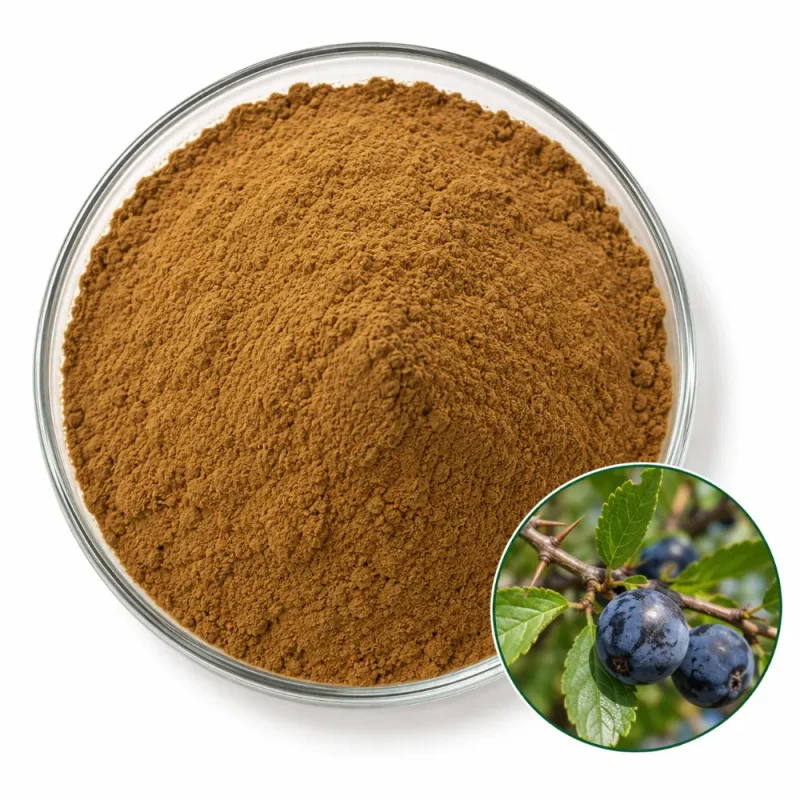
Blackthorn Extract Powder

The small blue-black fruit of Prunus spinosa, the blackthorn or sloe of European hedgerows, supplies this blackthorn extract, and the flowers, bark and leaves are not used. Water extraction concentrates the soluble fruit fraction, and the liquor is dried into a brown powder that disperses in water.

A 10:1 ratio sets the concentration, no marker percentage is attached, and the powder is milled to 80 mesh. No standardized extract, powder or isolated compound of this species is listed alongside it, so this ratio extract is the single blackthorn ingredient, with no declared tannin or anthocyanin figure.

Prunus spinosa Identity & Plant Part

The botanical entity is Prunus spinosa L., a thorny deciduous shrub of the Rosaceae family that grows in hedgerows and scrub across Europe and western Asia. The part used is the fruit, the sloe, a small round drupe with a dusty blue-black bloom. Flowers, bark, leaves, twigs and the stone are not part of this ingredient.

The fruit is unusually astringent and sour for a plum relative, which is why sloes are traditionally steeped in gin or sugar instead of eaten raw. Its tartness comes from malic acid and its dry mouthfeel from tannins, while its dark skin holds anthocyanins, mainly cyanidin and peonidin glycosides.

Blackthorn is a wild plum species, so it should not be confused with cultivated damson or plum, Prunus domestica, whose fruit is larger, sweeter and much less tannic.

Sloe fruit is picked after the first autumn frosts in traditional practice, which softens the skin; the harvest timing is a trade custom and not part of the specification of the blackthorn extract.

What 10:1 Means for Blackthorn

A 10:1 ratio records how much blackthorn fruit went into the extract. It is not a content figure for tannins, anthocyanins or any other constituent, and no such figure is attached to this product. The ratio describes concentration of the starting material only, which is the sloe fruit in this case.

Tannins and anthocyanins dissolve readily in hot water, so a water extract of sloes carries both into the powder along with the fruit acids. That explains the dried powder’s dry, puckering taste and the way its color moves with acidity, from deeper red at low pH toward duller brown-violet as the solution nears neutral.

Dried whole sloes and sloe powder are also traded, and those are fiber-bearing forms that behave differently from a dispersible blackthorn extract in a dry blend.

Typical Specifications

Specification ItemProduct Information
Latin NamePrunus spinosa
Plant PartFruit & Berry
ProcessingWater Extraction
Common NameBlackthorn (Sloe)
Ingredient TypeRatio Extract
Extract Ratio10:1
AppearanceBrown powder
Solubility / DispersibilityWater Dispersible
Quality Parameters
Moisture (LOD)≤5.0%
Total Ash≤5.0%
Particle Size80 mesh
Heavy MetalsLead ≤2 ppm · Arsenic ≤1 ppm · Cadmium ≤1 ppm · Mercury ≤0.1 ppm
MicrobiologyTPC ≤1,000 cfu/g · Yeast & Mold ≤100 cfu/g · E. coli Negative · Salmonella Negative/25 g
Shelf Life24 months in unopened original packaging, cool and dry storage

Application Areas

Fruit Tea-Style Instant Mixes

Sloe infusions are an old fruit-tea tradition, so tea-style instant mixes fit blackthorn extract. It disperses to a hazy garnet-brown cup with a sharp, dry edge that honey, apple or spiced flavors soften. Instant fruit-tea mixes carry blackthorn extract best beside a dispersible carrier.

Tablet Compression Blends

Blackthorn extract needs microcrystalline cellulose and a disintegrant for a tablet that breaks up on time. Its fruit sugars and acids make the powder take up humidity quickly, so tablet lines run in a dry room and finished tablets go into desiccated packs under a protective coating that also hides the dark core.

Capsule Fills for Tart Botanicals

Blackthorn extract is placed in two-piece capsules once a flow aid is mixed through it. Tart, astringent powders are best kept inside a capsule shell, which spares the mouth from the puckering note, and disintegration is worth testing on the finished fill.

Single-Dose Sachet Mixes

Sachets combine the extract with sweeteners and a dispersible base. Matching particle size keeps the dense brown powder from sinking, and a dry filling room avoids early lumping at the seal, which is where sticky fruit extracts tend to cause line stoppages.

Formulation Notes

The powder is brown with a faint plum-like aroma and a sharply tart, dry, astringent taste. In water it disperses to a hazy brown-red liquid, and the color deepens in air.

Tannins bind proteins and darken with iron, so test dairy-style mixes at bench scale and keep iron contact surfaces out of the line. Premixing blackthorn extract with a carrier stops it arching over the hopper outlet. After opening, reseal the liner at every draw, because a fruit extract rich in acid and sugar absorbs humidity and sets hard.

Packaging & Commercial Supply

Essencefield supports product evaluation, formulation trials, commercial orders, and ongoing ingredient supply. Packaging, storage, and shipping arrangements are determined by product characteristics, order quantity, stability requirements, and destination-market needs.

Supply ItemGeneral Information
SampleAvailable upon request for formulation, testing, and supplier evaluation
Order Quantities100 g · 1 kg · 5 kg · 25 kg · 100 kg · 500 kg · Bulk
Sample Lead TimeTypically 5–7 days after sample confirmation
Production Lead TimeTypically 15–30 days after order and specification confirmation
PackagingSuitable protective inner packaging with bags, cartons, drums, or other appropriate outer packaging
StorageStore in tightly sealed, suitable protective packaging in a cool, dry environment. Protect from moisture, heat, and direct sunlight. Specific storage conditions follow the approved product specification.
DocumentationCOA · Product Specification · TDS · SDS · Applicable declarations (as applicable)

Final order quantities, lead times, packaging, documentation, and shipping arrangements are confirmed according to the selected product and commercial requirements.

Request Ingredient Specifications & Quote

Share your target specification, application, quantity, and documentation needs. We’ll help confirm suitable options, samples, and commercial supply details.