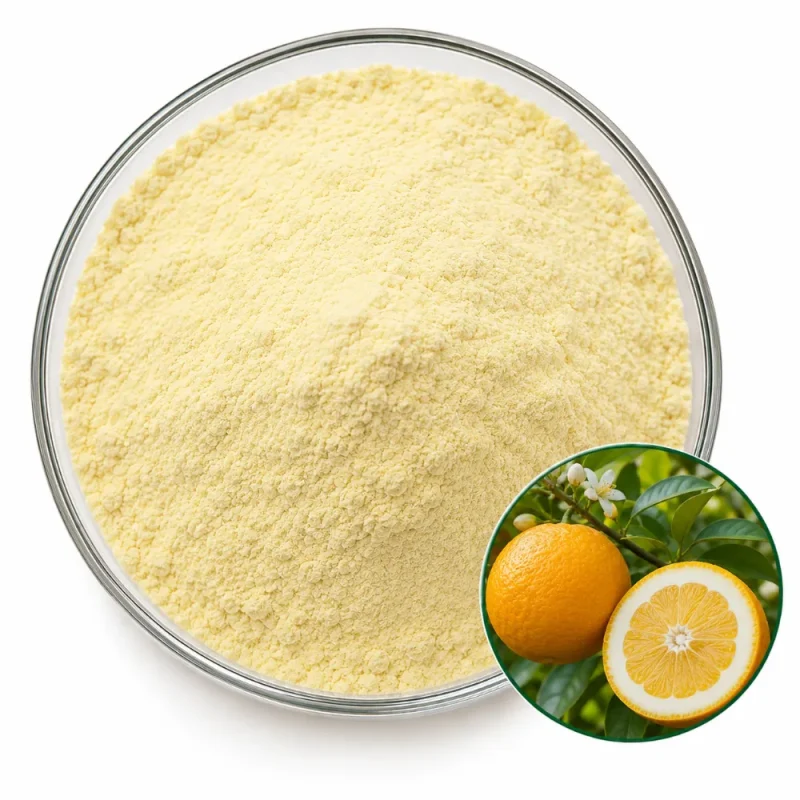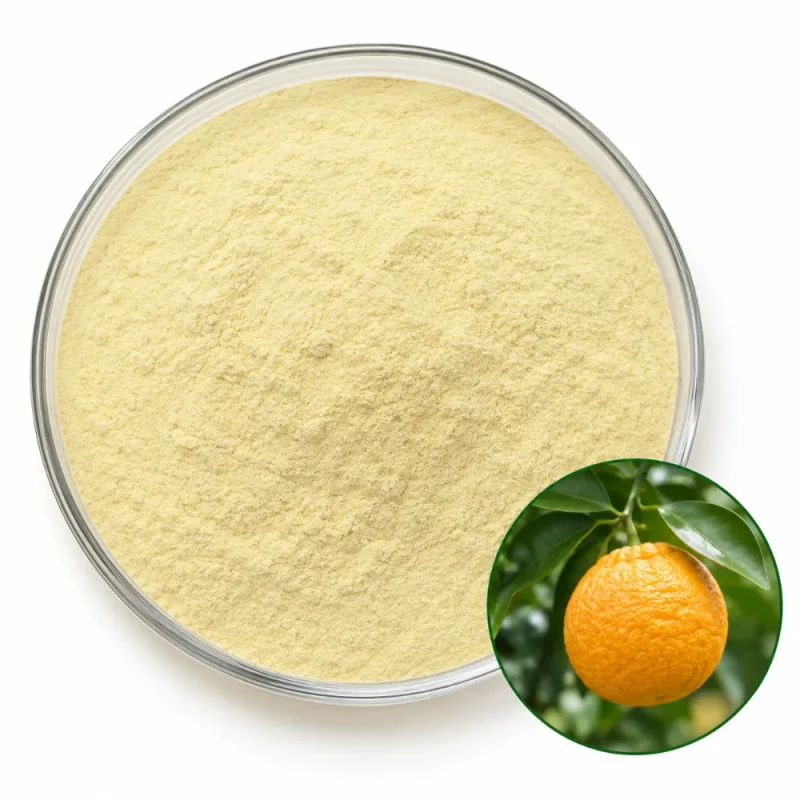
Diosmin 98%

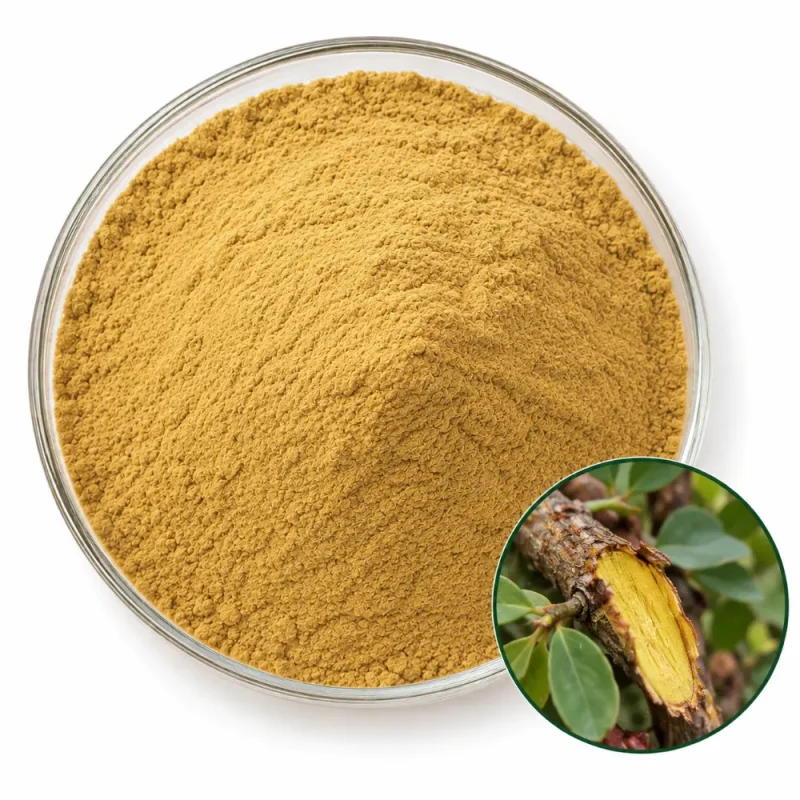
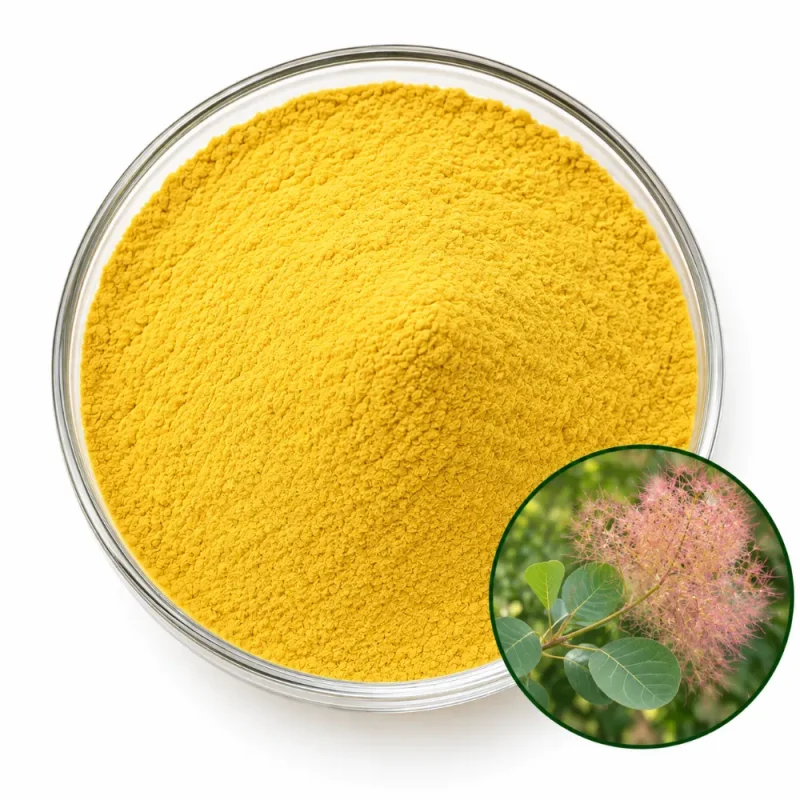
The flavone glycoside of citrus fruit that carries diosmetin on a rutinose sugar is diosmin, and this diosmin is isolated from the fruit of Citrus aurantium, the bitter orange, by solvent extraction and purification. It is diosmetin joined to the sugar rutinose, supplied as a light yellow powder that does not dissolve in water.

The primary grade is 98% diosmin by HPLC, with 90% and 95% grades also supplied, in Food / Dietary Supplement Grade. Diosmin is a flavone and not a flavanone, which puts it in a different chemical position from hesperidin even though the two are often sold side by side.

Diosmin Chemical Identity

Diosmin has the molecular formula C28H32O15 and a molecular weight of 608.5. The aglycone is diosmetin, a flavone with a hydroxyl and a methoxy group on the B-ring, and the rutinose chain is attached at position 7. The difference from hesperidin is two hydrogens: diosmin has a double bond between C2 and C3, which hesperidin lacks. That double bond makes the molecule flatter and more conjugated, so diosmin is less soluble and more tightly packed in the crystal than the flavanone.

The relationship between the two is practical as well as chemical. Hesperidin can be converted to diosmin by dehydrogenation, and this route is widely used to make diosmin industrially, while diosmin also occurs naturally in citrus fruit. For that reason the botanical origin should be stated next to the name. The natural source here is the fruit of Citrus aurantium L. Bitter orange is also supplied as Citrus aurantium Extract 6–30% Synephrine, the 10:1 Bitter Orange Extract Powder and the aglycone Diosmetin 98%. Those materials differ in constituents from the purified glycoside.

Typical Specifications

Specification ItemProduct Information
Natural SourceCitrus aurantium fruit
Plant PartFruit & Berry
ProcessingSolvent Extraction & Purification
Compound ClassFlavonoids, Polyphenols
Chemical Name (IUPAC)5-hydroxy-2-(3-hydroxy-4-methoxyphenyl)-7-[(2S,3R,4S,5S,6R)-3,4,5-trihydroxy-6-[[(2R,3R,4R,5R,6S)-3,4,5-trihydroxy-6-methyloxan-2-yl]oxymethyl]oxan-2-yl]oxychromen-4-one
CAS Number520-27-4
Molecular FormulaC28H32O15
Molecular Weight608.5
PubChem CID5281613
InChIKeyGZSOSUNBTXMUFQ-YFAPSIMESA-N
SMILESCC1C(C(C(C(O1)OCC2C(C(C(C(O2)OC3=CC(=C4C(=C3)OC(=CC4=O)C5=CC(=C(C=C5)OC)O)O)O)O)O)O)O)O
Purity98% (HPLC)
Available Grades90% · 95% · 98% (HPLC)
GradeFood / Dietary Supplement Grade
AppearanceLight Yellow powder
Solubility / DispersibilityInsoluble in Water
Quality Parameters
Moisture (LOD)≤5.0%
Total Ash≤5.0%
Heavy MetalsLead ≤2 ppm · Arsenic ≤1 ppm · Cadmium ≤1 ppm · Mercury ≤0.1 ppm
MicrobiologyTPC ≤1,000 cfu/g · Yeast & Mold ≤100 cfu/g · E. coli Negative · Salmonella Negative/25 g
Shelf Life24 months in unopened original packaging, cool and dry storage

Diosmin Purity Grades & Impurities

GradeAssay & MethodWhere It Fits
90% DiosminHPLCDry blends and premixes
95% DiosminHPLCCapsules and tablets
98% DiosminHPLCMicronized and reference grades

The HPLC assay counts the diosmin peak against all detected peaks. In a flavone glycoside this is a demanding measurement, because the related glycosides have similar spectra and elute near the main peak. The percentage tells a buyer how much of the absorbing material is diosmin, and it leaves out water, ash and anything that does not absorb.

The characteristic related substances are the companions of the citrus flavonoid family. Hesperidin is the most important, as the flavanone precursor of diosmin and a frequent residue of the production route. Isorhoifolin, linarin and the free aglycone diosmetin appear in smaller amounts, as does the rhamnoglucoside of other methoxylated flavones. A trace should resolve diosmin from hesperidin, since the two differ by only two hydrogens and are easily confused.

The grade steps reflect the amount of residual flavanone and other glycosides. At 90% a few percent of related flavonoids remains, which is acceptable for dry blends, while the 98% grade leaves very little and suits reference blends. The pale yellow color deepens when residual pigments are present. Moisture and ash are limited separately, and the powder should be stored dry and out of direct light.

Residual solvent is irrelevant to the HPLC trace but not to the powder. Flavone glycosides that were crystallized from a polar solvent can retain a small amount of it in the lattice, which shows as a loss on drying that is not water. The moisture limit in the table is therefore read as loss on drying, and a lot that loses weight slowly at the test temperature is treated differently from one that loses it quickly, since the first behaves like a solvate.

Diosmin Solubility & Delivery

Diosmin is practically insoluble in water and in most organic solvents, and it dissolves in dimethyl sulfoxide and in dilute alkali. The flat, conjugated structure and the tight hydrogen-bond network of the sugar chain make the crystal difficult to wet and slow to dissolve, which is the main handling issue of this compound.

Delivery therefore depends on particle size. Micronization is the standard approach, because a smaller particle dissolves faster from a tablet or capsule, and the supply of the powder in micronized form is common for this flavone. Wetting agents, hydrophilic carriers and cyclodextrin complexes are other tools described in the literature. Because the powder is hydrophobic and fine, it tends to float and form lumps in water, so pre-wetting with a small amount of surfactant or glycerin helps dispersion. In liquids, a suspending agent is needed to hold the solid evenly.

Because the compound is a glycoside, the sugar chain can be cleaved by acid or enzyme, releasing the aglycone diosmetin, and this hydrolysis is the main chemical change a formulator sees in water-based systems held warm. Neutral to slightly acidic bases keep the glycoside intact. Dry blends are stable, and a closed container, a cool store and protection from strong light keep the pale yellow color, which darkens slowly if the powder is left open on a warm shelf.

Application Areas

Capsule Fills of Micronized Powder

Capsules take diosmin at moderate inclusion. The fine, cohesive powder bridges in hoppers, so a flow agent, a sieved blend and a vibrating feed keep the fill weight steady from lot to lot, and a dry room avoids caking.

Tablets With Disintegrants

Tablets press diosmin with a binder and a disintegrant. Because the crystal is hydrophobic, a wetting agent in the blend helps the tablet break up, and a dissolution trial confirms that the insoluble solid is released at the intended rate.

Suspension Premixes

Powder sticks and liquid suspensions hold diosmin only with a suspending agent. Pre-wet the powder with glycerin to a paste, add it to the bulk with a thickener, and shake before use, since the solid settles in a few minutes.

Flavonoid Blends With Hesperidin

Citrus flavonoid blends combine diosmin with hesperidin in fixed ratios. Each ingredient is weighed separately and premixed in steps, and the HPLC trace of the blend is checked to confirm that the ratio has not shifted.

Packaging & Commercial Supply

Essencefield supports product evaluation, formulation trials, commercial orders, and ongoing ingredient supply. Packaging, storage, and shipping arrangements are determined by product characteristics, order quantity, stability requirements, and destination-market needs.

Supply ItemGeneral Information
SampleAvailable upon request for formulation, testing, and supplier evaluation
Order Quantities100 g · 1 kg · 5 kg · 25 kg · 100 kg · 500 kg · Bulk
Sample Lead TimeTypically 5–7 days after sample confirmation
Production Lead TimeTypically 15–30 days after order and specification confirmation
PackagingSuitable protective inner packaging with bags, cartons, drums, or other appropriate outer packaging
StorageStore in tightly sealed, suitable protective packaging in a cool, dry environment. Protect from moisture, heat, and direct sunlight. Specific storage conditions follow the approved product specification.
DocumentationCOA · Product Specification · TDS · SDS · Applicable declarations (as applicable)

Final order quantities, lead times, packaging, documentation, and shipping arrangements are confirmed according to the selected product and commercial requirements.

Request Ingredient Specifications & Quote

Share your target specification, application, quantity, and documentation needs. We’ll help confirm suitable options, samples, and commercial supply details.