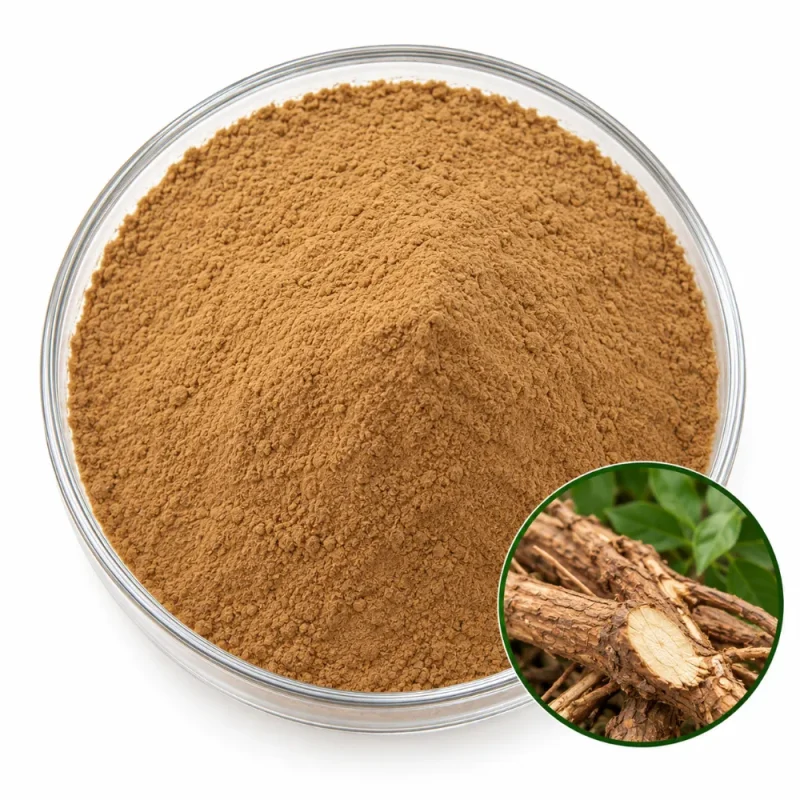
Hydrangea Root Extract Powder

Hydrangea root extract is made from the root of Hydrangea arborescens, the wild hydrangea of eastern North America, and not from the leaves or flower heads. Water extraction concentrates the soluble root fraction, and the liquor is dried into a light brown powder that disperses in water.

The extract is supplied at a 10:1 ratio and milled to 80 mesh, with no marker percentage declared. It is a plain root extract of a single named species, and no powder, marker grade or pure compound of the plant is listed beside it.

Hydrangea arborescens Identity & Plant Part

The botanical entity is Hydrangea arborescens L., wild hydrangea or smooth hydrangea, a deciduous shrub of the Hydrangeaceae native to the eastern United States. The part used is the root. Leaves, flower heads and stems are not included. The garden hydrangeas sold as ornamentals, such as Hydrangea macrophylla, are other species, and the root of those is not interchangeable with this one. Coumarins, flavonoids and saponins, along with glycosides, are the constituent families of Hydrangea arborescens root, named here without figures.

What 10:1 Means for Hydrangea Root

A 10:1 figure on a hydrangea root extract describes concentration against the starting root and carries no information about any single constituent. The name seven barks, used for the plant in older herbal trade, is a reminder that the common name is not a reliable identity. This Hydrangea arborescens extract is defined by the species, the root and the ratio, and no powder or marker grade is listed beside it. Buyers comparing offers should check the species line, because root material labeled hydrangea can come from a different species.

Typical Specifications

Specification ItemProduct Information
Latin NameHydrangea arborescens
Plant PartRoot & Rhizome
ProcessingWater Extraction
Common NameWild Hydrangea
Ingredient TypeRatio Extract
Extract Ratio10:1
AppearanceLight brown powder
Solubility / DispersibilityWater Dispersible
Quality Parameters
Moisture (LOD)≤5.0%
Total Ash≤5.0%
Particle Size80 mesh
Heavy MetalsLead ≤2 ppm · Arsenic ≤1 ppm · Cadmium ≤1 ppm · Mercury ≤0.1 ppm
MicrobiologyTPC ≤1,000 cfu/g · Yeast & Mold ≤100 cfu/g · E. coli Negative · Salmonella Negative/25 g
Shelf Life24 months in unopened original packaging, cool and dry storage

Application Areas

Root Extract Capsules

Hydrangea root extract goes into two-piece capsules as a light brown powder with a faint woody note. A fine root extract can bridge in the hopper, so a flow aid in the premix and early checks of fill weight keep the capsule weight steady.

Woody Tea-Style Mixes

In tea-style mixes the extract gives a hazy, pale brown liquid with a mild woody taste that pairs with ginger, cinnamon or citrus peel. Maltodextrin as the carrier gives the small dose a repeatable weight in each sachet. Hot water brings out the woody note more than cold water does.

Tablet Blends with Roots

A dry binder holds the extract in a tablet at moderate inclusion. Granulation first keeps the fine powder from sticking to the punches, and a film coat provides a moisture barrier for storage in humid markets. Test disintegration after a week of storage, since root polysaccharides can slow breakdown.

Powder Stick Premixes

Sticks carry the extract with a soluble bulking agent to keep dose weight repeatable. The faint taste needs little masking, so stick formulas stay short, and a laminate film limits moisture entering the pack during shelf life. Fill sticks soon after opening the drum to limit moisture pickup.

Soft Chew Blends

Soft chews take the extract with caramel, apple or ginger flavors. Add the powder to the cooked base late to limit heat exposure, and check the texture after a week, because root polysaccharides can firm the chew over time.

Formulation Notes

Hydrangea root extract is a light brown powder with a faint woody, slightly earthy aroma and a mildly bitter taste. Added to water, the powder makes a hazy tan liquid, and fine particles settle on standing. The sensory profile is mild enough that it rarely dominates a flavored blend.

Weigh the hydrangea root extract in a dry room and reseal the pack after each draw, because a root water extract takes up moisture and clumps. For capsule filling, blend the powder with a free-flowing carrier, and for drinks add it to the dry base before any liquid goes in.

Root extracts from woody species are usually sold as fine powders with little visible fiber. Hydrangea root extract passes the fine screens of stick and capsule lines without blocking, but weighing should still be done away from drafts, because the light powder travels easily.

Packaging & Commercial Supply

Essencefield supports product evaluation, formulation trials, commercial orders, and ongoing ingredient supply. Packaging, storage, and shipping arrangements are determined by product characteristics, order quantity, stability requirements, and destination-market needs.

Supply ItemGeneral Information
SampleAvailable upon request for formulation, testing, and supplier evaluation
Order Quantities100 g · 1 kg · 5 kg · 25 kg · 100 kg · 500 kg · Bulk
Sample Lead TimeTypically 5–7 days after sample confirmation
Production Lead TimeTypically 15–30 days after order and specification confirmation
PackagingSuitable protective inner packaging with bags, cartons, drums, or other appropriate outer packaging
StorageStore in tightly sealed, suitable protective packaging in a cool, dry environment. Protect from moisture, heat, and direct sunlight. Specific storage conditions follow the approved product specification.
DocumentationCOA · Product Specification · TDS · SDS · Applicable declarations (as applicable)

Final order quantities, lead times, packaging, documentation, and shipping arrangements are confirmed according to the selected product and commercial requirements.

Request Ingredient Specifications & Quote

Share your target specification, application, quantity, and documentation needs. We’ll help confirm suitable options, samples, and commercial supply details.