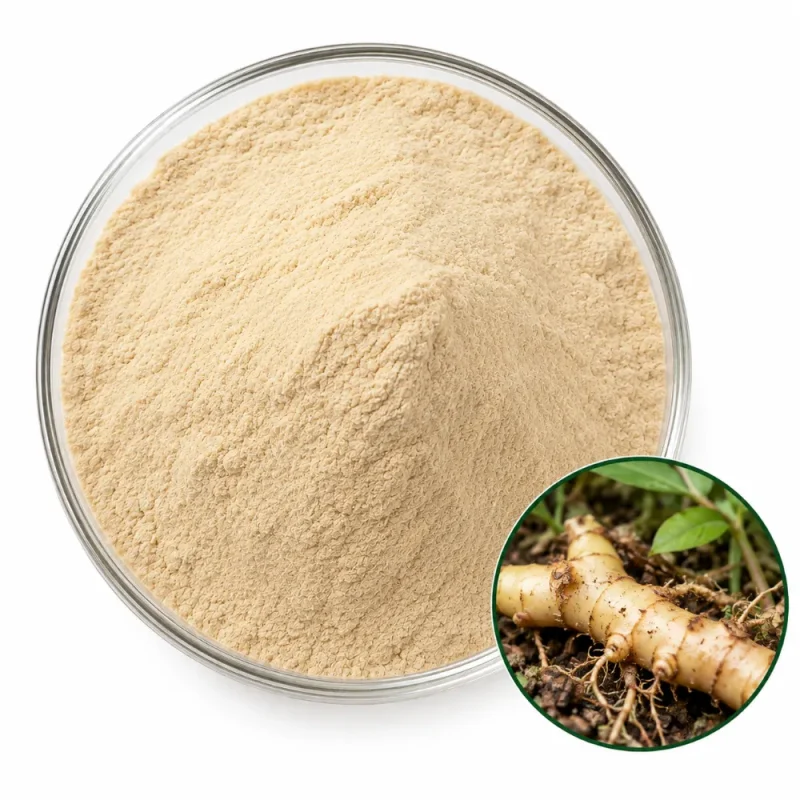
Polygonatum spp. Polysaccharide Powder

Water-extracted from the rhizome of Polygonatum sibiricum, this Polygonatum spp. polysaccharide powder holds the carbohydrate reserve of the plant, the part that makes the fresh rhizome sweet and sticky. It is purified, dried and milled to a fine light yellow powder.

Polysaccharide content is ≥30% by UV-Vis (phenol–sulfuric, as glucose), moisture and total ash are each ≤5.0%, and particles are milled to 80 mesh. The powder dissolves in water and is supplied for dietary supplements, functional beverages and functional foods.

Polygonatum Polysaccharide Identity

Polygonatum spp. polysaccharide powder is specified from the rhizome of Polygonatum sibiricum Redouté, a woodland perennial known as Solomon’s seal or Huangjing. The rhizome is the only part used. In the Chinese trade the name Huangjing covers several related species, including Polygonatum kingianum and Polygonatum cyrtonema, and the “spp.” in the product name reflects that naming, while the specified species here is P. sibiricum.

The rhizome is a storage organ, and its polysaccharides are a mixture. Fructan-type chains, in which fructose units form the bulk of the polymer, are reported alongside heteropolysaccharides containing galactose, glucose, mannose and uronic acid. Their proportions depend on species, rhizome age and processing, and for this reason the term polysaccharide here describes a group of chain types.

Traditional processing of the rhizome includes repeated steaming and drying, which changes taste and sugar content. This Polygonatum spp. polysaccharide powder is defined by its water-extracted carbohydrate fraction and not by the steaming history of the rhizome used. Hot-water extraction and ethanol precipitation remove most free sugar and saponin and keep the large polymers.

Rhizomes are dug after several years of growth, washed, sliced and dried before extraction. The raw rhizome is sticky and sweet, and the carbohydrate share changes with age and drying, so purification from dried material sets the profile of the finished powder rather than the raw root.

Related products from the same plant differ in form. Polygonatum Rhizome Powder is the milled rhizome, Polygonatum Rhizome Extract Powder is a ratio extract, and Polygonatum Peptide Powder is a protein hydrolysate.
Polysaccharide Content & Test Method

The content figure for this grade is polysaccharides ≥30% by UV-Vis, which is a total-carbohydrate measure. In the phenol–sulfuric reaction, hot sulfuric acid converts the polymer to monosaccharides, phenol develops a colored product, and absorbance is compared with a glucose curve. Results are expressed as glucose equivalents and count every sugar-releasing component.

Fructan-rich samples give an unusually sensitive reading. Fructose reacts quickly in hot sulfuric acid and, at equal mass, shows a different absorbance from glucose, so fructan-rich Polygonatum extract read against a glucose curve may be distorted in either direction. The reading is a consistent comparison for the same method, but it is not a measured mass of fructan.

Sample preparation adds another variable. Fructan chains hydrolyse partly during the sulfuric acid step if the sample is heated too long, so the heating time is fixed and standards are run under identical conditions.

Rhizomes also hold free sugars, which behave like polymer-bound sugar in this test. Ethanol precipitation keeps polymers and removes much of the small sugar before drying, and the percentage applies to the finished powder. A gravimetric precipitate would include protein, and an enzymatic assay would measure one linkage only, so this grade is specified by UV-Vis alone.

Typical Specifications

Specification ItemProduct Information
Latin NamePolygonatum sibiricum
Plant PartRoot & Rhizome
ProcessingWater Extraction & Purification
Common NameSolomon’s seal (Huangjing)
Ingredient TypePolysaccharide Extract
Polysaccharide TypeFructan-type and heteropolysaccharide fractions
ContentPolysaccharides ≥30% (UV-Vis, as glucose)
AppearanceLight Yellow powder
Solubility / DispersibilityWater Soluble
Quality Parameters
Moisture≤5.0% (LOD)
Total Ash≤5.0%
Particle Size80 mesh
Heavy MetalsLead ≤2 ppm · Arsenic ≤1 ppm · Cadmium ≤1 ppm · Mercury ≤0.1 ppm
MicrobiologyTPC ≤1,000 cfu/g · Yeast & Mold ≤100 cfu/g · E. coli Negative · Salmonella Negative/25 g
Shelf Life24 months in unopened original packaging, cool and dry storage

Polygonatum Polysaccharide Solution Behavior

Dissolved in water, the Polygonatum spp. polysaccharide powder gives a pale yellow, clear to slightly hazy solution. Fructan-type chains are compact and hydrate fast, so the solution stays thin at ordinary use levels, in contrast to the long chains of glucomannans or the gelling pectins. A mild sweetness remains from small sugars that escape precipitation.

The chains are sensitive to acid. Fructosyl linkages hydrolyse more readily than glucosidic ones when the pH falls and the temperature rises, so a hot, acidic filling step reduces chain length faster than it would for a glucan. Neutral and mildly acidic drinks held cold are stable.

Heating with amino compounds drives Maillard browning, and the sweet, caramel-like note that results from it can be a feature in baked or cooked formats but is a defect in clear drinks. The Polygonatum spp. polysaccharide powder is hygroscopic and cakes if left open.

Polygonatum spp. polysaccharide is compatible with common sweeteners, soluble fibers and plant extracts, and with most water-soluble vitamins. Incompatibilities appear mainly with strong acids and with enzymes, which are the main things to check before scaling up. No viscosity values are stated for this grade.

Application Areas

Instant Drink Granules

Polygonatum spp. polysaccharide dissolves quickly in warm or cold water and carries a faint sweetness, so it suits lightly sweetened drink granules. Hot, acidic fills may shorten the chains, so cold or neutral filling is the safer route, and the granule should be dried well before packing.

Capsule and Tablet Fills

The purified Polygonatum spp. polysaccharide powder is less sticky than milled rhizome, which is sugar-rich, and flows better in capsule filling. Tablets require protection from moisture, since fructan-type polymers absorb water and can soften, and a coating or desiccant sachet helps in humid markets.

Dry Sachet Blends

In stick packs with other plant extracts, the Polygonatum spp. polysaccharide powder dissolves with minimal residue. A flow carrier prevents caking, and a barrier film protects the contents during humid storage and transport, which keeps the Polygonatum spp. polysaccharide powder free-flowing when the sachet is opened.

Soft Candy and Gummy Matrices

Added to pectin or gelatin gummies after the syrup cools, the polysaccharide adds soluble solids. Its sweetness and fructan character can soften the set, so gel strength should be compared with a control, and the cooked syrup should be allowed to cool before dosing.

Cereal and Bar Binders

Syrup binders in bars can carry the powder at modest levels. Browning is faster than with glucan-based fibers, so baking temperature and time are the first settings to adjust. Color should be compared with a control after a week of storage.

Packaging & Commercial Supply

Essencefield supports product evaluation, formulation trials, commercial orders, and ongoing ingredient supply. Packaging, storage, and shipping arrangements are determined by product characteristics, order quantity, stability requirements, and destination-market needs.

Supply ItemGeneral Information
SampleAvailable upon request for formulation, testing, and supplier evaluation
Order Quantities100 g · 1 kg · 5 kg · 25 kg · 100 kg · 500 kg · Bulk
Sample Lead TimeTypically 5–7 days after sample confirmation
Production Lead TimeTypically 15–30 days after order and specification confirmation
PackagingSuitable protective inner packaging with bags, cartons, drums, or other appropriate outer packaging
StorageStore in tightly sealed, suitable protective packaging in a cool, dry environment. Protect from moisture, heat, and direct sunlight. Specific storage conditions follow the approved product specification.
DocumentationCOA · Product Specification · TDS · SDS · Applicable declarations (as applicable)

Final order quantities, lead times, packaging, documentation, and shipping arrangements are confirmed according to the selected product and commercial requirements.

Request Ingredient Specifications & Quote

Share your target specification, application, quantity, and documentation needs. We’ll help confirm suitable options, samples, and commercial supply details.