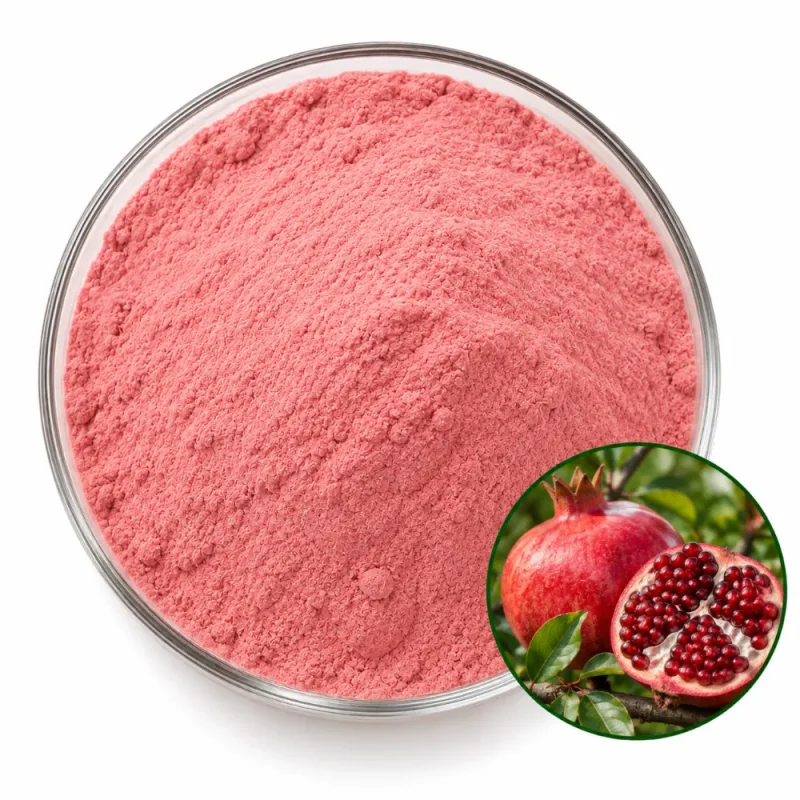
Pomegranate Juice Powder Processing
The species is Punica granatum L., the pomegranate, a deciduous shrub or small tree of the loosestrife family (Lythraceae) native to Iran and the northern Indian subcontinent. The only other member of the genus is the Socotra pomegranate, Punica protopunica, which has no commercial role. Because the fruit has several parts that are traded separately, the question for a buyer is always which part: arils and juice, whole fruit, husk, seed, flower or leaf.
The raw material is pomegranate juice concentrate. Arils are pressed, the juice is clarified or left lightly cloudy, concentrated, and blended with maltodextrin before atomization in a spray dryer. The carrier makes the powder soluble and free-flowing, and it softens the astringency of the pressed juice.
Pomegranates ripen in autumn, and a single fruit holds hundreds of arils packed in membranes. Commercial pressing either squeezes the whole fruit or extracts the arils separately, and the method changes how much husk tannin reaches the juice. The part of the fruit named here is the arils and their juice, which is the basis for the powder.
Pomegranate juice is acidic and sugar-rich, and solids of that kind stick to dryer walls, so a juice powder from this fruit generally needs a generous carrier share. That is a general feature of acidic juices, not a value stated for this product.