Berberine Tannate

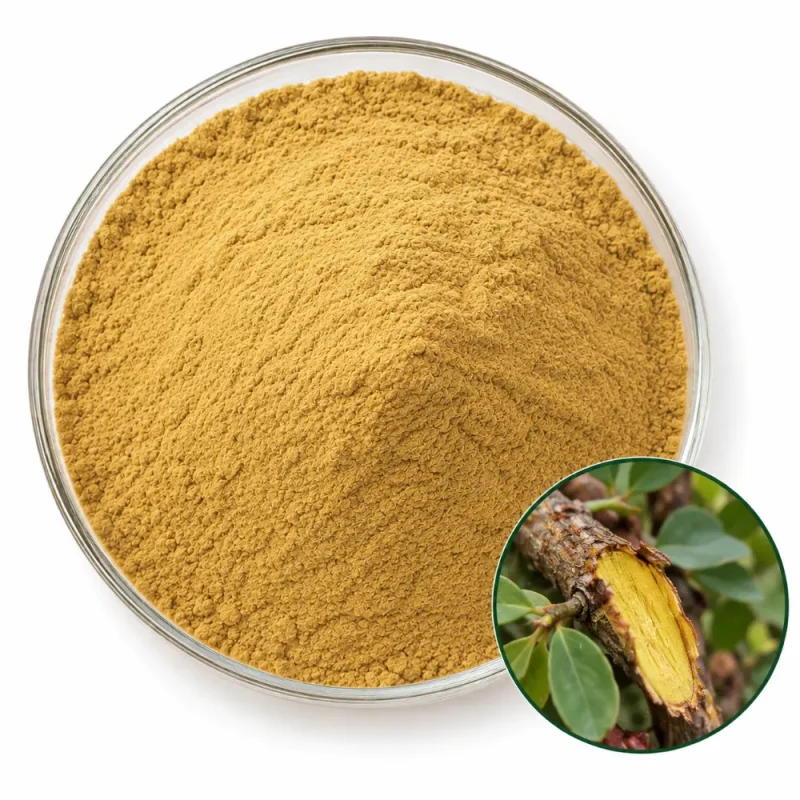
Berberine tannate pairs the berberine cation from the rhizome of Coptis chinensis with tannic acid, a gallotannin, and is supplied as a yellow-brown powder that does not dissolve in water. The plant material is processed by ethanol extraction and purification before the salt is defined.

The grade is 98% by HPLC, in Food / Dietary Supplement Grade. The tannate differs from berberine chloride in its counter-ion and in dissolution, because far less of it dissolves in water, which changes how the powder wets and tastes. It is used where this salt form, and not the free cation or the hydrochloride, is the defined ingredient.

Berberine Tannate Chemical Identity

The compound has two parts. The cation is berberine, a quaternary protoberberine alkaloid with a planar, positively charged ring system. The other part is tannic acid, a gallotannin built from glucose esterified with several gallic acid units. Tannic acid is a large and variable molecule and not a single defined structure, so a tannate has no fixed molecular formula in the way that a simple chloride salt does. Published records describe it as a computed complex, which is why the table gives no formula, molecular weight or identifiers.

What defines a lot is the berberine chromatogram and the nature of the counter-ion. The word tannate names that counter-ion, and it separates this salt from the chloride and sulfate forms in solubility and in the mass of non-alkaloid material carried per gram. The alkaloid comes from the rhizome of Coptis chinensis Franch., where berberine accompanies coptisine, palmatine and epiberberine. Related materials are supplied separately: Berberine 98%, the mixed Coptis Extract 20–50% Berberine and the unstandardized Coptis Rhizome Extract Powder.

Berberine tannate belongs to the family of drug-like salts in which a large, weakly acidic polyphenol replaces a small inorganic anion. That change lowers the solubility of the alkaloid at the cost of adding a heavy tannin fraction. A formulator choosing berberine tannate over berberine chloride is therefore choosing slower dissolution and a less intense bitter taste, and accepting a lower alkaloid share per gram of powder.

Typical Specifications

Specification ItemProduct Information
Natural SourceCoptis chinensis rhizome
Plant PartRoot & Rhizome
ProcessingEthanol Extraction & Purification
Compound ClassAlkaloids
Purity98% (HPLC)
GradeFood / Dietary Supplement Grade
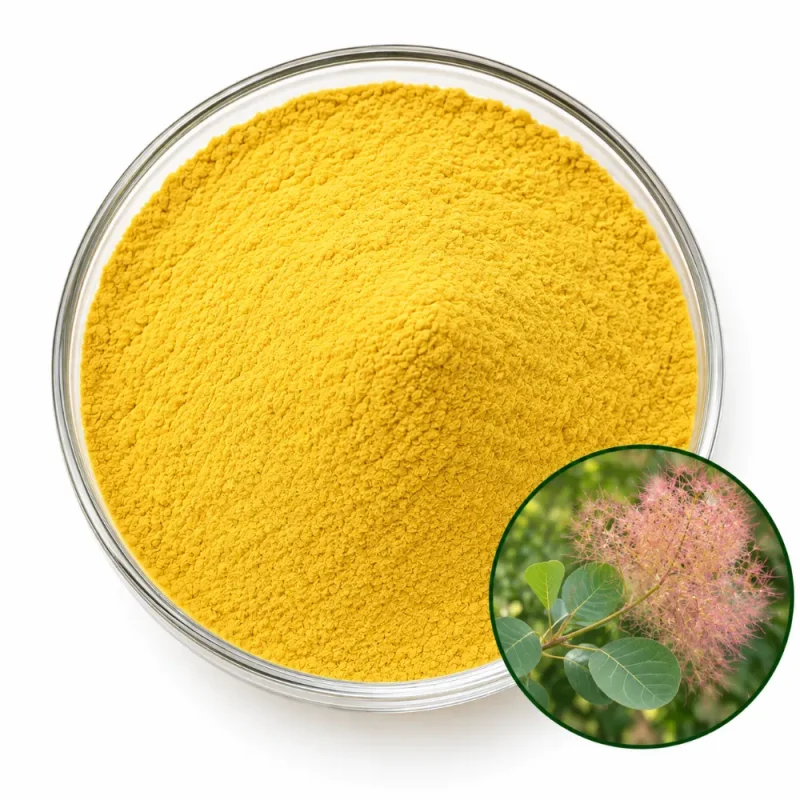
AppearanceYellow-Brown powder
Solubility / DispersibilityInsoluble in Water
Quality Parameters
Moisture (LOD)≤5.0%
Total Ash≤5.0%
Heavy MetalsLead ≤2 ppm · Arsenic ≤1 ppm · Cadmium ≤1 ppm · Mercury ≤0.1 ppm
MicrobiologyTPC ≤1,000 cfu/g · Yeast & Mold ≤100 cfu/g · E. coli Negative · Salmonella Negative/25 g
Shelf Life24 months in unopened original packaging, cool and dry storage

Berberine Tannate Purity Grades & Impurities

The 98% figure comes from an HPLC trace of the berberine cation. It is a purity of the chromatogram, comparing the berberine peak with the other detected peaks, and it is not the weight share of berberine in the salt. Tannic acid is a mixture of galloyl esters that does not form one clean peak, so it is largely invisible to the berberine method, and moisture and ash are limited separately in the table.

The related substances seen in the trace are the neighboring protoberberines. Epiberberine is an isomer of berberine and elutes close to it, and palmatine and coptisine follow. Gallic acid and its simple esters arise when the tannin hydrolyzes, and they are looked for as a sign of age or poor storage. Light and strongly alkaline conditions change the berberine chromophore, adding hydroxide to give a colorless carbinol form and a duller yellow.

Identity needs more than the HPLC peak. When a salt dissolves in the mobile phase it dissociates, and the berberine cation elutes at the same time whatever the counter-ion was. A chromatogram cannot therefore tell the tannate from the chloride. Supporting tests for tannin content and for insolubility in water, together with the stated salt name, establish that the lot is the tannate and not the free cation or another salt.

Storage affects the purity of berberine tannate more than most salts. Tannins darken and oxidize in warm, humid air, and the powder then shifts from yellow-brown toward a deeper brown while the HPLC trace of the alkaloid barely moves. For that reason color and flow are compared with a retained sample at every lot change, next to the chromatographic result, and the container is kept closed between weighings.

Berberine Tannate Solubility & Delivery

Berberine tannate is insoluble in water, where the chloride is slightly soluble, and that single difference drives most of its handling. The tannin component binds the cation and holds it in a poorly soluble complex, and the complex separates more readily in alkaline media or in some solvent mixtures. In water the powder wets slowly and forms a yellow-brown suspension that settles, so it behaves as a dispersed solid and not as a solution.

Delivery of berberine tannate therefore turns on particle size and wetting. Fine milling and a wetting agent help the powder disperse, and surfactant or suspension stabilizers keep it from sedimenting in liquid bases. Because little of it dissolves in the mouth, the powder is less bitter than a soluble salt of the same alkaloid would be, which formulators use to simplify taste-masking. The strong color stains equipment, skin and clothing, so closed transfer, dedicated scoops and a wipe-down step prevent cross-contamination between products.

In dry blends, berberine tannate is a bulky powder with moderate flow, and the tannin portion makes it slightly cohesive. Sieving before blending, a glidant at low level and a conditioned room keep fill weights steady. Tannins also bind to proteins and to some minerals, so a premix that contains protein powders or iron salts can change color or clump, and a compatibility trial of the finished blend is worth the time.

Application Areas

Capsule Fills of the Tannate Salt

Capsules take berberine tannate at low to moderate inclusion with a flow agent. The yellow-brown powder leaves residue on tooling, so a dedicated line and dust extraction protect the next product, and a two-step blend gives uniform fill weight.

Tablets With Protective Coats

Tablets of berberine tannate use a film coat to contain the color and any remaining bitterness. The salt is dry-blended with a binder and a lubricant, and a dissolution trial confirms that the poorly soluble complex releases at the intended rate.

Suspension Premixes

Powder sticks and suspension bases carry berberine tannate only with a thickener, since the solid does not dissolve. Pre-wet the powder with glycerin or a little water to a paste, then dilute, and shake or stir before use.

Salt-Form Comparison Blends

Formulators comparing salt forms of berberine use berberine tannate beside the chloride to see how counter-ion changes dissolution. Each weighing is logged, and the premix is built in steps so any sample can be traced to its lot and its HPLC trace.

Packaging & Commercial Supply

Essencefield supports product evaluation, formulation trials, commercial orders, and ongoing ingredient supply. Packaging, storage, and shipping arrangements are determined by product characteristics, order quantity, stability requirements, and destination-market needs.

Supply ItemGeneral Information
SampleAvailable upon request for formulation, testing, and supplier evaluation
Order Quantities100 g · 1 kg · 5 kg · 25 kg · 100 kg · 500 kg · Bulk
Sample Lead TimeTypically 5–7 days after sample confirmation
Production Lead TimeTypically 15–30 days after order and specification confirmation
PackagingSuitable protective inner packaging with bags, cartons, drums, or other appropriate outer packaging
StorageStore in tightly sealed, suitable protective packaging in a cool, dry environment. Protect from moisture, heat, and direct sunlight. Specific storage conditions follow the approved product specification.
DocumentationCOA · Product Specification · TDS · SDS · Applicable declarations (as applicable)

Final order quantities, lead times, packaging, documentation, and shipping arrangements are confirmed according to the selected product and commercial requirements.

Request Ingredient Specifications & Quote

Share your target specification, application, quantity, and documentation needs. We’ll help confirm suitable options, samples, and commercial supply details.