Alantolactone 98%

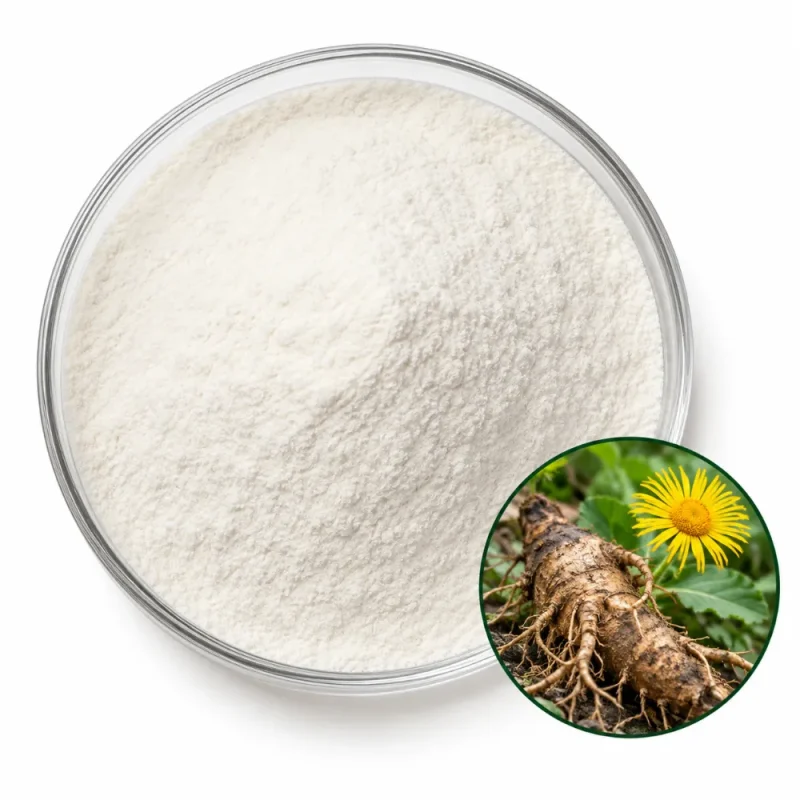
The principal sesquiterpene lactone of elecampane root, alantolactone is isolated here from the root of Inula helenium by ethanol extraction and purification. It is a bicyclic lactone with a reactive exocyclic double bond, and it is a white, crystalline powder that does not dissolve in water.

The primary grade is 98% alantolactone by HPLC, in Food / Dietary Supplement Grade. Elecampane root holds two isomeric lactones that are difficult to separate, so the identity of this product is both the compound name and the chromatographic evidence that the neighboring isomer is absent or limited.

Alantolactone Chemical Identity

Alantolactone has the molecular formula C15H20O2 and a molecular weight of 232.3. The skeleton is a eudesmane, a decalin-type sesquiterpene with 15 carbon atoms, fused to a gamma-butyrolactone ring that carries an exocyclic methylene group next to the carbonyl. That alpha-methylene-gamma-butyrolactone unit is the reactive heart of the molecule, since it is a Michael acceptor that adds thiols and amines, and it is the feature that sesquiterpene lactones of the daisy family have in common.

The isomer isoalantolactone has the same formula and weight and differs only in the position of one ring double bond. The two co-occur in the root, crystallize together and elute close together, so a method must resolve them, and the neighbor is supplied here as Isoalantolactone 98%. The natural source is the root of Inula helenium L., elecampane, a plant of the family Asteraceae. A pharmacopoeial monograph titled Indian elecampane refers to a different species, Inula racemosa, so the botanical name matters when comparing specifications. The root is also supplied as the Elecampane Root Extract Powder, a 10:1 ratio extract with no marker figure, and that material describes the root and not the pure lactone.

Typical Specifications

Specification ItemProduct Information
Natural SourceInula helenium root
Plant PartRoot & Rhizome
ProcessingEthanol Extraction & Purification
Compound ClassTerpenoids
Chemical Name (IUPAC)(3aR,5S,8aR,9aR)-5,8a-dimethyl-3-methylidene-5,6,7,8,9,9a-hexahydro-3aH-benzo[f][1]benzofuran-2-one
CAS Number546-43-0
Molecular FormulaC15H20O2
Molecular Weight232.32
PubChem CID72724
InChIKeyPXOYOCNNSUAQNS-AGNJHWRGSA-N
SMILESCC1CCCC2(C1=CC3C(C2)OC(=O)C3=C)C
Purity98% (HPLC)
GradeFood / Dietary Supplement Grade
AppearanceWhite powder
Solubility / DispersibilityInsoluble in Water
Quality Parameters
Moisture (LOD)≤5.0%
Total Ash≤5.0%
Heavy MetalsLead ≤2 ppm · Arsenic ≤1 ppm · Cadmium ≤1 ppm · Mercury ≤0.1 ppm
MicrobiologyTPC ≤1,000 cfu/g · Yeast & Mold ≤100 cfu/g · E. coli Negative · Salmonella Negative/25 g
Shelf Life24 months in unopened original packaging, cool and dry storage

Alantolactone Purity Grades & Impurities

The 98% figure is an HPLC result that compares the alantolactone peak with the other detected peaks, with detection at a short wavelength near 210 nm, because the lactone has no strong chromophore beyond the unsaturated carbonyl. The figure does not include water, ash or components without a response, and the table therefore gives moisture and ash their own limits. A single grade is offered.

Isoalantolactone is the key related substance. In root extracts the two lactones are present in comparable amounts, and a purification that reaches 98% alantolactone has had to separate them by crystallization or chromatography. A trace with a small, resolved isoalantolactone peak is evidence of that work. Other sesquiterpenoids of the root, such as alloalantolactone, dihydroalantolactone and the alcohol alantol, appear at trace level, and the polysaccharide inulin, which dominates the dry weight of the root, is removed by the solvent step.

Reactivity is the second quality theme. The exocyclic methylene reacts with nucleophiles, and the lactone ring opens in alkaline solution, so the compound degrades in basic media and in samples that contain amines or thiols. Sample solutions are therefore prepared in neutral or slightly acidic solvents and read promptly. A white crystalline powder is the sign of a clean lot, and a yellow or brown tint points to residual root pigment or oxidation. Moisture and ash are limited separately, and storage is sealed, cool and dry.

Alantolactone Solubility & Delivery

Alantolactone is insoluble in water and dissolves in ethanol, methanol, acetone, chloroform and ethyl acetate. Alantolactone is a compact, nonpolar molecule with a high logP, and it favors oils and surfactant phases over water. In water, the powder wets slowly and forms a suspension that settles, so it behaves as a dispersed solid.

Delivery of alantolactone therefore depends on particle engineering and on compatibility. Fine milling, wetting agents, oil suspensions, cyclodextrin complexes and amorphous solid dispersions are the approaches described in the literature. Because the lactone reacts with nucleophiles, formulators check compatibility with amino-bearing and thiol-bearing ingredients in a blend, and they keep the pH neutral to mildly acidic in liquids. In dry blends the powder is stable and not hygroscopic, though static makes small weights awkward, and anti-static tools plus a two-stage premix with a dry carrier give uniform results. Heat should be limited, since the lactone can rearrange.

Reactivity guides storage. The exocyclic methylene of the lactone can slowly add nucleophiles from moist air, and prolonged storage in humid rooms lowers the main peak, so sealed drums with a desiccant and a cool store keep the grade. Opened containers are re-flushed with dry gas, and a retained sample is retested at a set interval so that a change in purity is seen before the lot is used in a blend.

Application Areas

Oil-Based Capsule Fills

Softgels and oil-filled capsules suit lipophilic alantolactone, which dissolves in oil far better than in water. The milled powder is dispersed in oil with an emulsifier, settling is checked before encapsulation, and the tank is stirred so that the dose stays uniform across the batch.

Dry Capsule Fills

Dry capsules take alantolactone at small weight. The white crystalline powder is electrostatic, so a flow agent, anti-static scoops and a sieved premix give an even fill weight with little loss to equipment and a clean transfer.

Compatibility-Tested Tablet Blends

Tablets press the lactone with a dry binder and a lubricant. Excipients with free amino or thiol groups are avoided, and a month of storage under humid conditions with an HPLC check shows whether the reactive methylene survives.

Lactone Comparison Blends

Formulators comparing the two elecampane lactones blend alantolactone with isoalantolactone in fixed ratios. Every ingredient is weighed separately, and an HPLC run of the blend on a column that resolves the pair confirms the ratio.

Reference Standards for Root Fingerprints

Analytical teams use the 98% grade as the main peak in fingerprints of elecampane extracts. The standard is stored dry and cold, and a retained sample from each lot keeps a record of the isomer separation.

Packaging & Commercial Supply

Essencefield supports product evaluation, formulation trials, commercial orders, and ongoing ingredient supply. Packaging, storage, and shipping arrangements are determined by product characteristics, order quantity, stability requirements, and destination-market needs.

Supply ItemGeneral Information
SampleAvailable upon request for formulation, testing, and supplier evaluation
Order Quantities100 g · 1 kg · 5 kg · 25 kg · 100 kg · 500 kg · Bulk
Sample Lead TimeTypically 5–7 days after sample confirmation
Production Lead TimeTypically 15–30 days after order and specification confirmation
PackagingSuitable protective inner packaging with bags, cartons, drums, or other appropriate outer packaging
StorageStore in tightly sealed, suitable protective packaging in a cool, dry environment. Protect from moisture, heat, and direct sunlight. Specific storage conditions follow the approved product specification.
DocumentationCOA · Product Specification · TDS · SDS · Applicable declarations (as applicable)

Final order quantities, lead times, packaging, documentation, and shipping arrangements are confirmed according to the selected product and commercial requirements.

Request Ingredient Specifications & Quote

Share your target specification, application, quantity, and documentation needs. We’ll help confirm suitable options, samples, and commercial supply details.