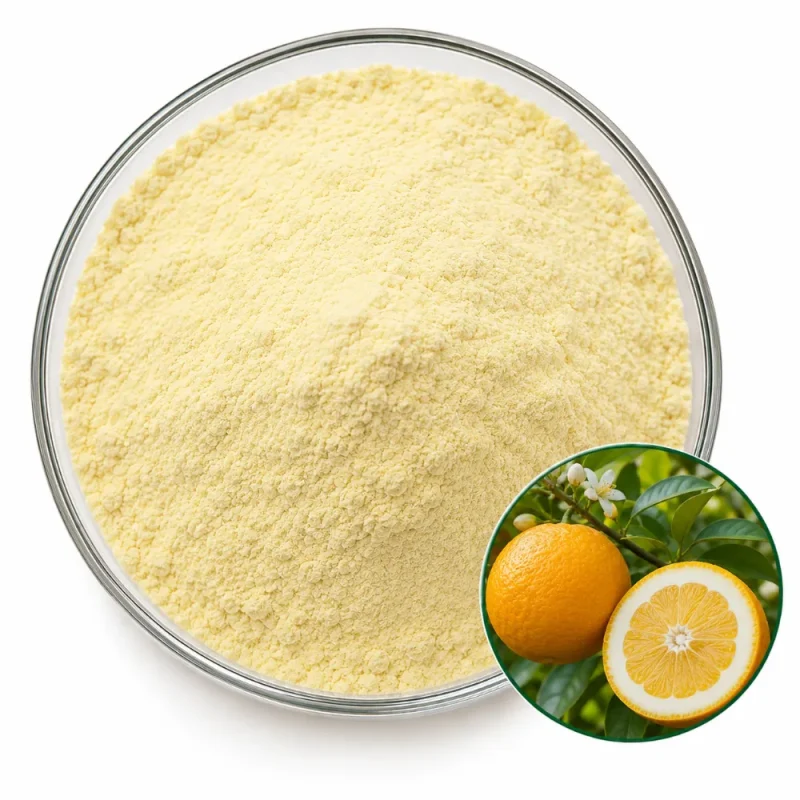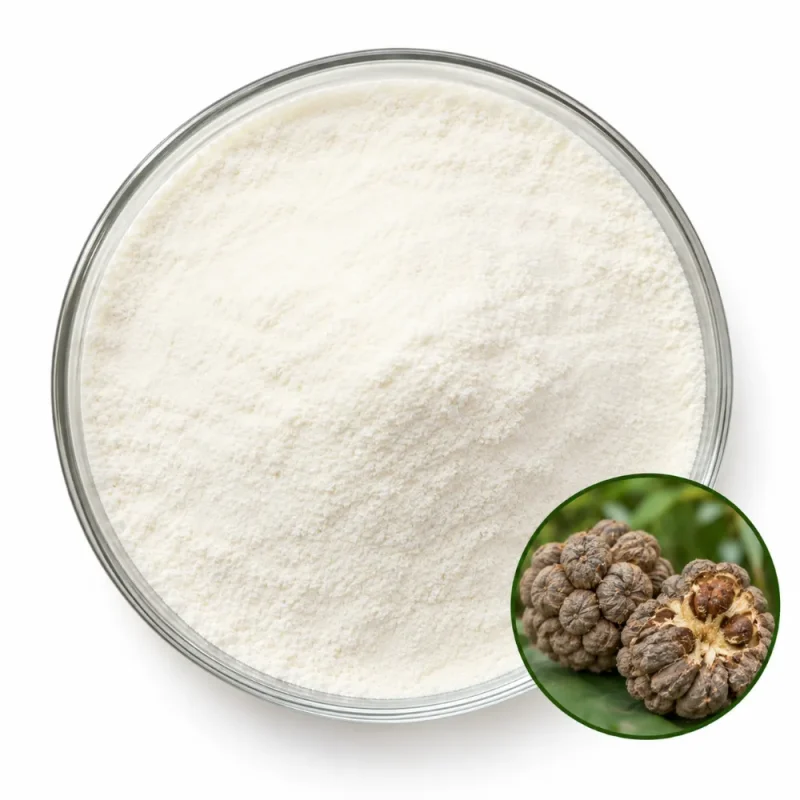
Alpinetin 98%

Katsumada galangal seed (Alpinia katsumadai) is a source of alpinetin, a flavanone with a free hydroxyl group at the 7-position and a methyl ether at the 5-position. It is isolated by ethanol extraction and purification and supplied as an off-white powder that is insoluble in water.

The Primary Grade is 98% alpinetin by HPLC, in Food / Dietary Supplement Grade. The figure describes this single flavanone, not total flavonoids, and the identity values in the table apply to alpinetin only. The open-chain chalcone cardamonin from the same seed is a separate product.

Alpinetin Chemical Identity

Alpinetin (7-hydroxy-5-methoxyflavanone, C16H14O4, molecular weight 270.28) is a flavanone: a chromanone ring closed between a phenolic A ring and a phenyl B ring, with a saturated bond between carbons 2 and 3. It has one stereocenter at carbon 2. Unlike a flavone, the saturated ring breaks the full conjugation, which is why the powder is pale instead of yellow.

The raw material is the seed of Alpinia katsumadai Hayata (Zingiberaceae), the spice-like seed mass used in Chinese herbal practice; other Alpinia species such as A. oxyphylla are different raw materials. Alpinetin is closely related to pinocembrin, which is 5,7-dihydroxyflavanone, and to cardamonin, the chalcone that can cyclize into alpinetin and carries the same formula C16H14O4.

Related products include Cardamonin 98%, Pinocembrin 98% and Alpinia katsumadai extract powder. Chalcone and flavanone are isomers with the same mass, so the CAS number 1090-65-9 and the InChIKey in the table fix the identity.

Several names circulate for the same seed constituents, which makes searches noisy. Alpinetin is sometimes listed under its systematic name 7-hydroxy-5-methoxyflavanone, and cardamonin appears as alpinetin chalcone. A purchase specification that quotes the CAS number 1090-65-9 and the HPLC grade identifies the flavanone and excludes the chalcone isomer.
Typical Specifications

Specification ItemProduct Information
Natural SourceAlpinia katsumadai seed
Plant PartSeed & Grain
ProcessingEthanol Extraction & Purification
Compound ClassFlavonoids, Polyphenols
Chemical Name (IUPAC)7-hydroxy-5-methoxy-2-phenyl-2,3-dihydrochromen-4-one
CAS Number1090-65-9
Molecular FormulaC16H14O4
Molecular Weight270.28 g/mol
PubChem CID4053302
InChIKeyQQQCWVDPMPFUGF-UHFFFAOYSA-N
Purity98% (HPLC)
GradeFood / Dietary Supplement Grade
AppearanceOff-White powder
Solubility / DispersibilityInsoluble in Water
Quality Parameters
Moisture (LOD)≤5.0%
Total Ash≤5.0%
Heavy MetalsLead ≤2 ppm · Arsenic ≤1 ppm · Cadmium ≤1 ppm · Mercury ≤0.1 ppm
MicrobiologyTPC ≤1,000 cfu/g · Yeast & Mold ≤100 cfu/g · E. coli Negative · Salmonella Negative/25 g
Shelf Life24 months in unopened original packaging, cool and dry storage

Alpinetin Purity & Related Substances

Alpinetin 98% is a single-compound grade measured by HPLC. The value expresses the alpinetin peak as a proportion of the chromatogram, with water, ash and material that does not absorb left out. Flavanones absorb in the UV near 280 nm, so detection is routine, and the wavelength is stated when certificates are compared.

The related substances from the seed are cardamonin, pinocembrin and other flavonoids, together with diarylheptanoids and volatile oil traces. Cardamonin has the same mass as alpinetin, so the two are separated by retention time, and a yellowish tint in the powder points to residual chalcone. The chalcone-flavanone pair can interconvert under acidic or basic conditions, so a lot stored in damp air may change slightly over time.

The stated route is ethanol extraction and purification of the seed, so the material is plant-derived. Total flavonoid values from a seed extract are a different measurement and cannot replace the HPLC percentage for alpinetin.

Release criteria are a single dominant peak at the expected retention time, a low residual cardamonin peak and a clean baseline. A diode-array spectrum of the peak should match the flavanone profile, not the chalcone, which absorbs at a longer wavelength. Because the chalcone is yellow, the white to off-white color of the powder is also a rough check.

Alpinetin Solubility & Delivery

Alpinetin is insoluble in water. The pale flavanone has one phenolic hydroxyl group and one methyl ether, so it is lipophilic and dissolves in ethanol, methanol, acetone and other organic solvents. The saturated ring makes the molecule more flexible than a flat flavone, which helps it dissolve slightly faster than comparable flavones in warm organic solvents.

In principle, delivery relies on micronized powders, oil-phase dispersions, co-solvent premixes, phospholipid or cyclodextrin complexes and surfactant-assisted dispersions. The compound is stable when dry and kept closed, and it tolerates moderate temperatures during blending. Strong alkali opens the ring toward the chalcone form, so neutral to mildly acidic conditions are safer in aqueous systems.

The fine powder may carry static charge and forms dust, so closed transfer and a quick weighing step reduce losses. Because the dose is small, a dilution premix in a neutral carrier improves uniformity. White powder shows traces of contamination clearly, which helps visual checks.

Handling is straightforward for a stable, non-colored powder. Alpinetin does not stain equipment, tolerates moderate temperatures in blending and keeps well in closed containers. Humidity control prevents caking, and static control reduces losses of the fine powder during weighing and transfer to the blender.

Application Areas

Hard capsules with premixing

Alpinetin is dosed in small weights, so a premix with a free-flowing excipient gives reliable fills. A dry room and closed containers keep the fine powder from clumping, and fill weights are sampled throughout the run to confirm the dose.

Softgels with oil carriers

A micronized alpinetin dispersion in oil wets better than a dry fill. The tank is stirred during encapsulation and the fill is sampled for uniformity, so the insoluble powder does not settle and every softgel carries the same dose.

Tablets at low inclusion

In tablets the pale powder is diluted with filler and binder and compressed at low inclusion. A wetting agent helps the matrix disintegrate, and a content uniformity check confirms that the small dose is spread evenly.

Neutral-pH stick packs

Because the powder does not dissolve, stick packs add a dispersant or hydrocolloid so that it stays distributed in the glass. Sticks are tested for settling and visible specks, and the pH of the finished drink is kept near neutral to protect the ring.

Seed-flavonoid combination blends

Alpinetin is paired with cardamonin or pinocembrin in capsules. Each component is assayed by its own HPLC method, and the finished blend is checked for the intended ratio of flavanone to chalcone. The result is recorded for each lot.

Packaging & Commercial Supply

Essencefield supports product evaluation, formulation trials, commercial orders, and ongoing ingredient supply. Packaging, storage, and shipping arrangements are determined by product characteristics, order quantity, stability requirements, and destination-market needs.

Supply ItemGeneral Information
SampleAvailable upon request for formulation, testing, and supplier evaluation
Order Quantities100 g · 1 kg · 5 kg · 25 kg · 100 kg · 500 kg · Bulk
Sample Lead TimeTypically 5–7 days after sample confirmation
Production Lead TimeTypically 15–30 days after order and specification confirmation
PackagingSuitable protective inner packaging with bags, cartons, drums, or other appropriate outer packaging
StorageStore in tightly sealed, suitable protective packaging in a cool, dry environment. Protect from moisture, heat, and direct sunlight. Specific storage conditions follow the approved product specification.
DocumentationCOA · Product Specification · TDS · SDS · Applicable declarations (as applicable)

Final order quantities, lead times, packaging, documentation, and shipping arrangements are confirmed according to the selected product and commercial requirements.

Request Ingredient Specifications & Quote

Share your target specification, application, quantity, and documentation needs. We’ll help confirm suitable options, samples, and commercial supply details.