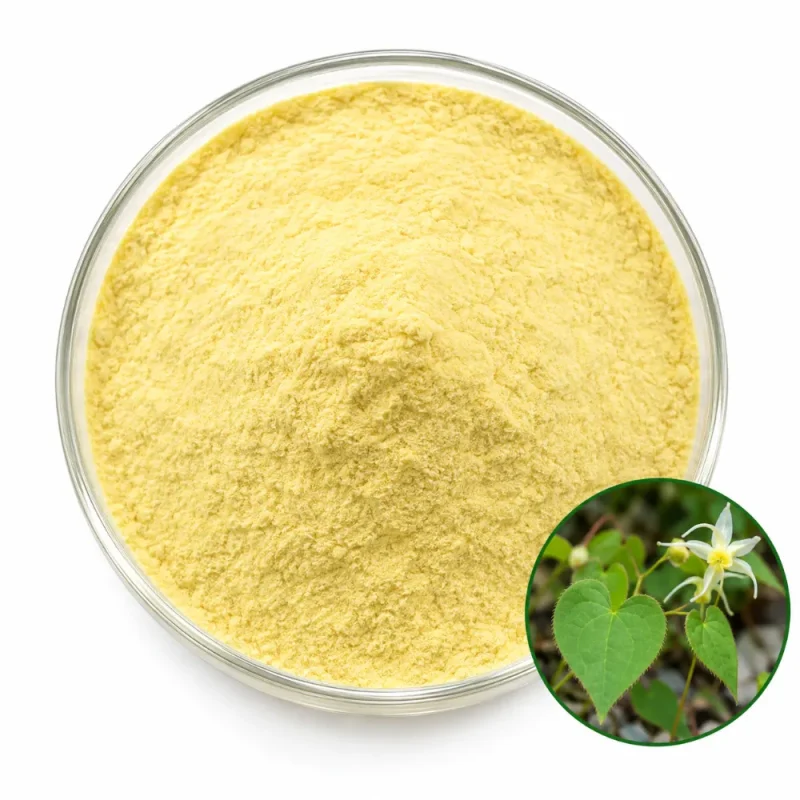
Anhydroicaritin 98%

A prenylated flavonol whose prenyl chain has closed into a ring, anhydroicaritin is isolated here from the leaf of Epimedium brevicornum by ethanol extraction and purification. It sits on the same biosynthetic line as icariin and icaritin, and it is a yellow powder that does not dissolve in water.

The primary grade is 98% anhydroicaritin by HPLC, in Food / Dietary Supplement Grade. Epimedium holds a family of closely related flavonols, and the cyclized ring is what makes this compound a separate ingredient, not a synonym for its better-known neighbors.

Anhydroicaritin Chemical Identity

Anhydroicaritin has the molecular formula C21H20O6 and a molecular weight of 368.4. The skeleton is a flavonol with a 4′-methoxy group on the B-ring and hydroxyl groups at positions 3 and 5. Where icaritin carries a free prenyl chain at position 8 and a hydroxyl at position 7, anhydroicaritin has lost one molecule of water, which is the meaning of anhydro, and the prenyl group has closed onto the 7-oxygen to form a dihydropyran ring. The result is a more compact, more lipophilic molecule with one fewer free hydroxyl.

The line of compounds is easy to describe. Icariin is the glycoside, with a sugar at position 3 and another at position 7. Removing the sugars gives icaritin, the aglycone, and cyclizing its prenyl group gives anhydroicaritin. The natural source is the leaf of Epimedium brevicornum Maxim., which GBIF lists under the spelling brevicornu, a plant of the family Berberidaceae often called horny goat weed. Related products are Epimedium Extract 5–50% Icariin, the 10:1 Epimedium Extract Powder and Baohuoside I 98%. The extracts are mixtures defined by a different marker, while anhydroicaritin here is a single aglycone.

Because the Epimedium family of flavonols uses names that look alike, the formula, the CAS number and the retention time are the dependable identifiers.

Typical Specifications

Specification ItemProduct Information
Natural SourceEpimedium brevicornum leaf
Plant PartLeaf & Herb
ProcessingEthanol Extraction & Purification
Compound ClassFlavonoids, Polyphenols
Chemical Name (IUPAC)3,5-dihydroxy-2-(4-methoxyphenyl)-8,8-dimethyl-9,10-dihydropyrano[2,3-h]chromen-4-one
CAS Number38226-86-7
Molecular FormulaC21H20O6
Molecular Weight368.4
PubChem CID14583584
InChIKeyPPCHTBBOSVKORE-UHFFFAOYSA-N
SMILESCC1(CCC2=C(O1)C=C(C3=C2OC(=C(C3=O)O)C4=CC=C(C=C4)OC)O)C
Purity98% (HPLC)
GradeFood / Dietary Supplement Grade
AppearanceYellow powder
Solubility / DispersibilityInsoluble in Water
Quality Parameters
Moisture (LOD)≤5.0%
Total Ash≤5.0%
Heavy MetalsLead ≤2 ppm · Arsenic ≤1 ppm · Cadmium ≤1 ppm · Mercury ≤0.1 ppm
MicrobiologyTPC ≤1,000 cfu/g · Yeast & Mold ≤100 cfu/g · E. coli Negative · Salmonella Negative/25 g
Shelf Life24 months in unopened original packaging, cool and dry storage

Anhydroicaritin Purity Grades & Impurities

The 98% figure is an HPLC result that compares the anhydroicaritin peak with the other detected peaks, with detection near 270 nm and the flavonol band at longer wavelengths. Water, ash and components without a response are outside the percentage, and the table lists moisture and ash as separate limits. One grade is offered.

The related substances are the other prenylated flavonols of the leaf and their sugar-bearing forms. Icaritin elutes just before anhydroicaritin, since it keeps its free hydroxyl and is somewhat more polar, and baohuoside I, icariside II, icariin and the epimedins elute earlier because they carry sugars. Their presence points to incomplete hydrolysis. A method that resolves icaritin from the cyclized compound is the key identity check, because the two differ by one water molecule and have a similar spectrum.

The relationship between the two also defines a stability question. The cyclization of icaritin to anhydroicaritin is promoted by acid and heat, so a lot made by hydrolysis under harsh conditions can carry a large share of the cyclized product, while a mild route leaves more icaritin. The reverse conversion does not occur readily, so the ratio records how the lot was handled. Oxidation of the flavonol 3-hydroxyl darkens the powder.

A clean lot of anhydroicaritin is a bright yellow powder. A green tint points to residual chlorophyll from the leaf, and a brown tone to oxidation or pigment. Storage is sealed, dry and out of strong light, and moisture and ash have their own limits.

Anhydroicaritin Solubility & Delivery

Anhydroicaritin is insoluble in water and dissolves in ethanol, methanol, acetone, ethyl acetate and dimethyl sulfoxide. The cyclized ring and the methoxy group make it more lipophilic than icaritin, and its logP is high. The planar flavonol core stacks in the crystal, so dissolution is slow even in good solvents.

Delivery therefore uses dispersion and lipid systems. Fine milling, wetting agents, oil suspensions, lipid carriers, cyclodextrin complexes and amorphous solid dispersions are the approaches described in the literature. Because of its higher lipophilicity compared with the glycosides, oil-based fills are practical. In dry blends the solid keeps well and takes up little water. Static makes small weights awkward, so anti-static tools and a two-stage premix with a dry carrier give uniform results. Strong alkali and long heating darken the compound.

The cyclized ring also changes how the molecule behaves in analysis. Without its free 7-hydroxyl, the compound is less acidic than icaritin and less soluble in dilute alkali. Laboratories that keep both compounds as standards can use this difference, together with retention time, to confirm which of the two is the main peak in a lot.

Application Areas

Oil-Based Softgel Fills

Softgels suit the lipophilic flavonol. The milled powder is dispersed in oil with an emulsifier and an antioxidant, settling is checked before encapsulation, and the stirred tank keeps the dose uniform across the batch from the first shell to the last.

Capsule Fills at Low Inclusion

Capsules take anhydroicaritin at small weight. The yellow powder is cohesive and electrostatic, so a flow agent, anti-static tools and a sieved premix give an even fill weight, and opaque capsules slow fading of the color.

Tablet Blends With Wetting Agents

Tablets combine the aglycone with a dry binder, a lubricant and a wetting agent. A disintegration and dissolution run on the finished blend shows that the hydrophobic solid is released at the intended rate and not held back by the lubricant.

Aglycone Line Comparison Blends

Formulators studying the icariin line blend anhydroicaritin with icaritin and baohuoside I in fixed ratios. Each ingredient is weighed on its own, and an HPLC trace that resolves the pair confirms that the ratio has not shifted.

Reference Standards for Leaf Fingerprints

Analytical teams use the 98% grade as an anchor peak in fingerprints of Epimedium extracts. The standard is stored dry and cold, and a retained sample from every lot preserves the retention-time record for audits.

Packaging & Commercial Supply

Essencefield supports product evaluation, formulation trials, commercial orders, and ongoing ingredient supply. Packaging, storage, and shipping arrangements are determined by product characteristics, order quantity, stability requirements, and destination-market needs.

Supply ItemGeneral Information
SampleAvailable upon request for formulation, testing, and supplier evaluation
Order Quantities100 g · 1 kg · 5 kg · 25 kg · 100 kg · 500 kg · Bulk
Sample Lead TimeTypically 5–7 days after sample confirmation
Production Lead TimeTypically 15–30 days after order and specification confirmation
PackagingSuitable protective inner packaging with bags, cartons, drums, or other appropriate outer packaging
StorageStore in tightly sealed, suitable protective packaging in a cool, dry environment. Protect from moisture, heat, and direct sunlight. Specific storage conditions follow the approved product specification.
DocumentationCOA · Product Specification · TDS · SDS · Applicable declarations (as applicable)

Final order quantities, lead times, packaging, documentation, and shipping arrangements are confirmed according to the selected product and commercial requirements.

Request Ingredient Specifications & Quote

Share your target specification, application, quantity, and documentation needs. We’ll help confirm suitable options, samples, and commercial supply details.