Beta-Aescin 98%

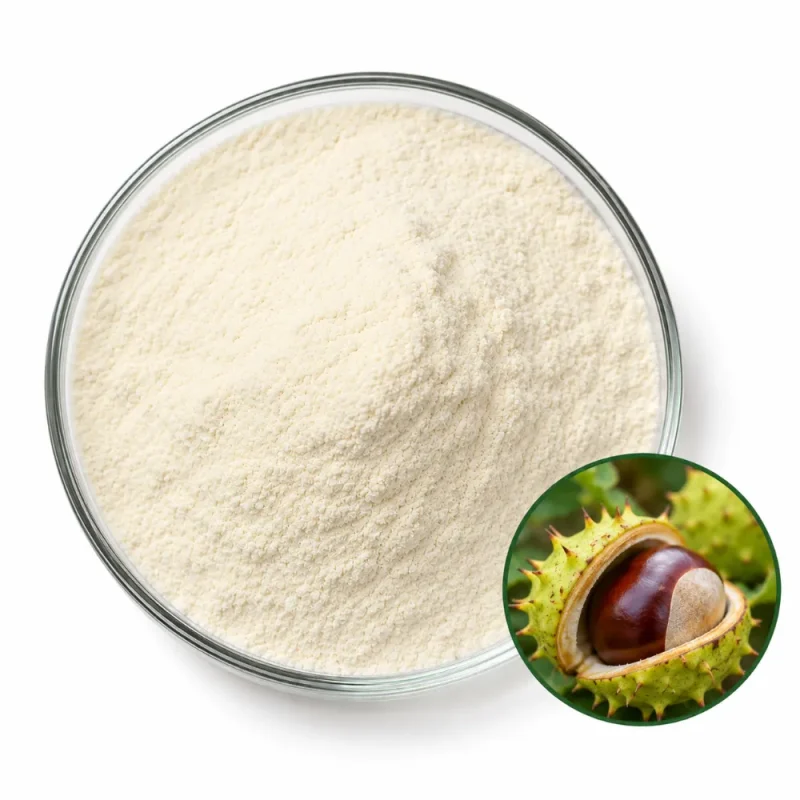
Horse chestnut seed (Aesculus hippocastanum) holds beta-aescin as the main crystalline member of its triterpenoid saponin mixture, isolated by ethanol extraction and purification. It is supplied as an off-white powder that is classed as water soluble, with a supplied range of 90–98%.

The Primary Grade is 98% beta-aescin by HPLC, in Food / Dietary Supplement Grade. The figure describes this saponin fraction, not total aescin, escin or total saponins. The molecule is large and carries a trisaccharide, so its identity is fixed by the CAS number and the InChIKey in the table.

Beta-Aescin Chemical Identity

Beta-aescin (C55H86O24, molecular weight 1131.3) is a pentacyclic triterpenoid saponin: an oleanane-type aglycone, protoaescigenin, esterified with acetic acid and a short-chain unsaturated acid and carrying a trisaccharide that includes glucuronic acid. The sugar chain makes it amphiphilic, so it forms foams and micelles in water, and the free carboxylic acid of glucuronic acid lets the molecule behave differently at different pH values.

The raw material is the seed of Aesculus hippocastanum L. (Sapindaceae). The edible sweet chestnut Castanea sativa is a different tree and not a source. Aescin appears in literature as aescin and as escin, and the forms α-aescin and β-aescin are isomers; β-aescin is the principal and best-defined one, with CAS number 11072-93-8 in the table.

Neighbors are horse chestnut extract with 10–20% aescin and horse chestnut extract powder, where aescin is one constituent among esculin, flavonoids and others. Beta-aescin 98% is the isolated saponin, not the mixture.

Horse chestnut products carry several neighboring names. Aescin refers to the saponin mixture, escin is a spelling variant, and esculin is an unrelated coumarin from the same seed. Beta-aescin 98% is the isolated saponin fraction, identified by CAS number 11072-93-8, and it should not be confused with the coumarin or with a seed extract.

Typical Specifications

Specification ItemProduct Information
Natural SourceAesculus hippocastanum seed
Plant PartSeed & Grain
ProcessingEthanol Extraction & Purification
Compound ClassSaponins
CAS Number11072-93-8
Molecular FormulaC55H86O24
Molecular Weight1131.3 g/mol
PubChem CID16211024
InChIKeyAXNVHPCVMSNXNP-YSYFQUGBSA-N
Purity98% (HPLC)
Available Grades90–98% (HPLC)
GradeFood / Dietary Supplement Grade
AppearanceOff-White powder
Solubility / DispersibilityWater Soluble
Quality Parameters
Moisture (LOD)≤5.0%
Total Ash≤5.0%
Heavy MetalsLead ≤2 ppm · Arsenic ≤1 ppm · Cadmium ≤1 ppm · Mercury ≤0.1 ppm
MicrobiologyTPC ≤1,000 cfu/g · Yeast & Mold ≤100 cfu/g · E. coli Negative · Salmonella Negative/25 g
Shelf Life24 months in unopened original packaging, cool and dry storage

Beta-Aescin Purity & Related Substances

Beta-aescin 98% is a single-fraction grade measured by HPLC, and the supplied range is 90–98%. HPLC purity here means the peak share of beta-aescin in the trace, and moisture, ash and compounds that do not absorb are not counted. Saponins absorb weakly in the UV, so methods use low-wavelength detection or a light-scattering detector, and the detector should be named when certificates are compared.

The related substances are α-aescin, cryptoescin and desacyl escins, together with esculin and other coumarins, which come from the seed and are removed in purification. Esculin is a distinct impurity class, and an esculin-free statement should rest on its own test. The isomers α- and β-aescin have the same formula and mass, so the method must separate them by retention time.

Plant origin follows from the route: ethanol extraction of the seed followed by purification. A total saponin result by foam or gravimetric methods cannot replace the single-fraction HPLC figure, and aescin values quoted as a percentage of an extract are measured on a different scale.

Release criteria combine an HPLC figure with simple physical checks. A solution of beta-aescin in neutral buffer should be clear and foam strongly, and a cloudy solution at neutral pH points to impurities or to the acid form. Esculin is tested for separately if the buyer needs a low-coumarin material.

Beta-Aescin Solubility & Delivery

Beta-aescin is classed as water soluble, though the behavior depends on pH. In neutral to slightly alkaline water the carboxylate is ionized and the saponin dissolves into a foaming solution. In acidic water below about pH 4 the acid form is less soluble and can precipitate, so liquids are buffered above that range. The amphiphilic structure also forms micelles and can solubilize other lipophilic ingredients.

Delivery in principle uses aqueous premixes at neutral pH, dry blends with dispersants, and encapsulated powders. The foaming tendency is a processing issue: vigorous stirring generates stable foam, so low-shear mixing, anti-foam agents or slow addition are used. Hydrolysis of the ester groups under strong alkali or acid releases the desacyl forms, which have different behavior.

The powder is fine and can generate dust, so closed transfer and dust extraction reduce losses. It is moderately hygroscopic, and a closed container with a desiccant keeps flow and weighing accuracy stable.

For handling, beta-aescin shares the traits of other saponins: it is fine, mildly hygroscopic and prone to foaming and dust. The foaming limits how quickly it can be added to liquids, so slow addition below the surface of the liquid, low-shear mixing and anti-foam agents are standard. Dry blends mix easily with other powders.

Application Areas

Hard capsules with dust control

Beta-aescin powder is fine and can raise dust, so capsule filling uses closed transfer and extraction. A premix with a free-flowing excipient gives reliable fills, and containers are kept closed because the saponin takes up moisture.

Tablets with neutral excipients

In tablets the saponin is compressed at low inclusion with filler and binder. Acidic excipients are avoided in direct contact, since low pH can reduce solubility, and a coating protects the core from humidity. Hardness and disintegration time are checked on samples from the run.

Beverage concentrates at neutral pH

Liquid concentrates keep beta-aescin dissolved at a neutral pH, with low-shear mixing to limit foam. Sediment checks after cold storage confirm that the acid form has not precipitated from the concentrate. The pH is verified on every batch of concentrate.

Low-foam stick packs

Dry mixes stirred into water foam strongly because of the saponin, so the stick design includes an anti-foam agent or a slow-dissolving carrier, and the drink is tested for foam height after stirring. The result is compared with the foam height of the previous batch.

Saponin combination blends

Beta-aescin is combined with other plant ingredients in capsules. Each component is assayed separately because percentages of different compounds do not add, and the blend is verified for uniformity. The result is recorded for each lot before release.

Packaging & Commercial Supply

Essencefield supports product evaluation, formulation trials, commercial orders, and ongoing ingredient supply. Packaging, storage, and shipping arrangements are determined by product characteristics, order quantity, stability requirements, and destination-market needs.

Supply ItemGeneral Information
SampleAvailable upon request for formulation, testing, and supplier evaluation
Order Quantities100 g · 1 kg · 5 kg · 25 kg · 100 kg · 500 kg · Bulk
Sample Lead TimeTypically 5–7 days after sample confirmation
Production Lead TimeTypically 15–30 days after order and specification confirmation
PackagingSuitable protective inner packaging with bags, cartons, drums, or other appropriate outer packaging
StorageStore in tightly sealed, suitable protective packaging in a cool, dry environment. Protect from moisture, heat, and direct sunlight. Specific storage conditions follow the approved product specification.
DocumentationCOA · Product Specification · TDS · SDS · Applicable declarations (as applicable)

Final order quantities, lead times, packaging, documentation, and shipping arrangements are confirmed according to the selected product and commercial requirements.

Request Ingredient Specifications & Quote

Share your target specification, application, quantity, and documentation needs. We’ll help confirm suitable options, samples, and commercial supply details.