Alpha-Mangostin 98%

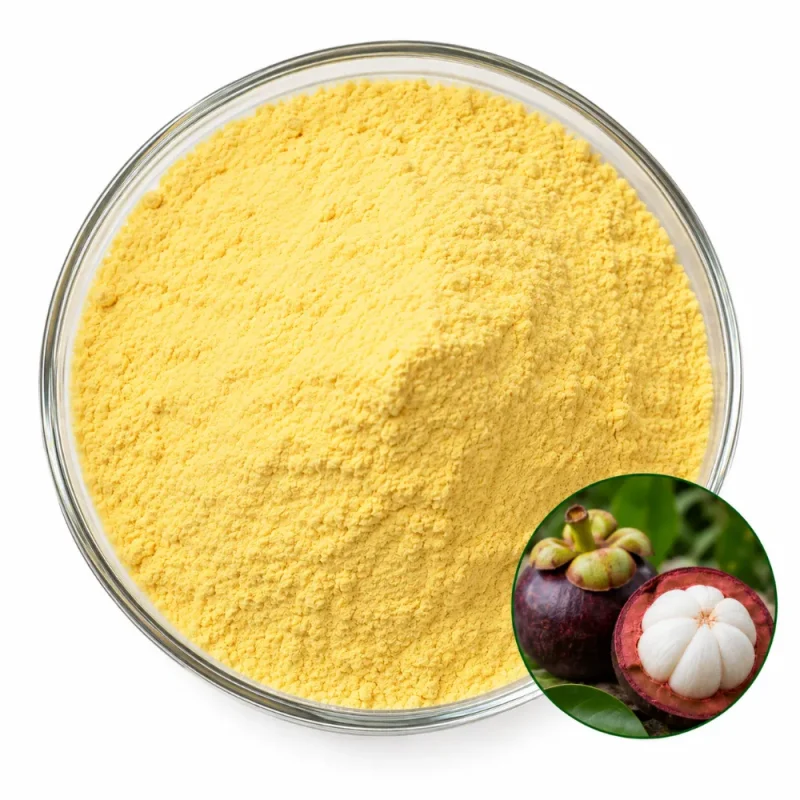
The most abundant xanthone of the mangosteen rind, alpha-mangostin is isolated here from the pericarp of Garcinia mangostana by ethanol extraction and purification. It is a prenylated xanthone with a methoxy group and three hydroxyls, and it is a yellow, crystalline powder that does not dissolve in water.

The primary grade is 98% alpha-mangostin by HPLC, with 90% and 95% grades also supplied, in Food / Dietary Supplement Grade. The pericarp, the rind of the fruit, is the source. The edible white aril is a different material and holds very little of this pigment.

Alpha-Mangostin Chemical Identity

Alpha-mangostin has the molecular formula C24H26O6 and a molecular weight of 410.5. The skeleton is a xanthone, a tricyclic system of two benzene rings bridged by a carbonyl and an oxygen, and it carries two prenyl groups, each a five-carbon branched chain with a double bond, at positions 2 and 8. Hydroxyl groups at 1, 3 and 6 and a methoxy group at 7 complete the pattern. The two prenyl groups make the molecule lipophilic, while the hydroxyls give it weak acidity and hydrogen-bonding ability.

Gamma-mangostin is the closest relative, with a free hydroxyl at position 7 where alpha-mangostin has the methoxy group. Beta-mangostin and the garcinones differ in further substituents or in cyclization of the prenyl groups. The natural source is the pericarp of Garcinia mangostana L., the mangosteen. Related products are the Mangosteen Extract 10–40% Total Xanthones / Mangostin-type marker, the 10:1 Mangosteen Extract Powder and Garcinone E 98%. The extracts are mixtures of xanthones, whereas alpha-mangostin here is the single compound.

Mangosteen fruit powders sold for food use are usually made from the whole fruit or from the pulp, and they are different materials. The part is therefore part of the identity, and a specification should name the pericarp.

Typical Specifications

Specification ItemProduct Information
Natural SourceGarcinia mangostana pericarp
Plant PartFruit & Berry
ProcessingEthanol Extraction & Purification
Compound ClassPolyphenols
Chemical Name (IUPAC)1,3,6-trihydroxy-7-methoxy-2,8-bis(3-methylbut-2-enyl)xanthen-9-one
CAS Number6147-11-1
Molecular FormulaC24H26O6
Molecular Weight410.5
PubChem CID5281650
InChIKeyGNRIZKKCNOBBMO-UHFFFAOYSA-N
SMILESCC(=CCC1=C(C2=C(C=C1O)OC3=C(C2=O)C(=C(C(=C3)O)OC)CC=C(C)C)O)C
Purity98% (HPLC)
Available Grades90% · 95% · 98% (HPLC)
GradeFood / Dietary Supplement Grade
AppearanceYellow powder
Solubility / DispersibilityInsoluble in Water
Quality Parameters
Moisture (LOD)≤5.0%
Total Ash≤5.0%
Heavy MetalsLead ≤2 ppm · Arsenic ≤1 ppm · Cadmium ≤1 ppm · Mercury ≤0.1 ppm
MicrobiologyTPC ≤1,000 cfu/g · Yeast & Mold ≤100 cfu/g · E. coli Negative · Salmonella Negative/25 g
Shelf Life24 months in unopened original packaging, cool and dry storage

Alpha-Mangostin Purity Grades & Impurities

GradeAssay & MethodWhere It Fits
90% Alpha-MangostinHPLCOil suspensions and premixes
95% Alpha-MangostinHPLCCapsules and complex systems
98% Alpha-MangostinHPLCReference-grade blends

An HPLC assay for alpha-mangostin reads the main peak at a wavelength near 245 or 320 nm, where the xanthone chromophore absorbs strongly, and the percentage compares that peak with the other detected peaks. Water, ash and silent components are outside the percentage, so moisture and ash have separate limits in the table.

The characteristic related substances are the other xanthones of the rind. Gamma-mangostin elutes before the main peak because the free hydroxyl makes it more polar, and beta-mangostin, gartanin, 8-deoxygartanin and the garcinones appear as smaller peaks. A method that separates alpha- from gamma-mangostin is essential, since their ratios vary between lots, and a specification that gives only the sum of mangostins does not identify the compound. Mangostanin and other methylated or cyclized derivatives may be present at trace level.

The 90%, 95% and 98% grades differ in the share of those companions and in the amount of resinous rind material. A yellow, fine crystalline powder is the sign of a clean lot, while an orange or brown cast indicates residual rind pigment, tannins or oxidation. The pericarp is rich in tannins, which are removed in purification and which appear as a dark tone when carry-over occurs. Storage in sealed, cool and dry conditions protects the grade, and moisture and ash have their own limits.

Alpha-Mangostin Solubility & Delivery

Alpha-mangostin is insoluble in water and dissolves in ethanol, methanol, acetone, ethyl acetate and dimethyl sulfoxide. The two prenyl groups give it a high logP, so it favors oils and surfactant phases. It crystallizes readily from alcohol, and the crystals wet poorly, so dispersion is the main formulation problem.

Delivery of alpha-mangostin in practice uses particle engineering and lipid systems. Fine milling, wetting agents, oil suspensions, lipid carriers, cyclodextrin complexes and amorphous solid dispersions are the approaches in the literature, and nanoemulsion or micellar systems have been studied for xanthones in general. The phenolic hydroxyls can oxidize on long exposure to air and light in solution, so antioxidants in the oil phase and opaque packaging protect the color. In dry blends the powder is stable, free flowing when not too fine, and not hygroscopic. Static makes small weights awkward, so a two-stage premix with a dry carrier gives a more uniform result.

The resinous character of rind extracts shows in the physical behavior of the powder. A grade that retains a trace of resin is tacky in warm rooms and cakes under pressure, while a well-purified crystalline grade of alpha-mangostin stays free flowing. Comparing the bulk behavior of retained samples is therefore a useful complement to the HPLC content when a formulator changes lot, and a sieve test on arrival catches a caked drum before it reaches the blender.

Application Areas

Oil-Based Softgel Suspensions

Softgels disperse milled alpha-mangostin in oil with an emulsifier and an antioxidant. Check settling before encapsulation, since the crystals are denser than the oil, and keep the tank stirred and shaded until the last unit is closed so the dose stays even.

Capsule Fills at the 95% Grade

The 95% grade fills capsules at small weight. The yellow powder is electrostatic and slightly resinous, so a flow agent, anti-static tools and a sieved premix give an even fill weight, and opaque capsules protect the color.

Lipid and Micelle Systems

Lipid carriers and micellar systems raise the dispersion of the insoluble xanthone. The system is built in a warm oil or surfactant step, cooled under shear and filtered, and a retained sample of each lot lets the formulator compare particle size and color on repeat.

Dry Premixes at the 90% Grade

The 90% grade suits dry premixes where the color tolerance is wider. The premix is built in steps with a dry carrier and sieved to remove yellow specks, then packed in opaque containers to slow oxidation.

Xanthone Comparison Blends

Formulators studying mangosteen chemistry blend alpha-mangostin with gamma-mangostin and garcinone E in fixed ratios. Each ingredient is weighed on its own, and an HPLC trace of the blend, run on a column that resolves the pair, confirms the ratios.

Packaging & Commercial Supply

Essencefield supports product evaluation, formulation trials, commercial orders, and ongoing ingredient supply. Packaging, storage, and shipping arrangements are determined by product characteristics, order quantity, stability requirements, and destination-market needs.

Supply ItemGeneral Information
SampleAvailable upon request for formulation, testing, and supplier evaluation
Order Quantities100 g · 1 kg · 5 kg · 25 kg · 100 kg · 500 kg · Bulk
Sample Lead TimeTypically 5–7 days after sample confirmation
Production Lead TimeTypically 15–30 days after order and specification confirmation
PackagingSuitable protective inner packaging with bags, cartons, drums, or other appropriate outer packaging
StorageStore in tightly sealed, suitable protective packaging in a cool, dry environment. Protect from moisture, heat, and direct sunlight. Specific storage conditions follow the approved product specification.
DocumentationCOA · Product Specification · TDS · SDS · Applicable declarations (as applicable)

Final order quantities, lead times, packaging, documentation, and shipping arrangements are confirmed according to the selected product and commercial requirements.

Request Ingredient Specifications & Quote

Share your target specification, application, quantity, and documentation needs. We’ll help confirm suitable options, samples, and commercial supply details.