Watermelon Powder

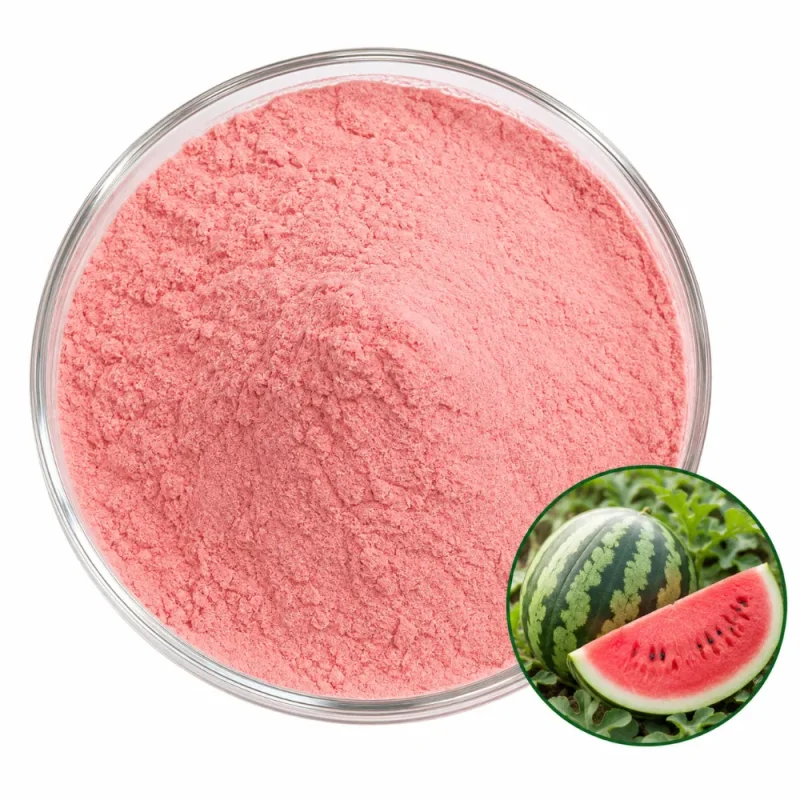
Watermelon powder is spray-dried from the pressed juice of Citrullus lanatus fruit on a maltodextrin carrier. It is a red, water-soluble powder with a light, sweet, fresh flavor. Seeds and rind are not part of the juice and are separate materials.

Watermelon juice is mostly water, and a juice powder has to remove a great deal of it. The finished powder therefore depends heavily on its carrier, and its flavor is subtle compared with berry or citrus powders. Maltodextrin is the only carrier, and the powder suits drink mixes, frozen pops, gummies and snack dusts.

Watermelon Juice Powder Processing

The species is Citrullus lanatus (Thunb.) Matsum. & Nakai, the watermelon, a trailing annual vine of the gourd family (Cucurbitaceae) domesticated in northeastern Africa. It is not the citron melon, a closely related type used for preserves, and it is not the cantaloupe or honeydew, which are Cucumis melo. The parts used are the red flesh and its juice, and the seeds are traded separately as a different product.

The raw material is watermelon juice concentrate. The flesh is pressed, the juice is strained and concentrated by evaporation, and the concentrate is blended with maltodextrin before atomization in a spray dryer. The carrier makes the powder soluble and free-flowing, and in this fruit it carries a larger share of the solids than in a juice that starts richer in sugar and acid.

The color of red-fleshed watermelon is lycopene, the same pigment as tomato, which stays largely in the pulp particles of the juice. The red of the powder therefore comes from carotenoid particles that disperse in water and not from a dissolved dye.

Seeded and seedless types are both grown, and red-fleshed, yellow-fleshed and orange-fleshed fruit exist. The master color of this powder is red, which fits the red-fleshed fruit that is the standard for juice. Fruit that ripens fully in the field gives the best sweetness, and it is pressed soon after harvest because cut flesh breaks down quickly.
Watermelon Flavor, Color & Forms

The powder is red, and it gives a pale pink to red, slightly cloudy solution in water. The taste is light, sweet and refreshing with a clean, watery finish and a faint green note reminiscent of cucumber. Acidity is low. Because the volatile compounds are sparse and delicate, watermelon flavor needs a careful hand in formulation and is easy to mask with stronger ingredients.

Characteristic constituents are fructose-rich sugars, lycopene and related carotenoids, and the amino acid citrulline, which takes its name from the species. No figure is given for any of them, and nothing is claimed as an effect.

FormWhat It IsChoose It When
Watermelon Juice PowderSpray-dried juice on a maltodextrin carrierA soluble, light watermelon base is wanted
Freeze-Dried Watermelon PowderFlesh dried under vacuum without a carrierPulp solids and full color are wanted
Watermelon Seed PowderPowder from the seed, a different partThe seed, not the flesh, is specified
Watermelon Extract PowderRatio extract of watermelonA concentrated extract is specified

Typical Specifications

Specification ItemProduct Information
Latin NameCitrullus lanatus
Plant PartFruit & Berry
ProcessingSpray-Dried Juice
Common NameWatermelon
Raw MaterialWatermelon juice concentrate
Ingredient TypeJuice Powder
CarrierMaltodextrin
AppearanceRed powder
FlavorLight, sweet, fresh
Solubility / DispersibilityWater Soluble
Quality Parameters
Moisture (LOD)≤5.0%
Heavy MetalsLead ≤2 ppm · Arsenic ≤1 ppm · Cadmium ≤1 ppm · Mercury ≤0.1 ppm
MicrobiologyTPC ≤10,000 cfu/g · Yeast & Mold ≤1,000 cfu/g · E. coli Negative · Salmonella Negative/25 g
Shelf Life24 months in unopened original packaging, cool and dry storage

Application Areas

Summer Drink Mixes

Dry drink mixes use watermelon powder for a refreshing, light fruit flavor and a pink-red color. It pairs with lime, mint and strawberry, and the delicate flavor works best at higher inclusion in a clear, lightly sweetened base.

Frozen Pop and Slush Bases

Pop and slush bases use watermelon powder to deliver fruit flavor and color without the high water content of fresh juice. The sugars lower the freezing point, so the base is balanced against stabilizers to hold a fine ice texture.

Gummies and Soft Candy

Confectioners add watermelon powder to gummies and sour candies for pink-red color and a candy-style flavor. The carotenoid color tolerates heat better than anthocyanins, and a touch of added acid sharpens the flavor. Pink watermelon candy is a familiar flavor category, so recognition is high even at modest levels.

Yogurt and Dairy Mixes

Dairy bases use watermelon powder for a light fruit note and soft red color. The pigment is stable at the pH of yogurt and milk, and the mild taste leaves room for vanilla or citrus accents.

Seasoning and Snack Dusts

Snack and seasoning dusts combine watermelon powder with salt, chili and lime for sweet-and-sour fruit coatings. It blends easily with dry ingredients, and its low acid keeps the dust from becoming harshly sour. The fruit note is sweet and mild, which gives the savory chili and salt a cooling contrast.

Moisture Pickup & Stability

Watermelon powder is a high-sugar glass whose sugars are largely fructose, a strongly water-attracting sugar. In humid air it becomes sticky faster than a sucrose-rich powder and sets into a hard mass that is difficult to dislodge. Weigh it in a dry room, close the liner promptly and sieve any lumps before blending.

Lycopene is the main color concern. It fades under light and oxygen, and a warm store accelerates the loss, shifting the red toward orange-brown. Opaque, sealed packaging and a cool store keep the shade closer to the received color. Being fat-soluble, the pigment moves into oil phases, which can deepen the color of creamy and oily products.

The fresh note of watermelon is quickly lost. Volatile aroma compounds are low in concentration and oxidize or evaporate with warmth and air, so aged powder tastes sweet but plain. Because acidity is low, a moisture-damaged drum is also a microbiological risk, and it should be set aside and not reworked.

Because the flavor is so delicate, watermelon powder often suffers more from nearby odors than from age. Stored beside onion, spice or cleaning supplies, it picks up foreign notes quickly. Keep drums sealed and in a clean, odor-free space, and open them only when needed for weighing.

Packaging & Commercial Supply

Essencefield supports product evaluation, formulation trials, commercial orders, and ongoing ingredient supply. Packaging, storage, and shipping arrangements are determined by product characteristics, order quantity, stability requirements, and destination-market needs.

Supply ItemGeneral Information
SampleAvailable upon request for formulation, testing, and supplier evaluation
Order Quantities100 g · 1 kg · 5 kg · 25 kg · 100 kg · 500 kg · Bulk
Sample Lead TimeTypically 5–7 days after sample confirmation
Production Lead TimeTypically 15–30 days after order and specification confirmation
PackagingSuitable protective inner packaging with bags, cartons, drums, or other appropriate outer packaging
StorageStore in tightly sealed, suitable protective packaging in a cool, dry environment. Protect from moisture, heat, and direct sunlight. Specific storage conditions follow the approved product specification.
DocumentationCOA · Product Specification · TDS · SDS · Applicable declarations (as applicable)

Final order quantities, lead times, packaging, documentation, and shipping arrangements are confirmed according to the selected product and commercial requirements.

Request Ingredient Specifications & Quote

Share your target specification, application, quantity, and documentation needs. We’ll help confirm suitable options, samples, and commercial supply details.