Mango Powder

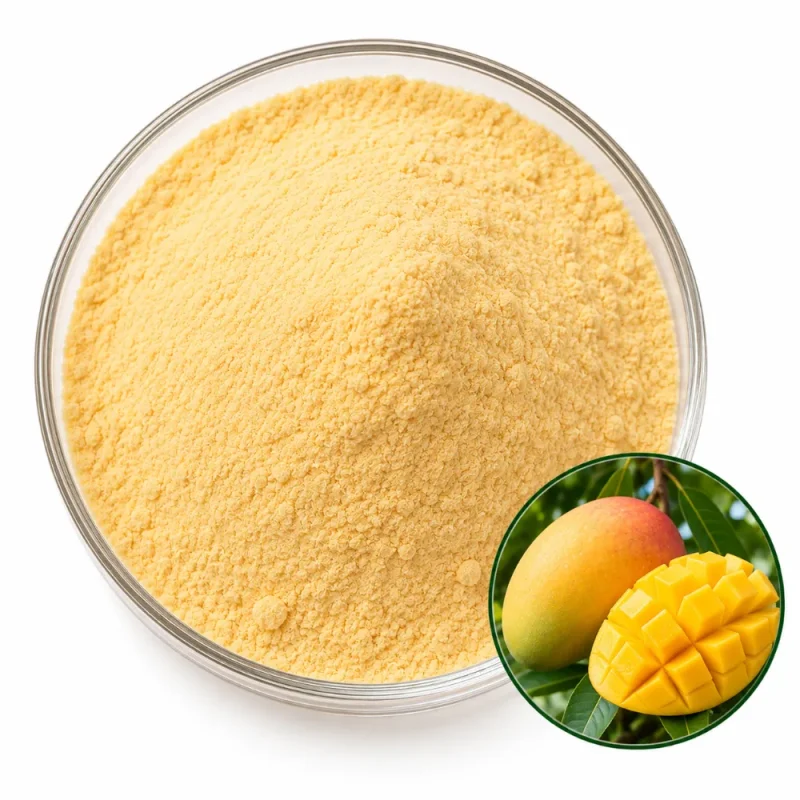
Mango powder is spray-dried from the juice of ripe Mangifera indica fruit on a maltodextrin carrier. It is a yellow-orange, water-soluble powder with a sweet, resinous tropical flavor. This is the ripe-fruit product; the sour, tan powder of unripe green mango sold in Indian cooking is a different material.

Ripe mango pulp carries carotenoids, sugars and aroma terpenes, and the juice powder keeps the golden color and the full sweet taste of the fruit. Leaf, kernel and bark of the mango tree are separate botanicals and are not used here.

Mango Juice Powder Processing

The species is Mangifera indica L., the common mango, a large evergreen tree of the cashew family (Anacardiaceae) cultivated across the tropics. Cultivars such as Alphonso, Kent, Tommy Atkins and Ataulfo differ in fiber, sweetness and aroma, but all belong to one species. Competing pages often confuse ripe-fruit powder with amchur, a dried unripe-mango powder, so the stage of the fruit is part of the identity.

The raw material is mango juice concentrate prepared from ripe pulp. Mango pulp is thick and fibrous, so the raw fruit is pulped, strained and concentrated before it is blended with maltodextrin and atomized in a spray dryer. The carrier gives the finished powder its solubility and flow, and it lightens the golden pulp toward a paler yellow-orange.

Mango season is short in each growing region, so concentrate producers draw on ripe fruit harvested across several origins and cultivars to hold a steady flavor through the year. The resulting powder is described by character, not by variety. A named single-cultivar powder, such as Alphonso, is a separate specification.

Because the fiber and coarse solids are screened out before drying, the powder dissolves into a smooth, opaque yellow drink instead of a gritty suspension. That is a practical difference from a whole-fruit powder, which keeps more fiber.
Mango Flavor, Color & Forms

The powder is yellow-orange, a color that comes from carotenoids in the pulp, mainly beta-carotene and related pigments. In water it gives an opaque golden liquid, because carotenoids are fat-soluble and stay dispersed instead of dissolving. The taste is sweet, with a tropical, slightly resinous and floral aroma carried by terpenes. A faint tartness balances the sugar. Ripeness is the main driver of flavor quality, since underripe pulp tastes green and acidic while overripe pulp turns winey, so the sweet, floral middle of the ripening curve is what the concentrate is built from.

Characteristic constituents are sugars, carotenoids, organic acids, pectin and aroma terpenes. No figure is given for any of them. Mangiferin, the xanthone often associated with mango, is found mainly in leaf and bark, and the fruit powder is not defined by it.

FormWhat It IsChoose It When
Mango Juice PowderSpray-dried ripe-fruit juice on maltodextrinA soluble, sweet mango base is wanted
Freeze-Dried Mango PowderRipe fruit dried under vacuumFruit solids and a fresher aroma matter
Mango Extract PowderRatio extract of the fruitA concentrated extract is specified
Mango Leaf Extract PowderRatio extract of the leafThe leaf, not the fruit, is the specified part

Typical Specifications

Specification ItemProduct Information
Latin NameMangifera indica
Plant PartFruit & Berry
ProcessingSpray-Dried Juice
Common NameMango
Raw MaterialMango juice concentrate
Ingredient TypeJuice Powder
CarrierMaltodextrin
AppearanceYellow-Orange powder
FlavorSweet, tropical, mildly resinous
Solubility / DispersibilityWater Soluble
Quality Parameters
Moisture (LOD)≤5.0%
Heavy MetalsLead ≤2 ppm · Arsenic ≤1 ppm · Cadmium ≤1 ppm · Mercury ≤0.1 ppm
MicrobiologyTPC ≤10,000 cfu/g · Yeast & Mold ≤1,000 cfu/g · E. coli Negative · Salmonella Negative/25 g
Shelf Life24 months in unopened original packaging, cool and dry storage

Application Areas

Smoothie and Lassi Mixes

Dry smoothie and lassi mixes use mango powder for sweetness, golden color and a rich tropical flavor. It disperses into milk, yogurt and plant drinks, and its carotenoid color survives the neutral pH of dairy, so the finished drink looks fresh without added colorants.

Fruit Snack and Gummy Confectionery

Gummy makers add mango powder for flavor and a natural yellow-orange tint. It joins the gel mass after cooking, since long heat dulls the aroma, and the sugars of the powder are counted in the total sugar of the candy.

Ice Cream and Sorbet Bases

Frozen dessert bases take mango powder to build a fruit layer without puree, which avoids ice crystals from added water. The sugar in the powder lowers the freezing point, so the base needs an adjusted sugar balance to keep the texture scoopable.

Bakery Fillings and Cream Mixes

Dry cream fillings and cheesecake mixes use mango powder for flavor and gentle color. Added to cooled fillings it preserves the terpene aroma, while baked into batter it loses brightness, so bakers treat it as a finishing flavor.

Savory Sauce and Curry Bases

Sweet-sour sauces and curry pastes use mango powder as a fruit note against spice. It dissolves in warm water, thickens slightly because of residual pectin, and pairs with chili, ginger and lime in dry premix recipes.

Moisture Pickup & Stability

Mango powder is a sugar-rich glass and a strong absorber of moisture. In humid air it softens, turns tacky and cakes, and a drum left open overnight can form a crust that does not break easily. Weigh in a dry room and reseal the liner after every draw.

Carotenoids set the stability profile for color. Light and oxygen bleach the golden shade over months, and warm storage speeds the fade. Opaque sealed packaging holds color best, and opened containers should be used within a short window. The pigment is fat-soluble, so a solution can leave a faint orange film on plastic surfaces.

The aroma fades first. Terpenes oxidize and evaporate with air and heat, and aged powder tastes sweeter but flatter. Keep drums cool, add the powder late in dry blending and keep open times short. Residual pectin means that solutions made at high concentration are slightly viscous, which matters in clear drinks.

Contact with oils and fats extends the color story. Carotenoids dissolve into fat, so mango powder in a fat-rich filling or beverage looks deeper orange than in a water-based drink, and the tint can migrate into the fat phase of a layered product.

Packaging & Commercial Supply

Essencefield supports product evaluation, formulation trials, commercial orders, and ongoing ingredient supply. Packaging, storage, and shipping arrangements are determined by product characteristics, order quantity, stability requirements, and destination-market needs.

Supply ItemGeneral Information
SampleAvailable upon request for formulation, testing, and supplier evaluation
Order Quantities100 g · 1 kg · 5 kg · 25 kg · 100 kg · 500 kg · Bulk
Sample Lead TimeTypically 5–7 days after sample confirmation
Production Lead TimeTypically 15–30 days after order and specification confirmation
PackagingSuitable protective inner packaging with bags, cartons, drums, or other appropriate outer packaging
StorageStore in tightly sealed, suitable protective packaging in a cool, dry environment. Protect from moisture, heat, and direct sunlight. Specific storage conditions follow the approved product specification.
DocumentationCOA · Product Specification · TDS · SDS · Applicable declarations (as applicable)

Final order quantities, lead times, packaging, documentation, and shipping arrangements are confirmed according to the selected product and commercial requirements.

Request Ingredient Specifications & Quote

Share your target specification, application, quantity, and documentation needs. We’ll help confirm suitable options, samples, and commercial supply details.