Dendrobium officinale Polysaccharide Identity
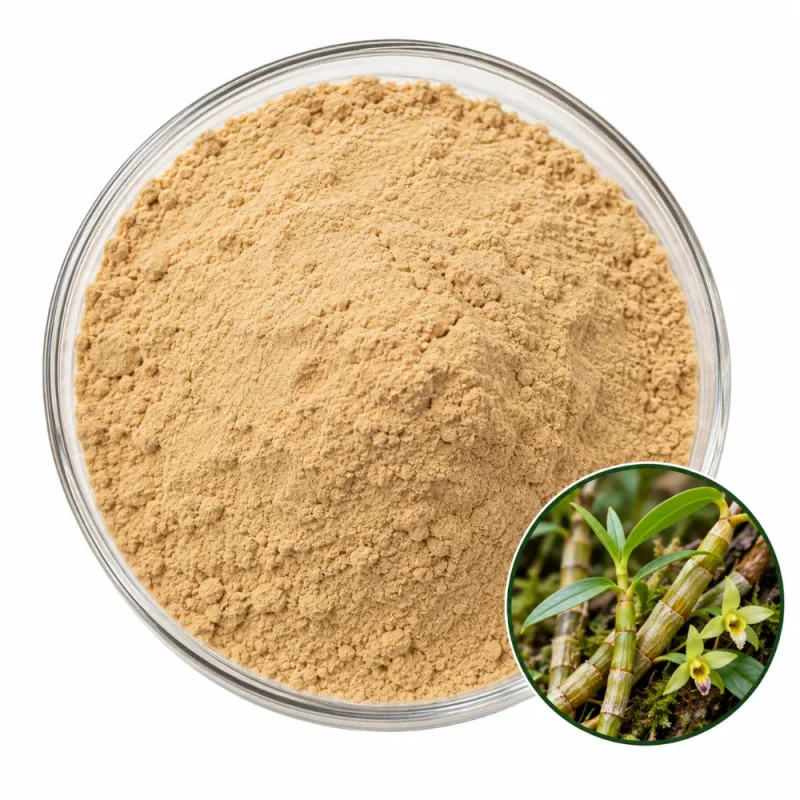
Dendrobium officinale polysaccharide powder is made from the stem of Dendrobium officinale Kimura & Migo, an epiphytic orchid grown on rock, bark or in facility beds, and known in Chinese trade as Tiepi Shihu. Dendrobium officinale stem is the only part used. Other Dendrobium species, such as Dendrobium nobile and Dendrobium huoshanense, are sold under similar names, and their polysaccharides differ in ratio and acetylation.
The main polymer is a glucomannan with a backbone of β-(1→4)-linked mannose and glucose units, with mannose in clear excess. Acetyl groups on some residues control how the chain behaves in water. The mucilage is stored in the stem as a reserve and swells strongly on contact with water, which is why raw stem decoctions are thick and slippery.
Hot-water extraction, followed by ethanol precipitation, removes most small sugars and phenolics from Dendrobium officinale, and leaves the glucomannan as the dominant carbohydrate. Dendrobium officinale polysaccharide is therefore a mannose-led fraction, distinct from the starch- and fructan-led fractions of roots and rhizomes.
The stem is harvested after a long growth period and is traditionally dried by twisting into coils, known as fengdou, which concentrates the mucilage. Dendrobium officinale polysaccharide starts from the dried stem, so stem age and drying method change the starting carbohydrate content before purification.
Two related products from the same species have different roles. Dendrobium Stem Powder is the milled stem and Dendrobium Extract Powder is a ratio extract. Neither is specified by a carbohydrate assay.