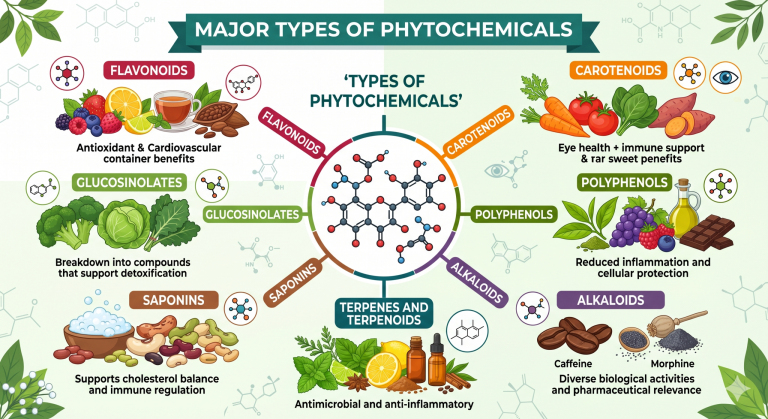
A standardized botanical extract is an extract manufactured to meet defined compositional or quality criteria from batch to batch. In commercial ingredients this usually includes a specified level or range of one or more marker compounds, verified by an appropriate analytical method. A marker percentage alone does not define the ingredient, though: botanical identity, plant part, extraction conditions, assay method, carrier system and acceptance criteria all shape how a standardized extract should be read. For formulators, sourcing teams and quality professionals, three questions matter most — what is measured, how it is measured, and what specification each batch must meet.
What Does “Standardized Botanical Extract” Mean?
Standardization places measurable controls around the natural and processing-related variation in botanical ingredients. A standardized grade may be defined by a combination of species and plant part, extraction process or solvent, one or more target constituents, an assay limit or range, the analytical method, extract ratio where relevant, carrier or excipient content, and agreed physical and quality parameters — considerably more than “5%”, “20%” or “95%” next to a botanical name.
United States Pharmacopeia General Chapter <565> Botanical Extracts describes extracts as complex preparations made with suitable solvents, notes that further processing may increase characterized constituents, decrease unwanted ones or both, and distinguishes native extracts from preparations with added carriers or diluents. Our Standardized Extracts portfolio is organized the same way, by botanical source, marker identity, assay level and method rather than botanical name alone.
Why Do Botanical Extracts Naturally Vary?
Within one species, composition shifts with cultivar, plant part, growing environment, harvest stage, post-harvest handling and storage. Processing adds a second layer: water, ethanol and hydroethanolic systems do not recover every constituent equally, and temperature, duration, concentration, purification, drying and carrier addition further change the finished ingredient. That is why two products from the same plant can differ in chemical profile, assay level, physical properties and intended grade.
How Is a Botanical Extract Standardized in Practice?
Standardization is not just a final laboratory test; it starts with defining what the finished extract should be. In practice it runs through five stages:
- Define the botanical raw material — species, plant part, identity, physical condition and other requirements, since variation here affects extraction efficiency and finished composition.
- Control the extraction process — solvent system, conditions, concentration and downstream steps chosen for the required profile.
- Establish the target specification — the marker or constituent group, extract ratio, physical characteristics and other quality parameters for the grade.
- Control the extract toward that target — through controlled extraction, concentration, enrichment, blending, purification, carrier adjustment or a combination.
- Verify the finished batch against the agreed specification before release.
Our Processing & Standardization service considers botanical identity, extraction route, marker targets, carrier systems, analytical verification and finished-batch criteria together. A passing final assay confirms the tested batch meets a defined target but says nothing on its own about how consistently the material was produced, so reliable standardization combines process control with finished-batch verification.
What Are Marker Compounds?
A marker compound is a chemically defined constituent, or group, selected to help identify, characterize, quantify or control a botanical material; it is not automatically the compound responsible for the botanical’s activity. The European Medicines Agency’s guidance on markers used in herbal medicinal products classifies markers by their analytical and quality-control purpose:
| Marker Type | Main Purpose | Practical Meaning |
|---|---|---|
| Active principle | Control of a constituent with established relevant activity | The constituent itself has a recognized role in activity |
| Active marker | Quantitative control related to activity | Helps characterize the preparation in relation to expected activity |
| Analytical marker | Identification or quantitative quality control | Selected primarily because it can be reliably measured |
| Negative marker | Control of an unwanted constituent | Establishes an upper limit or other restriction |
Active Principles and Active Markers
An active principle is a constituent whose relevant activity is sufficiently characterized; an active marker is associated with a preparation’s activity without accounting for its whole effect. Because extracts are multicomponent mixtures, a marker can be important for quality control without being the extract’s single “active ingredient”. For more, see Active Compounds vs Marker Compounds.
Analytical and Negative Markers
An analytical marker is chosen because it gives reproducible information for identification or quantitative control, even where no direct link to activity has been established. A negative marker works the other way, keeping an unwanted constituent below a limit. Standardization therefore means controlling the parameter relevant to the specification, which is not always maximizing a compound.
What Does “Standardized to 5%, 10% or 95%” Mean?
A percentage normally represents the measured concentration of a defined compound or group on a specified analytical basis. Commercial examples look like this:
| Botanical | Marker | Example Assay | Method |
|---|---|---|---|
| Maca | Macamides | 0.6% | HPLC |
| Loquat Leaf | Ursolic Acid | 25% | HPLC |
| Banaba Leaf | Corosolic Acid | 1–10% | HPLC |
| Bilberry | Anthocyanins | 25% | Defined analytical method |
Maca shows how one botanical can be supplied under different specification systems: our Maca Extract Powder includes a ratio grade, while the macamide-standardized grade is defined by assay. A ratio describes the relationship between starting material and extract; an assay describes measured constituent content.
Likewise, “Ashwagandha Extract — 5% Withanolides” is useful but leaves questions open: what the withanolide assay includes, whether 5% is a minimum, typical value or range, which method and plant part apply, and whether the result is as-is or dry basis. Compare how our Ashwagandha Extract 2.5–10% Withanolides grades are specified. A percentage is meaningful only when analyte, target, method and reporting basis are understood.
How Are Marker Compounds Assayed?
An assay is a quantitative determination of a specified constituent or group; for a standardized extract it connects the purchasing specification to a measurable laboratory result.
HPLC
High-performance liquid chromatography is widely used where individual phytochemicals or related compounds must be separated and quantified. Its advantage is selectivity: rather than treating the matrix as one combined response, it separates and measures defined analytes. So the useful question is what the HPLC method actually measures, not merely whether HPLC was used.
UV, UV-Vis and Other Methods
UV or UV-visible spectrophotometry can suit constituent groups whose absorbance relates to concentration, and GC, LC-MS, TLC or HPTLC may be appropriate depending on analyte, matrix and purpose. The most advanced instrument is not automatically best; the procedure must suit the parameter being controlled.
Why Does the Analytical Method Matter?
The same percentage can describe different measurements. “Total flavonoids ≥20% by UV” and “individual flavonoid X ≥20% by HPLC” both say 20% but do not measure the same thing, and differences can also arise from analyte definition, sample preparation, selectivity, calibration, calculation and reporting basis. Extraction efficiency, calibration materials, matrix effects and analytical controls all influence results — challenges discussed in NIST’s work on measurements and standards for botanical dietary supplements. Our Quality & Testing approach evaluates botanical, matrix, analyte, method, specification and acceptance criteria together rather than treating results from different methods as interchangeable.
Marker Assay vs Chemical Fingerprint
| Analytical Approach | Main Question |
|---|---|
| Marker assay | How much of a defined constituent is present? |
| Chemical fingerprint | Does the broader chemical profile match the expected extract? |
A marker assay yields a figure such as “Marker X: 12.4%”, whereas a chromatographic fingerprint looks at a broader pattern of constituents. Because a single marker can meet specification without representing the whole profile, the two approaches are complementary rather than interchangeable. See HPLC Fingerprinting for Botanical Extract Authentication.
How to Interpret a Botanical Extract Assay Specification
| Element | Question to Ask |
|---|---|
| Analyte | What exactly is being measured? |
| Target | Is the requirement a minimum, maximum, or range? |
| Method | How is the analyte measured? |
| Reference / Calibration Basis | What standard is used to identify or quantify it? |
| Reporting Basis | How is the result expressed? |
“Marker X ≥10.0% by HPLC, dry basis” says far more than “10% standardized extract”.
Target and Acceptance Criteria
“NLT 10%” (not less than 10%) and “10–12%” (a controlled range) establish different acceptance criteria.
Why Reference Materials Matter
Quantitative analysis depends on suitable calibration and quality-control materials, which help laboratories evaluate performance, improve comparability and judge whether a result supports a specification. An assay is the output of a defined measurement system, not simply a number from an instrument.
Standardized Extract vs Extract Ratio vs Isolated Compound
| Ingredient Type | Example | What It Describes |
|---|---|---|
| Ratio Extract | 10:1 | Relationship between starting botanical and resulting extract |
| Standardized Extract | 5% Marker X | Controlled level of a defined constituent or constituent group |
| Highly Purified Compound | Compound X 98% | High concentration or purity of one selected constituent |
Does a 10:1 Extract Mean 10% Active Compounds?
No. A ratio describes production concentration and an assay describes measured content; a 10:1 extract does not contain 10% marker or active compounds. See Botanical Extract Ratios Explained for detail.
Is a 95% Standardized Extract the Same as a 98% Isolated Compound?
Not necessarily. A standardized extract such as Turmeric Extract 95% Curcuminoids can retain a broader multicomponent matrix even with one constituent group heavily enriched, whereas a 98% isolated phytochemical such as Curcumin 98% is close to a purified compound. The percentage alone does not make them equivalent.
What Does Standardization Not Tell You?
It does not replace identity and authenticity testing: a marker can be present at the required level without confirming species, plant part or broader authenticity. It does not replace contaminant testing: a batch can pass its assay and fail heavy metals, pesticide residues, microbiological limits or residual solvents. It does not establish clinical efficacy: an analytical marker can serve quality control without proving any outcome. And the same assay does not mean the same extract: two products labeled “10% Marker X” can differ in species, plant part, solvent, carrier, method and wider profile. For supplier qualification, the question is whether two materials are analytically and commercially equivalent for the intended specification, not whether their headline percentages match — a comparison covered in Standardized vs Non-Standardized Botanical Extracts.
What Should a Standardized Botanical Extract Specification Include?
A good specification defines the ingredient clearly enough that sourcing, formulation, laboratory and quality teams are all evaluating the same material.
| Specification Area | What to Define | Why It Matters |
|---|---|---|
| Botanical Identity | Latin name, species, plant part | Defines the botanical source |
| Standardization | Marker/analyte and target | Defines the compositional requirement |
| Analytical Method | HPLC, UV, GC, or agreed procedure | Defines how the result is generated |
| Extract Definition | Ratio, solvent, native extract, carrier | Defines the supplied extract |
| Physical Properties | Moisture, particle size, density where relevant | Supports processing and formulation |
| Quality Limits | Microbiology, metals, pesticides, residual solvents where applicable | Defines broader material acceptance |
| Documentation | Specification, COA, and supporting records | Supports lot qualification |
Exact requirements should reflect the botanical’s risk profile, process, application, destination market and purchasing terms. The core principle is alignment: same ingredient, same analyte, same method, same acceptance criteria.
Specification vs Certificate of Analysis
A specification defines what an ingredient must meet; a Certificate of Analysis reports how a particular lot performed against it. If the specification says “curcuminoids NLT 95.0% by HPLC” and the lot COA reports 96.2% by HPLC, quality review asks whether that result meets the agreed requirement. This matters when comparing suppliers, because a high reported assay is not enough if the test definition, method or criteria differ from your purchasing specification. A step-by-step review is in How to Read a Botanical Extract COA.
How Should Buyers Compare Standardized Botanical Extracts?
- Confirm botanical identity: species, plant part, ingredient form and the identity or authenticity basis.
- Define the standardization target: the marker or group and whether it is a minimum, maximum or controlled range.
- Check the analytical method, including calibration and reporting basis where relevant.
- Review the extract definition: solvent, ratio, native extract content, carrier, and whether the material is a conventional extract, standardized grade, enriched fraction or purified constituent.
- Match the specification to the batch COA: test names, methods, criteria and lot results should align before physical and contaminant requirements are assessed.
This is especially important when qualifying a second source or replacing a supplier. Our Specification & Grade Matching service reviews identity, marker targets, methods, extract details, carriers, physical properties, application requirements and documentation together.
Standardization Is a System, Not Just a Percentage
A standardized botanical extract is best understood as a defined ingredient controlled within agreed compositional and quality parameters, evaluated in sequence from botanical identity and extract definition through marker, target, method and specification to the batch result. That is why two extracts with the same name, or even the same nominal assay, may not be interchangeable. Standardization does not remove botanical complexity; it defines which aspects must stay measurable and reproducible from batch to batch. The question to ask is how an ingredient is defined, measured, specified and verified — not just what percentage it is.
Request Standardized Extract Specifications or Samples
Browse our Standardized Extracts and Botanical Extracts, then send us the botanical and plant part, target marker and range, preferred method, application and estimated quantity. Matched grades can move to sample evaluation through our Sample & Bulk Supply workflow. Contact Essencefield Botanicals to request a specification, representative COA or sample.