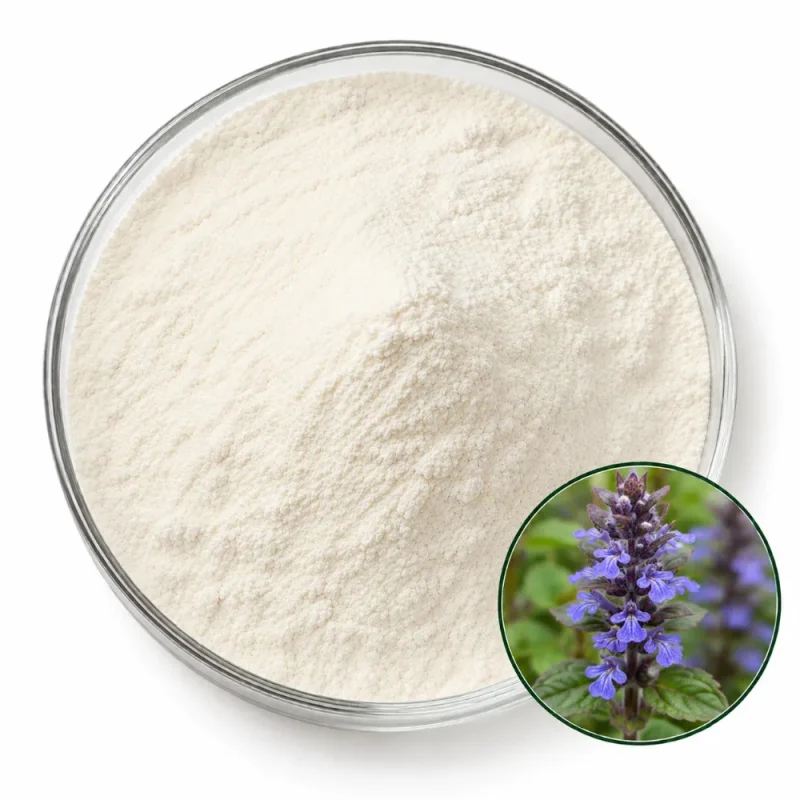
Ajugol 98%

An iridoid glycoside of the raw root, ajugol is isolated here from the root of Rehmannia glutinosa by ethanol extraction and purification. It is a small bicyclic monoterpenoid carrying one glucose unit, and it is a water soluble, off-white powder.

The primary grade is 98% ajugol by HPLC, in Food / Dietary Supplement Grade. Rehmannia is traded in several states, and the iridoid glycosides change with the processing of the root, so the botanical source and the compound name together are the identity of this product.

Ajugol Chemical Identity

Ajugol has the molecular formula C15H24O9 and a molecular weight of 348.3. The aglycone is a cyclopenta[c]pyran, the bicyclic skeleton typical of iridoids, with two hydroxyl groups and a methyl group on the five-membered ring, and a glucose is attached through an acetal carbon in the pyran ring. The acetal linkage is the reactive center of the molecule. It is stable in neutral solution and sensitive to acid and to the enzyme beta-glucosidase, which cleave the sugar and release a reactive aglycone.

The natural source is the root of Rehmannia glutinosa (Gaertn.) Libosch. ex Fisch. & C.A.Mey., a plant of the family Rehmanniaceae. The raw root, the dried root and the steamed, prepared root differ in color and in iridoid content, since steaming degrades the glycosides and darkens the material to black. A buyer who needs ajugol should therefore think about which state of the root a compound came from. Rehmannia is supplied in other forms: Rehmannia Glutinosa Extract 5–30% Iridoid Glycosides, the Prepared Rehmannia Root Extract Powder and the Radix Rehmanniae Extract Powder. Those mixtures contain several iridoids together with sugars and phenylethanoid glycosides, while ajugol here is one of them.
Typical Specifications

Specification ItemProduct Information
Natural SourceRehmannia glutinosa root
Plant PartRoot & Rhizome
ProcessingEthanol Extraction & Purification
Compound ClassIridoids, Terpenoids
Chemical Name (IUPAC)(2S,3R,4S,5S,6R)-2-[[(1S,4aR,5R,7S,7aS)-5,7-dihydroxy-7-methyl-4a,5,6,7a-tetrahydro-1H-cyclopenta[c]pyran-1-yl]oxy]-6-(hydroxymethyl)oxane-3,4,5-triol
CAS Number52949-83-4
Molecular FormulaC15H24O9
Molecular Weight348.34
PubChem CID6325127
InChIKeyVELYAQRXBJLJAK-XKKWFBPMSA-N
SMILESCC1(CC(C2C1C(OC=C2)OC3C(C(C(C(O3)CO)O)O)O)O)O
Purity98% (HPLC)
GradeFood / Dietary Supplement Grade
AppearanceOff-White powder
Solubility / DispersibilityWater Soluble
Quality Parameters
Moisture (LOD)≤5.0%
Total Ash≤5.0%
Heavy MetalsLead ≤2 ppm · Arsenic ≤1 ppm · Cadmium ≤1 ppm · Mercury ≤0.1 ppm
MicrobiologyTPC ≤1,000 cfu/g · Yeast & Mold ≤100 cfu/g · E. coli Negative · Salmonella Negative/25 g
Shelf Life24 months in unopened original packaging, cool and dry storage

Ajugol Purity Grades & Impurities

The 98% figure is an HPLC result that compares the ajugol peak with the other detected peaks. Iridoid glycosides absorb only weakly in the ultraviolet range, with detection near 210 nm, where many compounds respond, so the method needs a clean baseline and a well-resolved column. Water, ash and non-responding matter are not in the percentage, so the table limits moisture and ash on their own. A single grade is offered.

The related substances of rehmannia ajugol are the other iridoid glycosides of the root. Catalpol, rehmannioside A and D, aucubin and leonuride are the usual neighbors, and several are more polar and elute earlier. Acteoside, a phenylethanoid glycoside, and the oligosaccharides of the root, mainly stachyose, are removed by purification and appear only if cleanup is incomplete. Sugars are invisible to ultraviolet detection, so a sticky or hygroscopic powder suggests residual oligosaccharide even when the trace is clean.

Stability defines the quality story. Iridoid glycosides hydrolyze under acid and heat, and the freed aglycones polymerize into dark pigments, which is the chemistry behind the blackening of prepared rehmannia. A lot that has darkened from white to tan or brown has begun to degrade, and the main peak falls as the color deepens. Powder is stored dry, cool and sealed. Moisture and ash are limited separately, and the powder is protected from humidity because the glycoside is hygroscopic.

Ajugol Solubility & Delivery

Ajugol dissolves freely in water and in methanol and ethanol, and it is poorly soluble in nonpolar solvents. The glucose and the hydroxyl groups make the molecule highly polar, with a low logP, so it stays in the water phase. Solutions are colorless when fresh.

Delivery of ajugol follows from that polarity. A water-soluble glycoside needs no solubilizer, and the work lies in stability. Drink bases are held at a near-neutral to slightly acidic pH, strong acid is avoided, and heat steps are short, since hot acidic conditions cleave the sugar. Where plant enzymes may be present, as in blends with crude root powders, beta-glucosidase can degrade the glycoside, so such combinations are tested for stability. In dry blends the powder takes up water from the air, which makes it sticky, and a desiccant in the pack and a closed container protect flow. A premix with a dry carrier gives accurate small weights.

Hygroscopic glycosides gain weight on the balance while they are being weighed, so small portions are weighed quickly in a closed weighing bottle, and the moisture of the working standard is determined on the day of use. These small procedures explain much of the spread between laboratories that quote the same grade, and they are the reason a buyer should ask which weighing practice stands behind a purity figure.

Application Areas

Clear Aqueous Concentrates

Ajugol gives a clear, colorless solution in water, so it suits shots and concentrates. Fill cool, hold the pH near neutral to slightly acidic, and avoid long hot holds that would cleave the sugar and darken the solution.

Capsule Fills With Desiccant

Capsules take ajugol at low inclusion. The hygroscopic powder lumps in humid rooms, so a dry filling room, a flow agent and a desiccant in the bottle keep the fill weight steady across the shelf life.

Dry Sachet Premixes

Sachets carry the glycoside in a dry premix with a sweetener. The powder sticks when it meets moisture, so the premix is sieved, blended in steps with a dry carrier and packed in barrier film.

Enzyme-Free Botanical Blends

Blends with other root powders are checked for active glycosidases that could cleave ajugol. A stability run of the finished blend, measured by HPLC at the start and after a month, shows whether the glycoside survives.

Iridoid Reference Panels

Analytical teams use the 98% grade as one anchor in panels of rehmannia iridoids. The standard is stored dry and cold, and a retained sample of each lot keeps the retention-time record for column checks.

Packaging & Commercial Supply

Essencefield supports product evaluation, formulation trials, commercial orders, and ongoing ingredient supply. Packaging, storage, and shipping arrangements are determined by product characteristics, order quantity, stability requirements, and destination-market needs.

Supply ItemGeneral Information
SampleAvailable upon request for formulation, testing, and supplier evaluation
Order Quantities100 g · 1 kg · 5 kg · 25 kg · 100 kg · 500 kg · Bulk
Sample Lead TimeTypically 5–7 days after sample confirmation
Production Lead TimeTypically 15–30 days after order and specification confirmation
PackagingSuitable protective inner packaging with bags, cartons, drums, or other appropriate outer packaging
StorageStore in tightly sealed, suitable protective packaging in a cool, dry environment. Protect from moisture, heat, and direct sunlight. Specific storage conditions follow the approved product specification.
DocumentationCOA · Product Specification · TDS · SDS · Applicable declarations (as applicable)

Final order quantities, lead times, packaging, documentation, and shipping arrangements are confirmed according to the selected product and commercial requirements.

Request Ingredient Specifications & Quote

Share your target specification, application, quantity, and documentation needs. We’ll help confirm suitable options, samples, and commercial supply details.