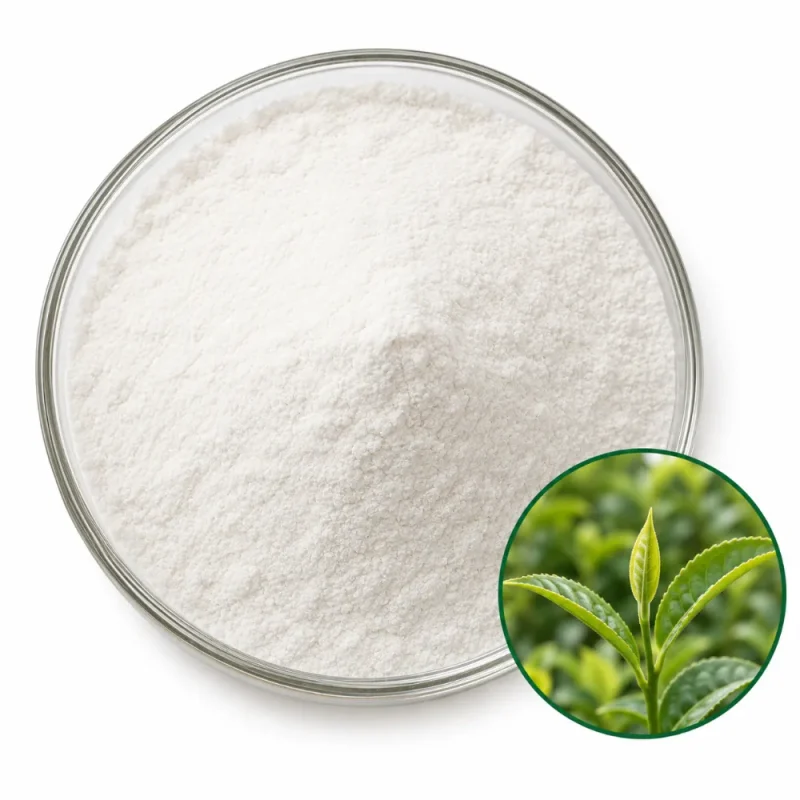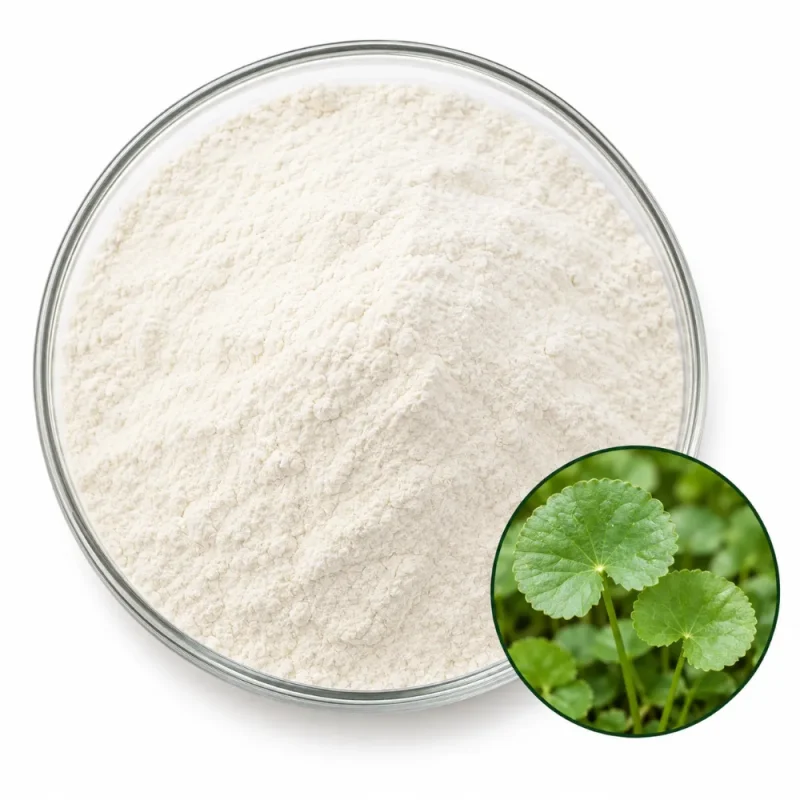
Asiatic Acid 98%

The sugar-free triterpenoid of the centella saponins, asiatic acid is isolated here from the aerial parts of Centella asiatica by ethanol extraction and purification. It is an ursane-type pentacyclic triterpene with a carboxylic acid and four hydroxyl groups, and it is a white powder that does not dissolve in water.

The primary grade is 98% asiatic acid by HPLC, with a 95% grade also supplied, in Food / Dietary Supplement Grade. The aerial parts are the source, the root is not used, and the compound name together with the plant part is the identity of this product.

Asiatic Acid Chemical Identity

Asiatic acid has the molecular formula C30H48O5 and a molecular weight of 488.7. The skeleton is the five-ring ursane system, with a double bond between C12 and C13, a carboxylic acid at C28, and hydroxyl groups at C2, C3 and C23. The hydroxyl at C23 is a primary alcohol on one of the angular methyl groups, and it distinguishes asiatic acid from the simpler ursolic acid, which has only the hydroxyl at C3. The several hydroxyls add polarity, yet the carbon skeleton is large and rigid enough that the molecule stays insoluble in water.

In the plant, asiatic acid is the aglycone of asiaticoside, a saponin that carries a trisaccharide chain on the carboxyl group. Madecassic acid, which has an extra hydroxyl at C6, is the aglycone of madecassoside, and the two acids are the pair that centella chemistry revolves around. The natural source is the aerial parts of Centella asiatica (L.) Urb., known as gotu kola, a plant of the family Apiaceae. Related products are the Gotu Kola / Centella asiatica Extract 8% total triterpenes, the 10:1 Centella Extract Powder and the milled Gotu Kola (Centella) Powder. The extracts are defined by a combined triterpene content, and asiatic acid here is one purified compound.

The Indian name brahmi is used for centella in some regions and for an unrelated plant in others, so a specification should always give the botanical name next to the common name.

Typical Specifications

Specification ItemProduct Information
Natural SourceCentella asiatica aerial parts
Plant PartLeaf & Herb
ProcessingEthanol Extraction & Purification
Compound ClassTriterpenoids, Terpenoids
Chemical Name (IUPAC)(1S,2R,4aS,6aR,6aS,6bR,8aR,9R,10R,11R,12aR,14bS)-10,11-dihydroxy-9-(hydroxymethyl)-1,2,6a,6b,9,12a-hexamethyl-2,3,4,5,6,6a,7,8,8a,10,11,12,13,14b-tetradecahydro-1H-picene-4a-carboxylic acid
CAS Number464-92-6
Molecular FormulaC30H48O5
Molecular Weight488.7
PubChem CID119034
InChIKeyJXSVIVRDWWRQRT-UYDOISQJSA-N
SMILESCC1CCC2(CCC3(C(=CCC4C3(CCC5C4(CC(C(C5(C)CO)O)O)C)C)C2C1C)C)C(=O)O
Purity98% (HPLC)
Available Grades95% · 98% (HPLC)
GradeFood / Dietary Supplement Grade
AppearanceWhite powder
Solubility / DispersibilityInsoluble in Water
Quality Parameters
Moisture (LOD)≤5.0%
Total Ash≤5.0%
Heavy MetalsLead ≤2 ppm · Arsenic ≤1 ppm · Cadmium ≤1 ppm · Mercury ≤0.1 ppm
MicrobiologyTPC ≤1,000 cfu/g · Yeast & Mold ≤100 cfu/g · E. coli Negative · Salmonella Negative/25 g
Shelf Life24 months in unopened original packaging, cool and dry storage

Asiatic Acid Purity Grades & Impurities

GradeAssay & MethodWhere It Fits
95% Asiatic AcidHPLCOil dispersions and premixes
98% Asiatic AcidHPLCCapsules and reference-grade blends

Triterpenoid acids absorb only weakly in the ultraviolet range, so the HPLC assay is read at a short wavelength near 205 nm, where the carboxyl group and the isolated double bond respond. Many compounds also absorb there, which makes baseline quality and a well-resolved column essential. The percentage compares the main peak with the other detected peaks, and it leaves out water, ash and anything without a response.

The related substances are the other triterpenoids of the herb. Madecassic acid is the closest, and it differs by one hydroxyl, so it elutes slightly earlier and has to be resolved from the main peak. Terminolic acid, an isomeric hydroxylated ursane acid, is a structural neighbor, and the glycosides asiaticoside and madecassoside elute much earlier, so their presence signals incomplete hydrolysis. Ursolic acid and betulinic acid, common triterpenoids of other plants, are not expected from centella.

Hydrolysis conditions shape the impurity profile. Alkaline cleavage of the ester-linked sugar chain is the usual route to the free acid, and it can leave residual glycoside if the reaction is incomplete, while harsh acid can dehydrate hydroxyl groups. The 95% and 98% grades differ in the share of madecassic acid and glycoside. A white powder is the sign of a clean lot, and a cream or tan tone points to residual plant pigment. Moisture and ash are limited separately, and storage is sealed and dry.

Asiatic Acid Solubility & Delivery

Asiatic acid is insoluble in water and dissolves in ethanol, methanol, pyridine and dimethyl sulfoxide. It is a large, rigid, hydrophobic molecule with a high logP, in spite of its four oxygen-bearing groups, and it favors lipid and surfactant phases. The carboxylic acid gives salts with alkali, and such salts dissolve in water, but they are different chemical forms from the free acid supplied here.

Delivery of asiatic acid therefore depends on dispersion and particle engineering. Literature approaches include fine milling, wetting agents, oil suspensions, lipid carriers, cyclodextrin complexes and amorphous solid dispersions. In liquid bases, a suspending agent holds the solid, and a pH below the pKa keeps the molecule un-ionized. Dry blends hold the powder without moisture problems. Static complicates the weighing of small amounts, and grounded tools with a two-stage dry-carrier premix keep results uniform. Heating in strong acid is avoided, since it dehydrates the hydroxyls.

Application Areas

Oil-Based Softgel Suspensions

Softgels carry the milled acid dispersed in oil with an emulsifier. Settling is checked in the tank before encapsulation, since the crystals are denser than the oil, and the stirred fill keeps the dose uniform from the first unit to the last.

Capsule Fills of the Triterpenoid Acid

Capsules take asiatic acid at small weight. The white powder is electrostatic and cohesive, so a flow agent, anti-static scoops and a sieved premix give an even fill weight, and a dry room limits caking.

Tablet Blends With Wetting Agents

Tablets of asiatic acid combine a dry binder, a lubricant and a wetting agent. A disintegration and dissolution trial on the full blend, repeated after a month, confirms that the hydrophobic solid is released at the intended rate.

Aglycone and Saponin Comparison Blends

Formulators comparing centella forms blend asiatic acid with the saponin extract in fixed ratios. Each ingredient is weighed on its own, and an HPLC trace of the blend confirms that the ratios have not shifted.

Triterpenoid Reference Panels

Analytical teams use the 98% grade to confirm that a column separates asiatic acid from madecassic acid. The standard is stored dry, a retained sample is kept per lot, and the retention order is filed with the batch record.

Packaging & Commercial Supply

Essencefield supports product evaluation, formulation trials, commercial orders, and ongoing ingredient supply. Packaging, storage, and shipping arrangements are determined by product characteristics, order quantity, stability requirements, and destination-market needs.

Supply ItemGeneral Information
SampleAvailable upon request for formulation, testing, and supplier evaluation
Order Quantities100 g · 1 kg · 5 kg · 25 kg · 100 kg · 500 kg · Bulk
Sample Lead TimeTypically 5–7 days after sample confirmation
Production Lead TimeTypically 15–30 days after order and specification confirmation
PackagingSuitable protective inner packaging with bags, cartons, drums, or other appropriate outer packaging
StorageStore in tightly sealed, suitable protective packaging in a cool, dry environment. Protect from moisture, heat, and direct sunlight. Specific storage conditions follow the approved product specification.
DocumentationCOA · Product Specification · TDS · SDS · Applicable declarations (as applicable)

Final order quantities, lead times, packaging, documentation, and shipping arrangements are confirmed according to the selected product and commercial requirements.

Request Ingredient Specifications & Quote

Share your target specification, application, quantity, and documentation needs. We’ll help confirm suitable options, samples, and commercial supply details.