20(S)-Protopanaxatriol 98%

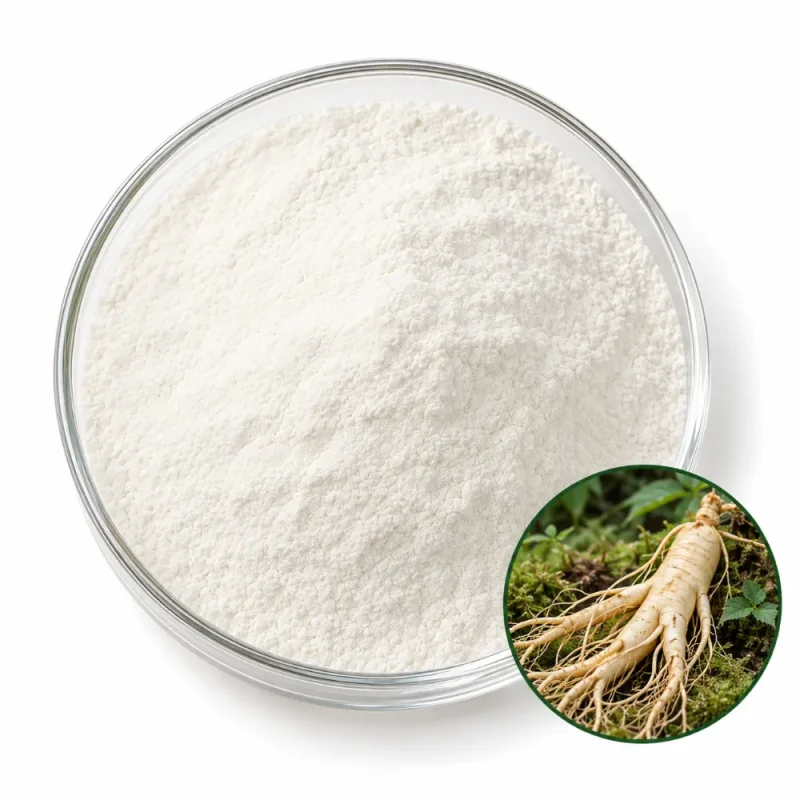
Carrying one hydroxyl more than its diol counterpart, 20-protopanaxatriol in its 20(S) form is prepared here from the root of Panax ginseng by ethanol extraction and purification. It is the aglycone of the triol-type ginsenosides, including Rg1, Re and Rf, and it is a white dammarane triterpene with four hydroxyl groups.

The primary grade is 98% 20(S)-protopanaxatriol by HPLC, with a 95% grade also supplied, in Food / Dietary Supplement Grade. The white powder is insoluble in water. The triol and the diol are separate compounds with separate identifiers, and the extra oxygen is their defining difference.

20(S)-Protopanaxatriol Chemical Identity

20-Protopanaxatriol has the molecular formula C30H52O4 and the molecular weight 476.7, one oxygen atom more than protopanaxadiol. The skeleton is the same four-ring dammarane system, and the hydroxyl groups sit at positions 3, 6 and 12 on the rings, with a fourth, tertiary hydroxyl at C20 on the side chain. The hydroxyl at C6 is the one that distinguishes the triol from the diol, and it is the position where the sugar chain is attached in ginsenosides such as Rg1 and Re. The S configuration at C20 is the natural one, and the R epimer is a separate compound.

The natural source is the root of Panax ginseng C.A.Mey. 20-Protopanaxatriol does not exist in the root as such. It is released by hydrolysis of the saponins, and the choice of method matters, because the C6 and C20 hydroxyls make the triol more prone to rearrangement under harsh acid than the diol. Other ginseng materials are Ginseng Extract 10–80% Ginsenosides, the 10:1 Ginseng Extract Powder and the Red Ginseng Extract Powder. The diol counterpart is supplied as 20(S)-Protopanaxadiol 98%.

Because ginsenoside nomenclature is dense, the aglycone family can look confusing in a catalog. A buyer is best served by checking the formula, the CAS number and the number of hydroxyl groups in the name against the data in the table.

Typical Specifications

Specification ItemProduct Information
Natural SourcePanax ginseng root
Plant PartRoot & Rhizome
ProcessingEthanol Extraction & Purification
Compound ClassTerpenoids
Chemical Name (IUPAC)(3S,5R,6S,8R,9R,10R,12R,13R,14R,17S)-17-[(2S)-2-hydroxy-6-methylhept-5-en-2-yl]-4,4,8,10,14-pentamethyl-2,3,5,6,7,9,11,12,13,15,16,17-dodecahydro-1H-cyclopenta[a]phenanthrene-3,6,12-triol
CAS Number34080-08-5
Molecular FormulaC30H52O4
Molecular Weight476.7
PubChem CID11468733
InChIKeySHCBCKBYTHZQGZ-CJPZEJHVSA-N
SMILESCC(=CCCC(C)(C1CCC2(C1C(CC3C2(CC(C4C3(CCC(C4(C)C)O)C)O)C)O)C)O)C
Purity98% (HPLC)
Available Grades95% · 98% (HPLC)
GradeFood / Dietary Supplement Grade
AppearanceWhite powder
Solubility / DispersibilityInsoluble in Water
Quality Parameters
Moisture (LOD)≤5.0%
Total Ash≤5.0%
Heavy MetalsLead ≤2 ppm · Arsenic ≤1 ppm · Cadmium ≤1 ppm · Mercury ≤0.1 ppm
MicrobiologyTPC ≤1,000 cfu/g · Yeast & Mold ≤100 cfu/g · E. coli Negative · Salmonella Negative/25 g
Shelf Life24 months in unopened original packaging, cool and dry storage

20(S)-Protopanaxatriol Purity Grades & Impurities

GradeAssay & MethodWhere It Fits
95% 20(S)-ProtopanaxatriolHPLCOil-based fills and premixes
98% 20(S)-ProtopanaxatriolHPLCReference-grade and complex systems

An HPLC purity for a dammarane triterpene is measured at a short wavelength or with a detector that does not depend on a chromophore, because the molecule has no conjugated system. The percentage compares the 20-protopanaxatriol peak with the other detected peaks, and it leaves out water, ash and anything without a response, so the moisture and ash limits in the table are needed beside it.

The principal related substances of 20-protopanaxatriol are the diol aglycone, which is the other half of the ginsenoside family, and the epimer at C20. Protopanaxadiol is less polar and elutes later, and the 20(R) form elutes close to the 20(S) form, so a method that resolves both is part of an identity check. Panaxatriol, the cyclized artifact formed when acid closes the side chain, is the characteristic impurity of a harshly prepared lot and is separated by its different retention.

Partly deglycosylated ginsenosides, such as ginsenoside F1 and Rh1, are the other class of related substances, and they indicate incomplete conversion. Because they carry a sugar, they are more polar and appear as early peaks. The difference between the 95% and 98% grades is the share of such intermediates, epimer and artifacts. A white powder is the sign of a clean lot, and a cream or tan tint suggests root pigment or oxidation.

20(S)-Protopanaxatriol Solubility & Delivery

20-Protopanaxatriol is insoluble in water and dissolves in ethanol, methanol, acetone and ethyl acetate. The extra hydroxyl makes it somewhat more polar than the diol, yet the rigid ring system and the lipophilic side chain keep the molecule strongly hydrophobic, and it does not foam or dissolve in water as the sugar-bearing saponins do.

Delivery of 20-protopanaxatriol is a matter of dispersion. Fine milling, wetting agents, oil suspensions, lipid carriers and cyclodextrin or phospholipid complexes are the approaches in the literature. The triol is somewhat more soluble in polar organic solvents than the diol, which helps when a complex is built in an ethanol-water step. Liquid bases need a suspending agent to hold the solid. In dry blends the powder is stable and not hygroscopic. Static makes small weights awkward, and anti-static tools plus a two-stage premix with a dry carrier give uniform results. Strong acid and prolonged heat are avoided in solution because they rearrange the side chain.

Weighing is the practical difficulty at small inclusion. The fine, dry 20-protopanaxatriol builds a static charge and clings to spatulas, weighing boats and the walls of the blender. Grounded equipment, a humidity-controlled room and a stepwise dilution in a dry carrier reduce losses, and the weight of each premix step is recorded so that the dose of the aglycone can be reconstructed from the batch record when a lot is audited.

Application Areas

Capsule Fills of the Triol Aglycone

Capsules take 20-protopanaxatriol at small weight with a flow agent. The fine powder is electrostatic and slightly cohesive, so anti-static tools and a sieved premix give an even fill weight, and the lot record carries the triol designation.

Oil Suspensions in Softgels

Softgels disperse milled 20-protopanaxatriol in oil with an emulsifier. The crystals are denser than the oil, so settling is checked in the tank before encapsulation and the fill is kept stirred until the last unit is closed.

Ethanol-Water Complex Systems

Complexes with cyclodextrin or phospholipid raise the dispersion of the insoluble solid. The more polar 20-protopanaxatriol dissolves in warm ethanol-water more readily than the diol, so the complex is built in that step, dried and milled, and a retained sample is kept per lot.

Diol and Triol Comparison Blends

Formulators comparing the two aglycone families blend 20-protopanaxatriol with the diol in fixed ratios. Each ingredient is weighed on its own, and the HPLC trace of the blend, run on a column that resolves the pair, confirms that the ratio has not shifted.

Wetting-Agent Tablets for Hydrophobic Solids

Tablets press 20-protopanaxatriol with a dry binder, a lubricant and a wetting agent. A disintegration and dissolution trial on the full blend, repeated after storage, confirms that the hydrophobic solid releases at the intended rate.

Packaging & Commercial Supply

Essencefield supports product evaluation, formulation trials, commercial orders, and ongoing ingredient supply. Packaging, storage, and shipping arrangements are determined by product characteristics, order quantity, stability requirements, and destination-market needs.

Supply ItemGeneral Information
SampleAvailable upon request for formulation, testing, and supplier evaluation
Order Quantities100 g · 1 kg · 5 kg · 25 kg · 100 kg · 500 kg · Bulk
Sample Lead TimeTypically 5–7 days after sample confirmation
Production Lead TimeTypically 15–30 days after order and specification confirmation
PackagingSuitable protective inner packaging with bags, cartons, drums, or other appropriate outer packaging
StorageStore in tightly sealed, suitable protective packaging in a cool, dry environment. Protect from moisture, heat, and direct sunlight. Specific storage conditions follow the approved product specification.
DocumentationCOA · Product Specification · TDS · SDS · Applicable declarations (as applicable)

Final order quantities, lead times, packaging, documentation, and shipping arrangements are confirmed according to the selected product and commercial requirements.

Request Ingredient Specifications & Quote

Share your target specification, application, quantity, and documentation needs. We’ll help confirm suitable options, samples, and commercial supply details.