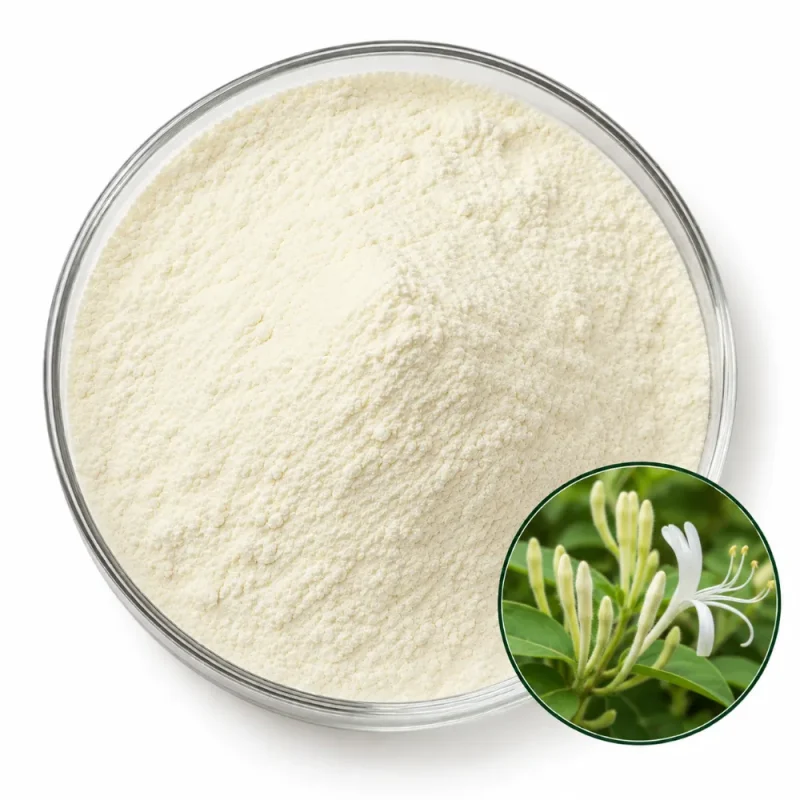
4,5-Dicaffeoylquinic Acid 98%

With caffeic acid esters on the two last hydroxyls of the quinic ring, 4,5-dicaffeoylquinic acid is isolated here from the flower of Lonicera japonica by ethanol extraction and purification. It is the isomer known in Chinese literature as isochlorogenic acid C, and it is a water soluble, off-white powder.

The primary grade is 98% 4,5-dicaffeoylquinic acid by HPLC, in Food / Dietary Supplement Grade. Five positional isomers share one formula, so the locants 4,5 are the identity of this product, confirmed by the retention time and the spectra of the main peak.

4,5-Dicaffeoylquinic Acid Chemical Identity

4,5-Dicaffeoylquinic acid has the molecular formula C25H24O12 and the molecular weight 516.4, and the CAS number is 57378-72-0. The quinic acid core carries its caffeoyl groups on the adjacent positions 4 and 5, which leaves the hydroxyls at C1 and C3 free. The two catechol rings lie next to each other on one edge of the cyclohexane ring, and that crowding shapes the way the molecule moves on a column and the way the esters migrate between positions.

In the older Chinese naming, 4,5-dicaffeoylquinic acid is isochlorogenic acid C, with the 3,5 isomer as A and the 3,4 isomer as B. Western papers use the locants, and some databases list the same compound under more than one set of numbers, so the name given here is the one a buyer should match against a reference standard. The natural source is the flower of Lonicera japonica Thunb., where chlorogenic acid dominates and the dicaffeoyl isomers are the minor but characteristic members of the family. The flower is further available as Honeysuckle Extract 5–25% Chlorogenic Acid, the 10:1 Honeysuckle Flower Extract Powder and the milled Honeysuckle Flower Powder. Those materials carry different markers, while this product is a single isomer. When two suppliers quote the same locants but give different CAS numbers, the retention time against the reference standard decides the question, and the standard should be bought with its own certificate.

Typical Specifications

Specification ItemProduct Information
Natural SourceLonicera japonica flower
Plant PartFlower
ProcessingEthanol Extraction & Purification
Compound ClassPolyphenols
CAS Number57378-72-0
Molecular FormulaC25H24O12
Molecular Weight516.4
Purity98% (HPLC)
GradeFood / Dietary Supplement Grade
AppearanceOff-White powder
Solubility / DispersibilityWater Soluble
Quality Parameters
Moisture (LOD)≤5.0%
Total Ash≤5.0%
Heavy MetalsLead ≤2 ppm · Arsenic ≤1 ppm · Cadmium ≤1 ppm · Mercury ≤0.1 ppm
MicrobiologyTPC ≤1,000 cfu/g · Yeast & Mold ≤100 cfu/g · E. coli Negative · Salmonella Negative/25 g
Shelf Life24 months in unopened original packaging, cool and dry storage

4,5-Dicaffeoylquinic Acid Purity Grades & Impurities

An HPLC assay near 325 nm compares the 4,5-dicaffeoylquinic acid peak with the other detected peaks, and the percentage does not cover water, ash or components without a response. The moisture and ash limits in the table therefore sit beside it, and one grade is offered for this isomer.

On a reversed-phase column 4,5-dicaffeoylquinic acid is usually the last of the three adjacent-position dicaffeoyl compounds to elute, so it is the end of a cluster whose neighbors are the 3,5 and 3,4 forms. The 1,3 and 1,5 isomers fall in other places in the run. A method that gives a clean gap between the 3,5 and 4,5 peaks is the evidence that the lot is the 4,5 isomer and not a mixture. The report should list the neighbors by name and by retention time.

The related substances include the products of acyl migration. In warm, neutral or mildly alkaline solution one caffeoyl group moves to the C3 hydroxyl and 4,5-dicaffeoylquinic acid converts toward the 3,5 and 3,4 forms, so the three share a dynamic equilibrium that favors whichever is more stable under the conditions. Hydrolysis frees caffeic acid and the monocaffeoylquinic acids. A lot stored damp or in the light will show both, and the main peak falls.

The powder should be off-white. A tan tone suggests oxidation of the catechol rings or flower pigment, and the color change can precede a visible drop in the HPLC peak. Samples for analysis are prepared fresh in a mildly acidic solvent and read promptly, and the autosampler is kept cool so that 4,5-dicaffeoylquinic acid does not convert while the queue runs.

4,5-Dicaffeoylquinic Acid Solubility & Delivery

4,5-Dicaffeoylquinic acid dissolves in water, in aqueous ethanol and in methanol, and nonpolar solvents leave it undissolved. A polar surface of free carboxyl and hydroxyl groups gives a slightly acidic, pale yellow solution. Warm water dissolves it faster, and a rising pH helps solubility while shortening its life.

Formulators therefore treat 4,5-dicaffeoylquinic acid as a water-phase ingredient that needs protection. Bases are held mildly acidic, thermal steps are short, and a chelating agent is included where mineral water or iron-bearing ingredients are used. The powder takes up moisture, so a closed container and a desiccant keep it free flowing, and weighing is easier from a premix with a dry carrier. Light drives the trans-to-cis change of the caffeoyl double bonds, so amber glass is used for solutions and for stored powder.

Application Areas

Cool-Filled Clear Concentrates

4,5-Dicaffeoylquinic acid gives a clear concentrate in water. Fill cool, keep the pH low, use deionized water, and run a one-week color check against a control, since heat and metal ions darken the solution through oxidation and migration.

Desiccated Capsule Fills

Capsules take 4,5-dicaffeoylquinic acid at low inclusion. A dry filling room, a flow agent and a desiccant in the bottle keep the hygroscopic powder from caking, so the fill weight stays steady across the shelf life.

Acid-Buffered Stick Premixes

Sticks carry 4,5-dicaffeoylquinic acid in a dry premix with a sweetener and a buffering fruit acid. The astringent edge of the ester is covered by fruit flavors, and sieving the premix removes the lumps that form when the powder meets moist air.

Honeysuckle Isomer Blends

Blends with the 3,4 and 3,5 isomers reconstruct the dicaffeoyl pattern of the flower. Each isomer is weighed on its own and premixed in steps, and an HPLC trace of the blend confirms that the migration equilibrium has not shifted the ratio.

Late-Eluting Reference Standard

Analytical teams use the 98% 4,5-dicaffeoylquinic acid grade to anchor the late end of the dicaffeoyl cluster when they tune a gradient. The standard is stored dry and cold, and a retained sample from each lot preserves the record of retention time.

Packaging & Commercial Supply

Essencefield supports product evaluation, formulation trials, commercial orders, and ongoing ingredient supply. Packaging, storage, and shipping arrangements are determined by product characteristics, order quantity, stability requirements, and destination-market needs.

Supply ItemGeneral Information
SampleAvailable upon request for formulation, testing, and supplier evaluation
Order Quantities100 g · 1 kg · 5 kg · 25 kg · 100 kg · 500 kg · Bulk
Sample Lead TimeTypically 5–7 days after sample confirmation
Production Lead TimeTypically 15–30 days after order and specification confirmation
PackagingSuitable protective inner packaging with bags, cartons, drums, or other appropriate outer packaging
StorageStore in tightly sealed, suitable protective packaging in a cool, dry environment. Protect from moisture, heat, and direct sunlight. Specific storage conditions follow the approved product specification.
DocumentationCOA · Product Specification · TDS · SDS · Applicable declarations (as applicable)

Final order quantities, lead times, packaging, documentation, and shipping arrangements are confirmed according to the selected product and commercial requirements.

Request Ingredient Specifications & Quote

Share your target specification, application, quantity, and documentation needs. We’ll help confirm suitable options, samples, and commercial supply details.