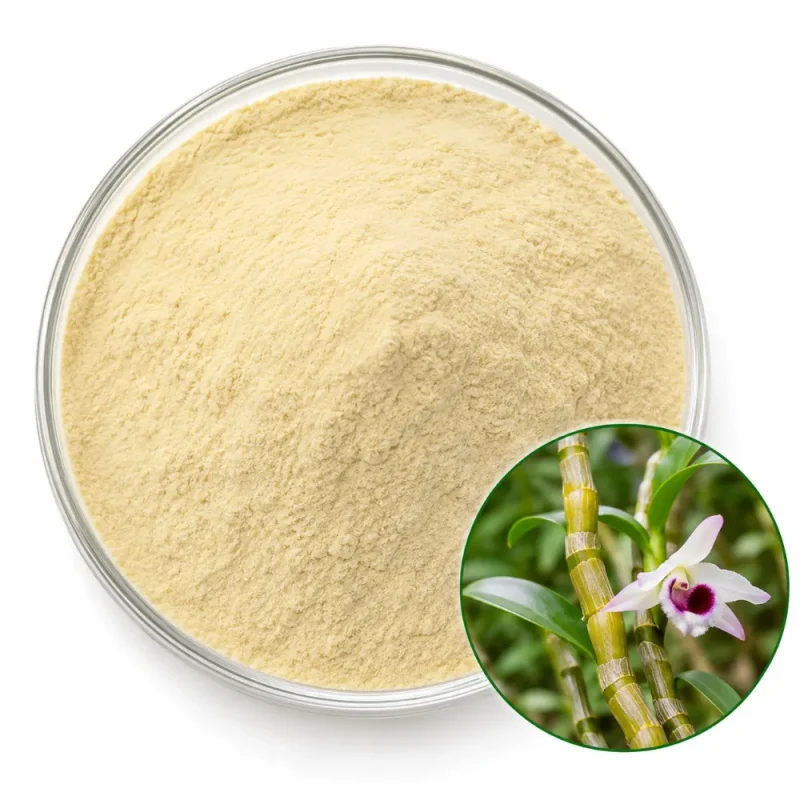
Dendrobium Nobile Polysaccharide Powder

From the dried stem of the orchid Dendrobium nobile Lindl., hot-water extraction and ethanol precipitation isolate a polysaccharide fraction that is dried and milled into this Dendrobium nobile polysaccharide powder. The light yellow powder dissolves in water and leaves behind the alkaloids and fiber of the whole stem.

Polysaccharide content is ≥30% by UV-Vis (phenol–sulfuric, as glucose), moisture and total ash are each ≤5.0%, and particle size is 80 mesh. It is supplied for supplements, drinks and functional foods, with the percentage stated beside its method.

Dendrobium Nobile Polysaccharide Identity

The source is the stem of Dendrobium nobile Lindl., a large epiphytic orchid of the family Orchidaceae with swollen, jointed canes. The stem is the only plant part used here. Flowers, roots and leaves are not part of the material. Many buyers associate the name dendrobium with Dendrobium officinale, the species marketed as tiepi shihu, which is a different plant with a different stem composition, and with Dendrobium huoshanense, another distinct species.

Dendrobium stems store a mucilaginous carbohydrate. The polysaccharide of Dendrobium nobile is described as a glucomannan-type heteropolysaccharide with a mannose and glucose backbone that carries acetyl groups, which is why the stem feels slippery when cut or chewed. Hot-water extraction brings the mucilage into solution, and ethanol precipitation then keeps the large polymers while small sugars remain in the supernatant.

The stem also holds the alkaloid dendrobine, which gives Dendrobium nobile its best-known marker. Dendrobine is a small molecule that stays in the ethanol supernatant, so it does not concentrate in this fraction. A buyer who wants the alkaloid should look at an alkaloid-standardized extract, and a buyer who wants the mucilage should look at this polysaccharide powder.

Cultivation of Dendrobium takes years, and stems of different age differ in mucilage content. Age and origin are not specified for this product.
Polysaccharide Content & Test Method

For Dendrobium nobile polysaccharide, UV-Vis means the phenol–sulfuric reading of total carbohydrate. Hot acid frees mannose and glucose from the glucomannan, the reaction product absorbs light, and the result is expressed as glucose equivalents. The figure counts the polysaccharide and any free sugar that remains in the powder.

Glucomannans make a specific complication. Mannose gives a lower color yield than glucose in the phenol–sulfuric assay, so a mannose-rich polymer can read slightly low when the reference is glucose. The result is acceptable for lot-to-lot control of one process but it is not a mass of glucomannan, and it should not be compared with the percentage on a konjac or bletilla powder from a different method.

Acetyl groups on the polymer do not react in the assay. A fraction that has lost its acetyl groups through harsh extraction can read the same by UV-Vis yet behave differently in solution, with lower solubility and a stronger tendency to gel. The test method therefore says nothing about acetylation.

Gravimetric ethanol-precipitate weights would include protein and other co-precipitated matter, and enzymatic β-glucan assays do not apply. In Dendrobium nobile work, compare the figure only with other UV-Vis results that use glucose as the reference.

Typical Specifications

Specification ItemProduct Information
Latin NameDendrobium nobile
Plant PartBark & Stem
ProcessingWater Extraction & Purification
Common NameDendrobium (noble dendrobium)
Ingredient TypePolysaccharide Extract
Polysaccharide TypeGlucomannan-type heteropolysaccharides
ContentPolysaccharides ≥30% (UV-Vis, as glucose)
AppearanceLight Yellow powder
Solubility / DispersibilityWater Soluble
Quality Parameters
Moisture≤5.0% (LOD)
Total Ash≤5.0%
Particle Size80 mesh
Heavy MetalsLead ≤2 ppm · Arsenic ≤1 ppm · Cadmium ≤1 ppm · Mercury ≤0.1 ppm
MicrobiologyTPC ≤1,000 cfu/g · Yeast & Mold ≤100 cfu/g · E. coli Negative · Salmonella Negative/25 g
Shelf Life24 months in unopened original packaging, cool and dry storage

Dendrobium Nobile Polysaccharide Solution Behavior

The powder dissolves in cold or warm water into a pale yellow, clear to slightly hazy solution. Dendrobium nobile polysaccharide forms a smooth, slightly slippery liquid, and viscosity rises with concentration more strongly than for a branched fruit polysaccharide because the glucomannan backbone is more linear. Warm water shortens dissolution, and sifting the powder into a stirred vortex prevents the lumps that form when it is dumped in.

Acetylated glucomannan stays soluble through ordinary pasteurization and in the mildly acidic to neutral range of drinks. Strong alkali removes the acetyl groups and can lead to gelation or precipitation, and prolonged boiling at low pH thins the solution by cleaving the backbone. A drink containing Dendrobium nobile polysaccharide is therefore best held near neutral pH or mild acidity.

Protein carried through the precipitation can interact with polyphenols from tea or fruit bases and cloud the liquid, so a trial in the final matrix precedes scale-up. Heating with amino compounds causes Maillard browning, and the pale yellow tone deepens toward amber with long hot holding.

The aroma is faint, slightly sweet and earthy. For Dendrobium nobile, the dry powder is hygroscopic and cakes in open air. This grade is released without a stated viscosity.

Trial work with Dendrobium nobile polysaccharide should include a rest period after dissolving, because entrained air leaves the slightly slippery liquid slowly and can show as foam at filling. A short hold, followed by a pass through a fine screen, gives a clean pour, and Dendrobium nobile polysaccharide solutions are best filled while still warm so that they flow evenly.

Application Areas

Tea-Style Drink Powders and Sticks

Dendrobium nobile polysaccharide dissolves into a pale solution and suits tea-style drink powders and stick packs. A slight slipperiness in the mouth is part of its character, and hot holding is kept short because residual sugars encourage browning.

Capsule Fill and Tablet Blends

The purified powder fills capsules more cleanly than milled stem, which is fibrous and sticky. Tablets need dry granulation or a controlled drying endpoint, because the mucilage surface turns tacky on wetting, and disintegration is checked since the polymer swells.

Ready-to-Drink Herbal Shots

In herbal shots and small-volume concentrates, the polysaccharide adds soluble solids and gentle body. Mineral-rich waters can cloud the solution, so demineralized water is used in the batch, and viscosity is compared with a control after storage.

Herbal Soup and Congee Seasoning Mixes

Dry herbal soup and congee mixes take the powder for body and a smooth feel. It dissolves in hot liquid with stirring, and the mild flavor leaves ginger, jujube and other herbs in front of the base.

Soft Chews and Jelly Formats

Soft chews and jelly sticks tolerate moderate inclusion because the polymer dissolves into the cooking syrup. Acid is added late to hold the color, and batch pH is recorded because gelatin and pectin sets both respond to it.

Packaging & Commercial Supply

Essencefield supports product evaluation, formulation trials, commercial orders, and ongoing ingredient supply. Packaging, storage, and shipping arrangements are determined by product characteristics, order quantity, stability requirements, and destination-market needs.

Supply ItemGeneral Information
SampleAvailable upon request for formulation, testing, and supplier evaluation
Order Quantities100 g · 1 kg · 5 kg · 25 kg · 100 kg · 500 kg · Bulk
Sample Lead TimeTypically 5–7 days after sample confirmation
Production Lead TimeTypically 15–30 days after order and specification confirmation
PackagingSuitable protective inner packaging with bags, cartons, drums, or other appropriate outer packaging
StorageStore in tightly sealed, suitable protective packaging in a cool, dry environment. Protect from moisture, heat, and direct sunlight. Specific storage conditions follow the approved product specification.
DocumentationCOA · Product Specification · TDS · SDS · Applicable declarations (as applicable)

Final order quantities, lead times, packaging, documentation, and shipping arrangements are confirmed according to the selected product and commercial requirements.

Request Ingredient Specifications & Quote

Share your target specification, application, quantity, and documentation needs. We’ll help confirm suitable options, samples, and commercial supply details.