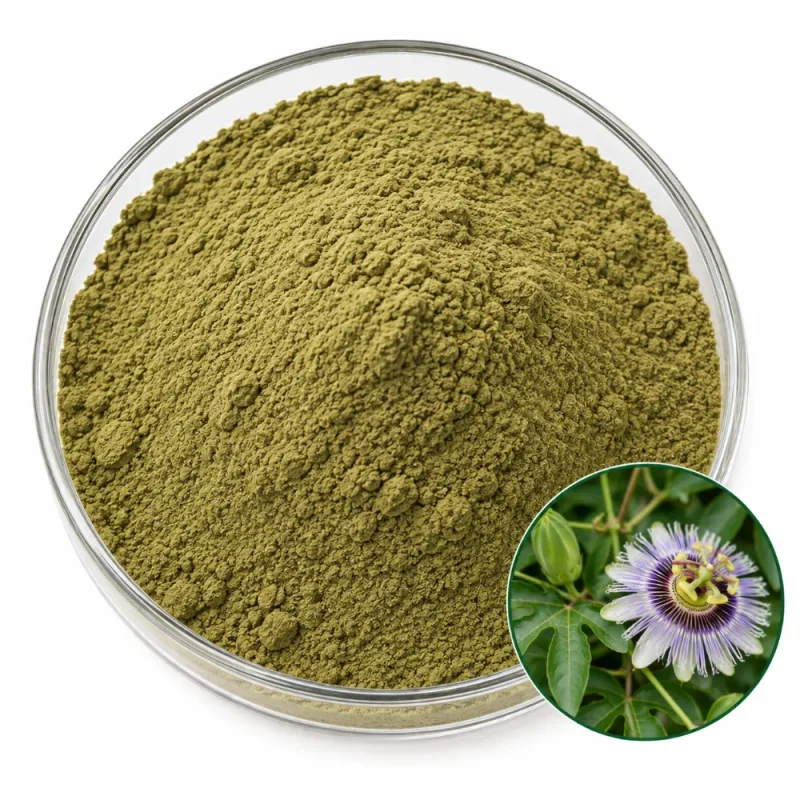
Passionflower Herb Powder

Aerial parts of Passiflora incarnata, the purple passionflower or maypop, are dried and milled into a light green powder that blends leaf, stem and flower material. The herb is used and the fruit is not, so the powder reflects the foliage and the climbing vine rather than passion fruit.

Passionflower herb powder is supplied at 80 mesh, with 40, 60 and 100 mesh optional, and has a mild, hay-like herbal odor with a faintly bitter, green taste. It is raw milled herb rather than an extract, so inclusion rates are higher and the leaf character is stronger than in the extract forms.

Passiflora incarnata Raw Material & Plant Part

The botanical name is Passiflora incarnata L., family Passifloraceae, known as purple passionflower, maypop or wild passion vine. The raw material is the dried aerial part of the plant, meaning the leaf, the slender stem and the flower, cut during the growing season, dried and milled. Roots and fruit are not included.

Several passion vines share the common name. Passiflora edulis is the passion fruit vine, grown for its fruit, and Passiflora caerulea, the blue passionflower, is an ornamental species. They are different plants, and leaf powders from them are not interchangeable with P. incarnata, which is why the full species name belongs in the specification.

The herb is characterized by C-glycosyl flavones, among them vitexin, isovitexin, orientin and isoorientin. These compounds are bound to a sugar through a carbon bond, which makes them stable against acids and heat compared with common flavonoid glycosides. They are given here as traits of the plant and not as levels for the powder.

Cutting and drying matter for passionflower herb. The vine is cut above the ground during flowering or just after, and the herb is dried quickly in thin layers. The leaves are three-lobed, with small glands at the leaf base, a detail that helps tell P. incarnata from look-alike vines when cut passionflower is inspected.

Passionflower Herb Powder vs Extract

FormWhat It IsChoose It When
Passionflower Herb PowderMilled dried aerial parts with their fiberWhole-herb inclusion in teas and dry blends
Passionflower Extract PowderWater-extracted herb with the fiber removedA soluble format at a lower inclusion rate
Passionflower Extract 4% Total Flavonoids as VitexinHerb extract standardized to total flavonoidsA defined flavonoid content is required
Isoorientin 98%Single flavone reference gradeAn isolated compound is needed

The herb powder keeps the leaf, stem and flower fiber together with all constituents at their natural, lower concentration. Inclusion rates are therefore higher than for an extract, and the powder only disperses in liquids, leaving green fibers in the cup.

The extract powder dissolves more easily and is lighter in smell, and the standardized extract is chosen for its defined flavonoid content. Isoorientin is a single compound and a different kind of ingredient altogether. Choose the herb powder when the aerial parts as a whole are the material of the specification.

For a buyer, passionflower herb powder is the form for tea-style and capsule products in which the green, fibrous herb itself is the point. Passionflower extract powder gives a darker, soluble liquid with less bulk, and the passionflower flavonoid markers matter only for the standardized grade. The fibers of the milled herb stay visible in water.

Typical Specifications

Specification ItemProduct Information
Latin NamePassiflora incarnata
Plant PartLeaf & Herb
ProcessingMilled
Common NamePassionflower, purple passionflower, maypop
Raw MaterialDried aerial parts
Ingredient TypeMilled Powder
AppearanceLight Green powder (natural color of the dried material)
Odor & TasteMild hay-like herbal odor; faintly bitter, green taste
Solubility / DispersibilityWater Dispersible
Quality Parameters
Moisture (LOD)≤8.0%
Particle Size80 mesh (40 / 60 / 100 mesh optional)
Heavy MetalsLead ≤2 ppm · Arsenic ≤1 ppm · Cadmium ≤1 ppm · Mercury ≤0.1 ppm
MicrobiologyTPC ≤10,000 cfu/g · Yeast & Mold ≤1,000 cfu/g · E. coli Negative · Salmonella Negative/25 g
Shelf Life24 months in unopened original packaging, cool and dry storage

Application Areas

Mild herbal infusion blends

Passionflower herb is a quiet base for infusion blends with chamomile, lemon balm and mint. Its taste is gentle, so the powder fills the body of the blend, and a 40 or 60 mesh grade keeps the fibers inside the tea bag.

Mixed-herb capsule fills

Capsules use the herb powder as a bulky, fibrous fill with a pale green color. Because the stem fraction is woody, flow is checked in the hopper, and the fill weight per shell is set by a pilot run.

Powder sticks with floral bases

Stick packs combine the powder with floral or fruit powders, since a herbal, hay-like note blends well with elderflower, apple or berry flavors. The fiber settles quickly in water, so stirring right before drinking is expected.

Dry soup and cereal blends

Dry soup, porridge and cereal mixes add the herb for a green, mild flavor and color. Heat dulls the green toward olive, so the powder goes in late in cooking. A low inclusion rate is enough for color and a mild herbal note.

Handling & Blending Notes

Aerial-part powders contain leaf, stem and flower tissue of different density, and the mix tends to separate on vibration. Blending times are kept short, and the finished premix is sampled from several points to confirm that the green leaf fraction and the woody stem fraction are distributed evenly. Fine fractions dust at open scoops, so covered transfer is helpful.

The herb takes moisture from the air and clumps in open bags. Barrier packaging, dry rooms and prompt resealing keep the powder free-flowing. A light, bright-green color points to careful drying, while a gray-brown tone points to heat or light damage, so color is a quick visual control on incoming lots.

Mesh choice follows the format. The 80 mesh grade suits capsules and dry blends, 40 and 60 mesh suit tea bags, and 100 mesh disperses more evenly in a drink. The hay-like note is easily masked by sweet or fruity partners. Opened containers are used quickly, away from light and strong odors.

Passionflower herb powder stores best in sealed, opaque packs. Light turns the green toward tan within weeks of open exposure, and humidity feeds mold on a fibrous herb, so opened packs are resealed and used within a short period. Rotation by lot date keeps older passionflower stock from lingering.

Packaging & Commercial Supply

Essencefield supports product evaluation, formulation trials, commercial orders, and ongoing ingredient supply. Packaging, storage, and shipping arrangements are determined by product characteristics, order quantity, stability requirements, and destination-market needs.

Supply ItemGeneral Information
SampleAvailable upon request for formulation, testing, and supplier evaluation
Order Quantities100 g · 1 kg · 5 kg · 25 kg · 100 kg · 500 kg · Bulk
Sample Lead TimeTypically 5–7 days after sample confirmation
Production Lead TimeTypically 15–30 days after order and specification confirmation
PackagingSuitable protective inner packaging with bags, cartons, drums, or other appropriate outer packaging
StorageStore in tightly sealed, suitable protective packaging in a cool, dry environment. Protect from moisture, heat, and direct sunlight. Specific storage conditions follow the approved product specification.
DocumentationCOA · Product Specification · TDS · SDS · Applicable declarations (as applicable)

Final order quantities, lead times, packaging, documentation, and shipping arrangements are confirmed according to the selected product and commercial requirements.

Request Ingredient Specifications & Quote

Share your target specification, application, quantity, and documentation needs. We’ll help confirm suitable options, samples, and commercial supply details.