Lutein Chemical Identity
Lutein has the molecular formula C40H56O2 and a molecular weight of 568.9. It is a dihydroxy carotenoid with two end rings, one a beta ring and one an epsilon ring, joined by a conjugated polyene chain of nine double bonds. The chain absorbs blue light and gives the orange-yellow color, and the two hydroxyls on the end rings make lutein a xanthophyll and not a carotene.
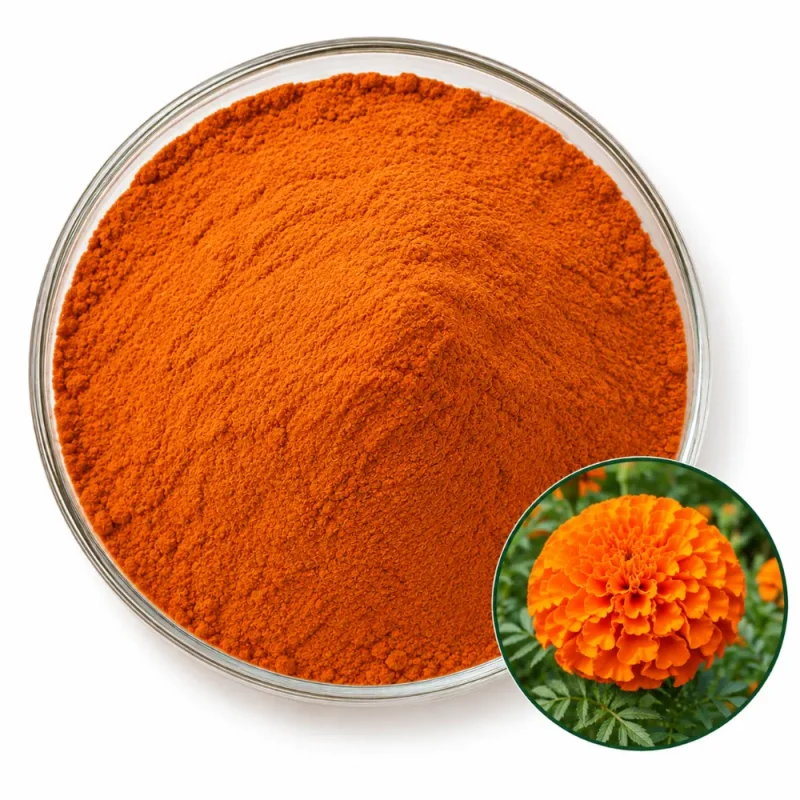
The natural source is the flower of Tagetes erecta L., the Aztec marigold, whose petals are the established commercial source of the pigment. The petals carry lutein as esters, and the free compound is obtained by hydrolysis and crystallization. Zeaxanthin is a close structural relative that differs only in the position of one double bond, and the two co-occur in the crude extract. Marigold is also supplied as Marigold Extract 10–20% Lutein, the 10:1 Marigold Extract Powder and the milled Marigold Flower Powder. Those are mixed materials, while lutein here is the crystalline pigment.
The route from flower to crystal explains several properties. Marigold petals are dried and milled, and the oleoresin is extracted with a solvent. Alkali then cleaves the fatty-acid esters, freeing the lutein, and the free pigment is crystallized and washed. Free lutein is less stable than the esterified form in the flower, because the esters protect the hydroxyl groups, which is why the crystals are packed away from air and light and are not stored as loose powder.