Beta-Sitosterol 95%

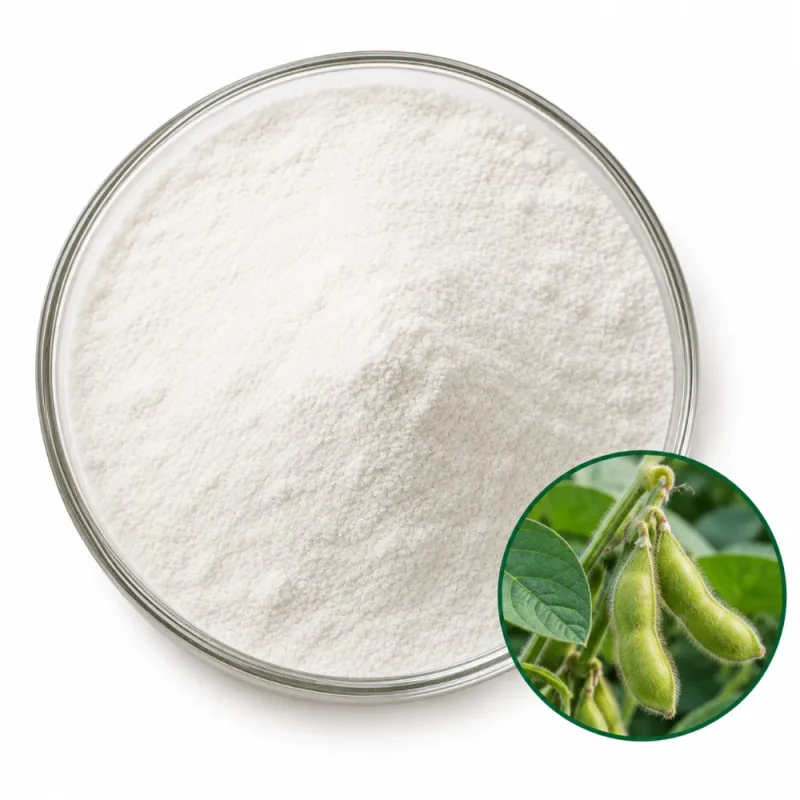
The most abundant phytosterol in the seed oils of legumes, beta-sitosterol is isolated here from the seed of Glycine max, the soybean, by ethanol extraction and purification. It is a C29 sterol with a cholesterol-like ring system and an ethyl group on the side chain, and it crystallizes as a white waxy powder.

The primary grade is 95% beta-sitosterol by GC, in Food / Dietary Supplement Grade, with a 90–95% range available. The powder is insoluble in water. It is used where the single sterol, rather than a mixed phytosterol blend, is the defined ingredient.

Beta-Sitosterol Chemical Identity

Beta-sitosterol has the molecular formula C29H50O and a molecular weight of 414.7. The molecule is built on the four-ring steroid nucleus, with one hydroxyl group at position 3, one double bond in the ring system, and a branched nine-carbon side chain. The ethyl branch on that side chain is what separates sitosterol from cholesterol, which has none, and from campesterol, which has a methyl branch at the same position.

The natural source is the seed of Glycine max (L.) Merr. Soybean is a major commercial source of phytosterols, which are concentrated in the oil fraction and in the deodorizer distillate that remains after refining. Beta-sitosterol is accompanied there by campesterol, stigmasterol and their saturated forms, and the sitosterol of a plant source is therefore always one member of a family. The soybean is also supplied as Black Soybean Extract 5–25% Anthocyanins, Soybean Extract 20–80% Isoflavones and the 10:1 Black Soybean Extract Powder, none of which is defined by sterols.

The distinction between beta-sitosterol and the wider group of plant sterols is a frequent source of confusion. Phytosterol products are usually mixtures in which sitosterol is the largest member, and the label beta-sitosterol can be applied to a material that holds a majority of it only. A buyer who needs the single compound looks for the GC share of that one peak, together with the botanical source, and not for the total of sterols. Soybean is the source named here, and sterols from other seed oils carry a slightly different companion profile.

Typical Specifications

Specification ItemProduct Information
Natural SourceGlycine max seed
Plant PartSeed & Grain
ProcessingEthanol Extraction & Purification
Compound ClassPhytosterols
Chemical Name (IUPAC)(3S,8S,9S,10R,13R,14S,17R)-17-[(2R,5R)-5-ethyl-6-methylheptan-2-yl]-10,13-dimethyl-2,3,4,7,8,9,11,12,14,15,16,17-dodecahydro-1H-cyclopenta[a]phenanthren-3-ol
CAS Number83-46-5
Molecular FormulaC29H50O
Molecular Weight414.7
PubChem CID222284
InChIKeyKZJWDPNRJALLNS-VJSFXXLFSA-N
SMILESCCC(CCC(C)C1CCC2C1(CCC3C2CC=C4C3(CCC(C4)O)C)C)C(C)C
Purity95% (GC)
Available Grades90–95% (GC)
GradeFood / Dietary Supplement Grade
AppearanceWhite powder
Solubility / DispersibilityInsoluble in Water
Quality Parameters
Moisture (LOD)≤5.0%
Total Ash≤5.0%
Heavy MetalsLead ≤2 ppm · Arsenic ≤1 ppm · Cadmium ≤1 ppm · Mercury ≤0.1 ppm
MicrobiologyTPC ≤1,000 cfu/g · Yeast & Mold ≤100 cfu/g · E. coli Negative · Salmonella Negative/25 g
Shelf Life24 months in unopened original packaging, cool and dry storage

Beta-Sitosterol Purity Grades & Impurities

A sterol is assayed by gas chromatography, not liquid chromatography, because it lacks a strong chromophore and is volatile enough after derivatization. The sample is converted to a trimethylsilyl ether, injected, and the beta-sitosterol peak is compared with the others, usually as an area share. The 95% grade is a GC result on that basis, and the 90–95% range reflects the same method applied across the supplied lots.

The principal companions are the sterols that occur beside it. Campesterol and stigmasterol are the next most abundant, and their peaks lie close to sitosterol, so column resolution is the first point to check on a chromatogram. Sitostanol, the saturated form, and delta-5-avenasterol are smaller members of the family. Because commercial products are often mixed phytosterols, the label beta-sitosterol is meaningful only when the single-compound GC share is stated.

Oxidation products of sterols, called phytosterol oxides, form when the powder is stored warm in air, and they are the main stability concern. A white, free-flowing powder is the sign of a fresh lot. Moisture and ash are limited separately in the table, and the sterol content is tied to the GC method and not to a gravimetric figure.

Crystal form is the last point on which sterol lots differ. Beta-sitosterol can crystallize as a hydrate or as the anhydrous solid, and the two melt and flow differently, although the GC assay cannot tell them apart. Because it is a waxy solid, a lot that has been stored warm cakes and loses its free-flowing behavior. A retained sample from each lot lets a formulator compare flow and melting behavior at the next order.

Beta-Sitosterol Solubility & Delivery

Beta-sitosterol is insoluble in water and only sparingly soluble in cold ethanol. It dissolves in hot ethanol, chloroform, ether and edible oils, where the solubility is limited and drops sharply on cooling. Its logP is high, so the molecule is strongly lipophilic, and the crystal is very hydrophobic and wets poorly.

The delivery question is therefore dispersion. Esterification with fatty acids raises oil solubility, and that is how sterols are often added to fat-based foods, but this product is the free sterol. Micronizing the crystals, dispersing them in oil with an emulsifier, and blending them with lecithin or other amphiphiles are the approaches described in the literature. Hot-melt methods can co-crystallize the sterol with a carrier. A dry blend should keep contact with air and heat short, since oxidation proceeds on the surface of fine powder.

Dissolving the sterol in warm oil is the most practical route for liquid fills. The oil is heated just enough to dissolve the sterol, and the solution is cooled under shear so that the crystals form small and uniform. Seeding the oil with a little fine sterol powder encourages the right crystal form. Slow, quiet cooling gives large plates that settle and make a gritty fill, so controlled agitation is a part of the process specification.

Application Areas

Softgel Oil Suspensions

Softgels carry beta-sitosterol as a milled suspension in oil with an antioxidant. The sterol settles in the fill tank, so continuous stirring and a viscosity check before encapsulation keep the dose uniform from the first shell to the last.

Capsule Fills of the Waxy Powder

Capsules take the powder at moderate inclusion. It is waxy and lumps when warm, so a cool room, a flow agent and a sieved blend keep the fill weight even, and amber bottles protect the sterol from light during storage.

Tablet Blends With Lecithin

Tablets combine the sterol with lecithin or another amphiphile to improve wetting. Pre-granulating the sterol with the amphiphile before compression avoids sticking, and a disintegration trial confirms that the hydrophobic crystal releases from the tablet.

Oil-Phase Premixes

Premixes for oil-based products dissolve the sterol in warm oil, then cool under shear to a fine dispersion. The cooling rate decides crystal size, and a quick chill gives smaller crystals and a smoother texture than slow cooling.

Packaging & Commercial Supply

Essencefield supports product evaluation, formulation trials, commercial orders, and ongoing ingredient supply. Packaging, storage, and shipping arrangements are determined by product characteristics, order quantity, stability requirements, and destination-market needs.

Supply ItemGeneral Information
SampleAvailable upon request for formulation, testing, and supplier evaluation
Order Quantities100 g · 1 kg · 5 kg · 25 kg · 100 kg · 500 kg · Bulk
Sample Lead TimeTypically 5–7 days after sample confirmation
Production Lead TimeTypically 15–30 days after order and specification confirmation
PackagingSuitable protective inner packaging with bags, cartons, drums, or other appropriate outer packaging
StorageStore in tightly sealed, suitable protective packaging in a cool, dry environment. Protect from moisture, heat, and direct sunlight. Specific storage conditions follow the approved product specification.
DocumentationCOA · Product Specification · TDS · SDS · Applicable declarations (as applicable)

Final order quantities, lead times, packaging, documentation, and shipping arrangements are confirmed according to the selected product and commercial requirements.

Request Ingredient Specifications & Quote

Share your target specification, application, quantity, and documentation needs. We’ll help confirm suitable options, samples, and commercial supply details.