Hesperidin 98%

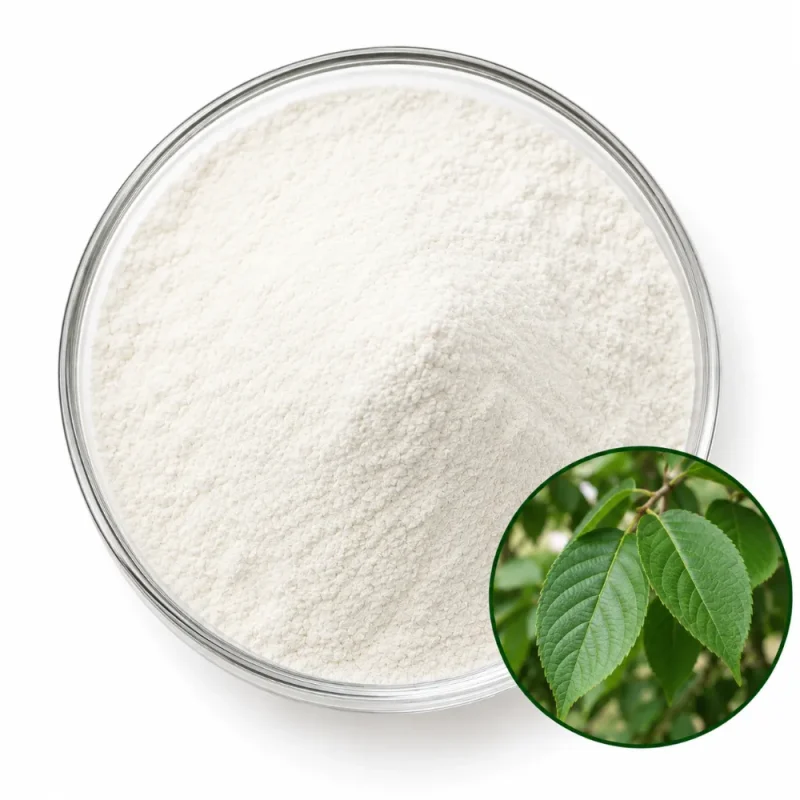
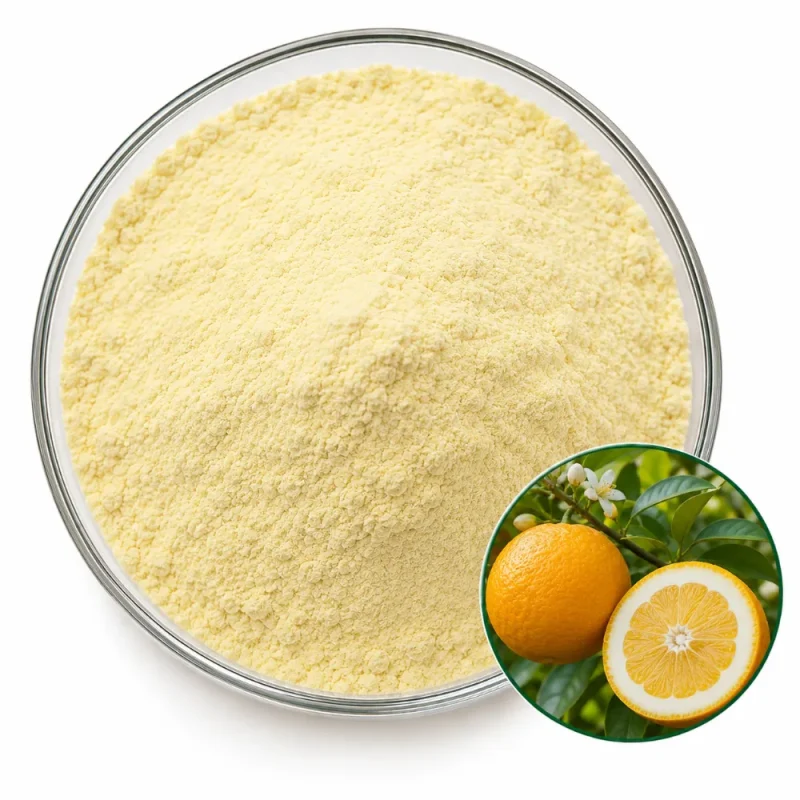
The flavanone glycoside that makes up much of the flavonoid content of citrus peel is hesperidin, and this hesperidin is isolated from the peel of Citrus sinensis, the sweet orange, by solvent extraction and purification. It is hesperetin bound to the disaccharide rutinose, supplied as a light yellow powder that is practically insoluble in water.

The primary grade is 98% hesperidin by HPLC, with 90% and 95% grades also supplied, in Food / Dietary Supplement Grade. Hesperidin sits among the most abundant flavonoids of the genus, and the buyer’s choice is mostly one of purity, particle size and dispersion.

Hesperidin Chemical Identity

Hesperidin has the molecular formula C28H34O15 and a molecular weight of 610.6. The aglycone is hesperetin, a flavanone with a methoxy group on the B-ring, and a rutinose unit of glucose and rhamnose is attached at position 7. The flavanone ring has a stereocenter at C2, and the natural compound is the (2S) form. The large sugar chain adds polarity but not enough to make the molecule dissolve in water, because the flat aglycone drives crystallization.

The natural source is the peel of Citrus sinensis (L.) Osbeck, where hesperidin concentrates in the albedo, the white inner layer, and in unripe fruit. GBIF lists this name as a synonym of Citrus aurantium, and the botanical identity here follows the master record. The compound is also found in other citrus peels, so the source belongs beside the name. Citrus is supplied in several related forms: Citrus Bioflavonoids Extract 40–90% Total Bioflavonoids, Bitter Orange Peel Extract Powder and Citrus Bioflavonoid Extract Powder. Those mixtures are defined by the total of flavonoids, whereas hesperidin here is the single glycoside.

Typical Specifications

Specification ItemProduct Information
Natural SourceCitrus sinensis peel
Plant PartFruit & Berry
ProcessingSolvent Extraction & Purification
Compound ClassFlavonoids, Polyphenols
Chemical Name (IUPAC)(2S)-5-hydroxy-2-(3-hydroxy-4-methoxyphenyl)-7-[(2S,3R,4S,5S,6R)-3,4,5-trihydroxy-6-[[(2R,3R,4R,5R,6S)-3,4,5-trihydroxy-6-methyloxan-2-yl]oxymethyl]oxan-2-yl]oxy-2,3-dihydrochromen-4-one
CAS Number520-26-3
Molecular FormulaC28H34O15
Molecular Weight610.6
PubChem CID10621
InChIKeyQUQPHWDTPGMPEX-QJBIFVCTSA-N
SMILESCC1C(C(C(C(O1)OCC2C(C(C(C(O2)OC3=CC(=C4C(=O)CC(OC4=C3)C5=CC(=C(C=C5)OC)O)O)O)O)O)O)O)O
Purity98% (HPLC)
Available Grades90% · 95% · 98% (HPLC)
GradeFood / Dietary Supplement Grade
AppearanceLight Yellow powder
Solubility / DispersibilityInsoluble in Water
Quality Parameters
Moisture (LOD)≤5.0%
Total Ash≤5.0%
Heavy MetalsLead ≤2 ppm · Arsenic ≤1 ppm · Cadmium ≤1 ppm · Mercury ≤0.1 ppm
MicrobiologyTPC ≤1,000 cfu/g · Yeast & Mold ≤100 cfu/g · E. coli Negative · Salmonella Negative/25 g
Shelf Life24 months in unopened original packaging, cool and dry storage

Hesperidin Purity Grades & Impurities

GradeAssay & MethodWhere It Fits
90% HesperidinHPLCDry blends and premixes
95% HesperidinHPLCCapsules and tablets
98% HesperidinHPLCReference-grade blends and complexes

An HPLC purity figure counts the hesperidin peak against all other absorbing peaks, so the percentage includes every flavonoid that elutes and excludes water, ash and non-absorbing matter. The 90%, 95% and 98% grades differ in how much of the neighboring flavonoid material is left, and the cost of purification rises with each step.

The main related substance is neohesperidin and its relatives, which dominate in bitter orange and appear in other citrus species. Hesperidin and neohesperidin share the aglycone and differ in the sugar linkage, rutinose against neohesperidose, so they have the same formula and are separated only by chromatography. Narirutin, didymin and the free aglycone hesperetin are smaller companions, and hesperetin appears when the glycoside hydrolyzes.

Another point is the form of the solid. Hesperidin crystallizes readily and may be isolated as a hydrate, so water content varies with drying and storage, and the moisture limit in the table applies to the supplied lot. The color of a good lot is light yellow to off-white, and a deeper yellow or brown suggests residual pigments or oxidation of the phenolic ring.

Pectin and other peel polysaccharides are a practical impurity of citrus flavonoids. They do not absorb in the ultraviolet range and so are invisible to HPLC, yet they make the powder sticky, slow to filter and prone to clumping. Their level is controlled by the washing and recrystallization steps, and a lot that feels gummy or that forms a gel when wetted points to residual peel polysaccharide even when the chromatographic purity reads high.

Hesperidin Solubility & Delivery

Hesperidin is practically insoluble in water and in most organic solvents, and it dissolves in dimethyl sulfoxide, in dilute alkali and, with difficulty, in hot methanol. The planar aglycone and the hydrogen-bonding sugar chain pack into a stable crystal, which explains the slow dissolution. In alkaline solutions it dissolves and turns a deep yellow, and it may then degrade by ring opening, so that approach is used for analysis and not for finished products.

Delivery in practice therefore relies on dispersion and on particle engineering. Micronization increases the dissolution rate, wetting agents prevent clumping, and complexes with cyclodextrins or other carriers raise the apparent solubility. Co-processing with a more soluble relative, such as methylated hesperidin, is also used in some formulas. Powder sticks and drinks need suspending agents, since the crystal does not dissolve and tends to settle quickly.

Particle shape and size decide how the powder behaves in the machine as well as in the cup. Fine needle-like crystals are cohesive and electrostatic, while a granulated or lightly agglomerated grade flows better in hoppers. Moisture also changes the picture, since a hydrated crystal can clump in humid rooms. A formulator who compares two lots of the same grade checks bulk flow, wetting time and sedimentation, and not only the HPLC content, before the new lot replaces the old.

Application Areas

Capsule Fills at the 95% Grade

Capsules take the 95% grade at moderate inclusion. The fine crystalline powder is cohesive, so a flow agent and a sieved blend give even fill weight, and a dry room keeps the powder from picking up moisture, which would otherwise soften the fill.

Tablet Blends With Binders

Hesperidin presses into tablets with a dry binder and a lubricant. The crystals are hard and abrasive to tooling, so a compression trial checks punch wear, and a disintegrant helps the tablet release the insoluble solid.

Micronized Dispersions

The 98% grade is micronized and wetted before it is added to suspensions or complexes. Particle size is checked after milling, and a retained sample of each lot allows a comparison of dissolution when the process is repeated.

Dry Blends and Sticks

Sticks hold hesperidin only as a suspension, so the premix includes a thickener, and the blend is sieved to prevent specks in the cup. The 90% grade suits these cost-sensitive blends where the color tolerance is wider.

Packaging & Commercial Supply

Essencefield supports product evaluation, formulation trials, commercial orders, and ongoing ingredient supply. Packaging, storage, and shipping arrangements are determined by product characteristics, order quantity, stability requirements, and destination-market needs.

Supply ItemGeneral Information
SampleAvailable upon request for formulation, testing, and supplier evaluation
Order Quantities100 g · 1 kg · 5 kg · 25 kg · 100 kg · 500 kg · Bulk
Sample Lead TimeTypically 5–7 days after sample confirmation
Production Lead TimeTypically 15–30 days after order and specification confirmation
PackagingSuitable protective inner packaging with bags, cartons, drums, or other appropriate outer packaging
StorageStore in tightly sealed, suitable protective packaging in a cool, dry environment. Protect from moisture, heat, and direct sunlight. Specific storage conditions follow the approved product specification.
DocumentationCOA · Product Specification · TDS · SDS · Applicable declarations (as applicable)

Final order quantities, lead times, packaging, documentation, and shipping arrangements are confirmed according to the selected product and commercial requirements.

Request Ingredient Specifications & Quote

Share your target specification, application, quantity, and documentation needs. We’ll help confirm suitable options, samples, and commercial supply details.