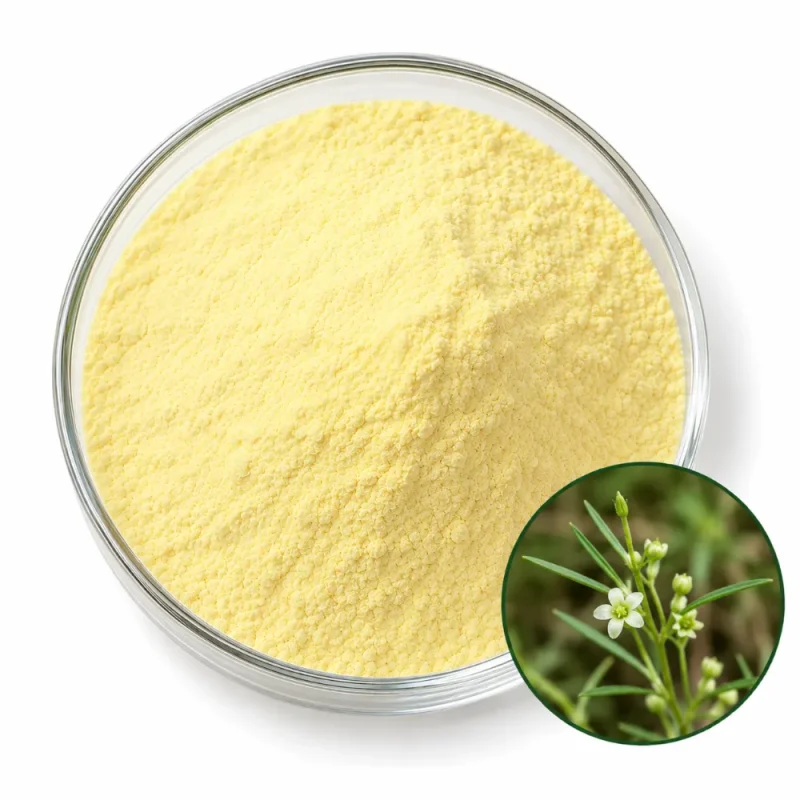
Afzelin 98%

The rhamnoside of kaempferol that fish mint produces, afzelin is isolated here from the aerial parts of Houttuynia cordata by ethanol extraction and purification. It is kaempferol joined to a single rhamnose sugar at position 3, and it is a yellow, slightly water soluble powder.

The primary grade is 98% afzelin by HPLC, in Food / Dietary Supplement Grade. Afzelin is one of several closely related kaempferol and quercetin glycosides in the plant, and a precise name and CAS number are what keep it distinct from them.

Afzelin Chemical Identity

Afzelin has the molecular formula C21H20O10 and a molecular weight of 432.4. The aglycone is kaempferol, a flavonol with hydroxyls at positions 3, 5, 7 and 4′, and the rhamnose, a six-carbon deoxy sugar, is attached through the 3-hydroxyl. Because only one sugar is present and it is a deoxy sugar, the molecule is much less polar than a glucoside with two sugars, and more soluble in organic solvents than its sugar-rich relatives. The glycosidic bond is acid-labile, and the free aglycone appears when it breaks.

The relatives are easy to confuse. Quercitrin carries rhamnose on quercetin, which has one more hydroxyl than kaempferol. Kaempferitrin has two rhamnose units, at positions 3 and 7. Astragalin carries glucose in place of rhamnose. Each has its own CAS number and retention time, and a buyer should match both when comparing with a reference standard. The natural source is the aerial parts, the leaf and stem, of Houttuynia cordata Thunb., a herb of the family Saururaceae known as fish mint. Related products are Houttuynia Cordata Extract 5–30% Total Flavonoids, the 10:1 Houttuynia Extract Powder and the milled Houttuynia (Fish Mint) Powder. The extract is defined by the total of flavonoids, whereas afzelin here is one glycoside.

Typical Specifications

Specification ItemProduct Information
Natural SourceHouttuynia cordata aerial parts
Plant PartLeaf & Herb
ProcessingEthanol Extraction & Purification
Compound ClassFlavonoids, Polyphenols
Chemical Name (IUPAC)5,7-dihydroxy-2-(4-hydroxyphenyl)-3-[(2S,3R,4R,5R,6S)-3,4,5-trihydroxy-6-methyloxan-2-yl]oxychromen-4-one
CAS Number482-39-3
Molecular FormulaC21H20O10
Molecular Weight432.4
PubChem CID5316673
InChIKeySOSLMHZOJATCCP-AEIZVZFYSA-N
SMILESCC1C(C(C(C(O1)OC2=C(OC3=CC(=CC(=C3C2=O)O)O)C4=CC=C(C=C4)O)O)O)O
Purity98% (HPLC)
GradeFood / Dietary Supplement Grade
AppearanceYellow powder
Solubility / DispersibilitySlightly Soluble in Water
Quality Parameters
Moisture (LOD)≤5.0%
Total Ash≤5.0%
Heavy MetalsLead ≤2 ppm · Arsenic ≤1 ppm · Cadmium ≤1 ppm · Mercury ≤0.1 ppm
MicrobiologyTPC ≤1,000 cfu/g · Yeast & Mold ≤100 cfu/g · E. coli Negative · Salmonella Negative/25 g
Shelf Life24 months in unopened original packaging, cool and dry storage

Afzelin Purity Grades & Impurities

The 98% figure is an HPLC result that compares the afzelin peak with the other detected peaks, with detection near 265 and 345 nm where the flavonol glycoside shows its two absorption bands. Water, ash and anything without a response fall outside the figure, which is why the table lists moisture and ash as separate limits. Only one grade is offered.

The related substances of fish mint are the flavonol glycosides listed above, plus rutin, hyperoside and isoquercitrin, which are more polar and elute earlier. Quercitrin elutes close to afzelin, since the two differ by a single hydroxyl, so a method must show that the pair is resolved. Kaempferol itself, the aglycone, elutes later and marks hydrolysis. Chlorogenic acid and other phenolic acids of the herb appear as early peaks and are removed in purification.

Fish mint also contains volatile oil compounds, notably decanoyl acetaldehyde, which give the herb its fishy smell. They are removed with the other lipophilic material, and a lot that retains a pronounced odor was not cleaned properly. The odor, therefore, is a quick qualitative check, even though it does not appear in the HPLC trace.

A clean afzelin lot is a bright yellow powder, and a green tint suggests residual chlorophyll from the leaf. A brown tone indicates oxidation or residual pigment. Moisture and ash are limited separately. Plant-derived and synthetic glycosides share the main peak, and the stated source and the impurity profile tell a buyer which route the lot took.

Afzelin Solubility & Delivery

Afzelin is slightly soluble in water and dissolves in ethanol, methanol, acetone and dimethyl sulfoxide. The rhamnose unit gives the molecule enough polarity to wet in water, while the flat kaempferol core keeps the solubility low. It is more soluble in hot water than in cold, and a hot solution may deposit yellow crystals as it cools.

For delivery, the practical task is dispersion. Fine milling, wetting agents and cyclodextrin or phospholipid complexes raise the dissolution rate, and a suspending agent holds the solid in liquids. Dissolving in warm aqueous ethanol and diluting gives a stable dispersion only when the concentration stays below the solubility limit. The glycoside is stable in dry blends if sealed and kept away from strong light. Heating in acid hydrolyzes the sugar, so acid and heat are not combined for long. Static makes small weights awkward, and a premix with a dry carrier gives uniform results.

Physical form follows from drying. Afzelin crystallizes as fine yellow needles from alcohol, and a lot dried quickly may be fluffier and more electrostatic than one dried slowly. Bulk density and flow therefore differ between lots with the same HPLC content, and a formulator who changes lot compares tap behavior and sieve residue as well as purity, since a fluffy grade is harder to weigh in small amounts and fills capsules unevenly.

Application Areas

Capsule Fills of the Glycoside

Capsules take afzelin at low inclusion. The yellow powder is electrostatic, so a flow agent, anti-static scoops and a two-step premix give an even fill weight, and a dry filling room avoids slight caking in the hopper.

Tablet Blends With Disintegrants

Tablets press afzelin with a dry binder and a disintegrant. A dissolution trial on the full blend confirms that the slightly soluble solid is released, and a short stability run shows whether the yellow color changes under humid storage.

Warm-Dissolved Concentrates

Concentrates dissolve the glycoside in warm aqueous ethanol and are diluted to a level below saturation. Crystals can form on cooling, so a cold-storage check follows, and a suspending agent is used when a hazy product is acceptable.

Flavonol Glycoside Comparison Blends

Formulators comparing fish mint flavonoids blend afzelin with quercitrin and rutin in fixed ratios. Each ingredient is weighed on its own, and an HPLC trace of the blend, run on a column that resolves the pair, confirms the ratio.

Reference Standards for Herb Fingerprints

Analytical teams use the 98% grade as an anchor peak in fingerprints of fish mint extracts. The standard is stored dry and dark, and a retained sample of each lot preserves the retention-time record for column checks.

Packaging & Commercial Supply

Essencefield supports product evaluation, formulation trials, commercial orders, and ongoing ingredient supply. Packaging, storage, and shipping arrangements are determined by product characteristics, order quantity, stability requirements, and destination-market needs.

Supply ItemGeneral Information
SampleAvailable upon request for formulation, testing, and supplier evaluation
Order Quantities100 g · 1 kg · 5 kg · 25 kg · 100 kg · 500 kg · Bulk
Sample Lead TimeTypically 5–7 days after sample confirmation
Production Lead TimeTypically 15–30 days after order and specification confirmation
PackagingSuitable protective inner packaging with bags, cartons, drums, or other appropriate outer packaging
StorageStore in tightly sealed, suitable protective packaging in a cool, dry environment. Protect from moisture, heat, and direct sunlight. Specific storage conditions follow the approved product specification.
DocumentationCOA · Product Specification · TDS · SDS · Applicable declarations (as applicable)

Final order quantities, lead times, packaging, documentation, and shipping arrangements are confirmed according to the selected product and commercial requirements.

Request Ingredient Specifications & Quote

Share your target specification, application, quantity, and documentation needs. We’ll help confirm suitable options, samples, and commercial supply details.