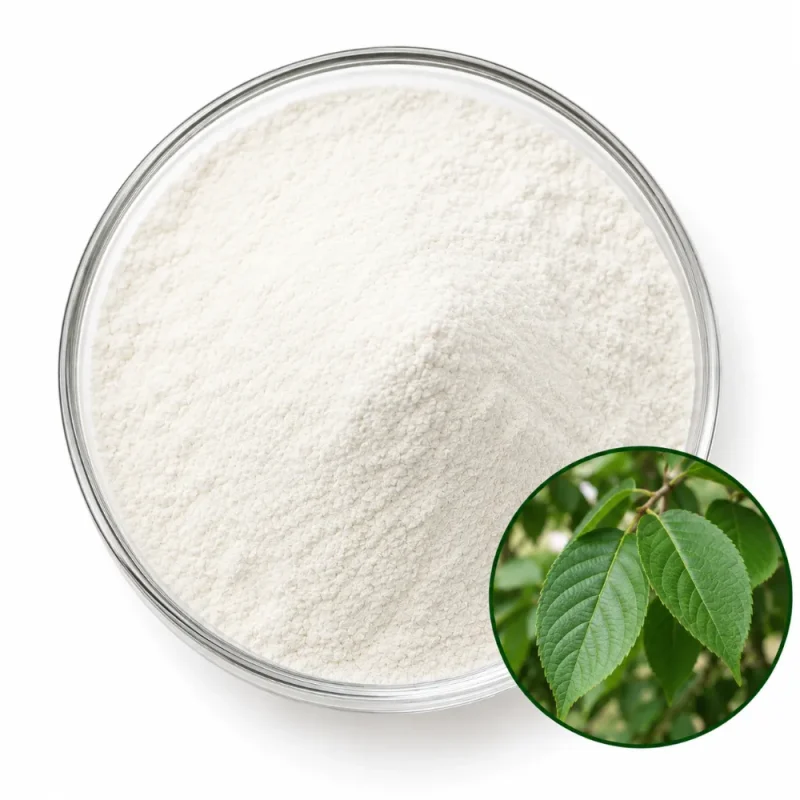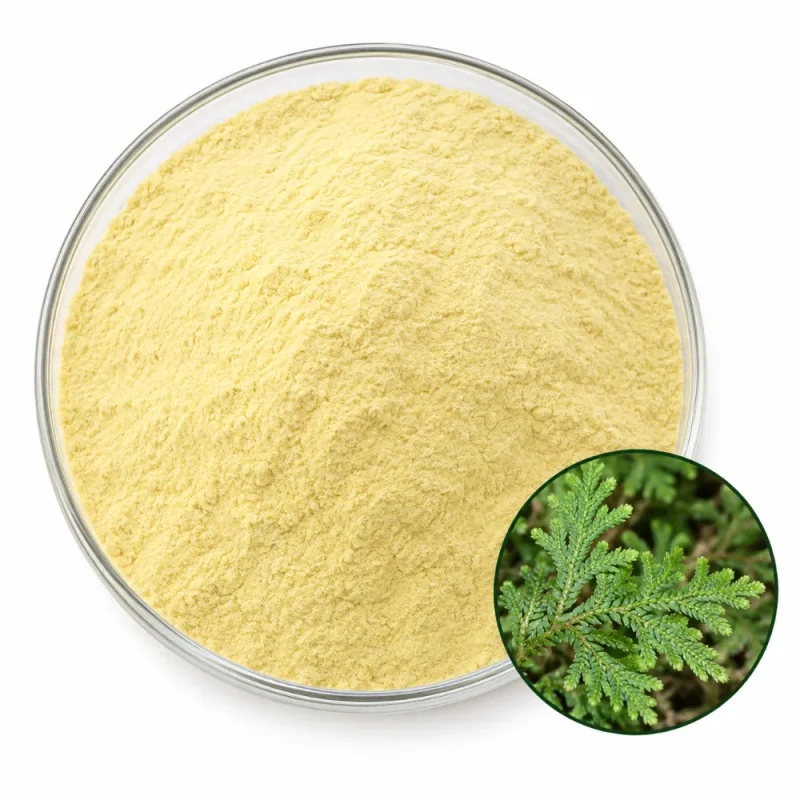
Amentoflavone 98%

A biflavonoid built from two apigenin units, amentoflavone is isolated here from the whole plant of Selaginella tamariscina by ethanol extraction and purification. It is a large, flat, yellow molecule with eight hydroxyl groups on two flavone halves, and it is a powder that does not dissolve in water.

The primary grade is 98% amentoflavone by HPLC, in Food / Dietary Supplement Grade. Biflavonoids are rare among the common supplement compounds, and the name, the source and the linkage between the two flavones are what a buyer needs to see together.

Amentoflavone Chemical Identity

Amentoflavone has the molecular formula C30H18O10 and a molecular weight of 538.5. Two apigenin units, a flavone with hydroxyls at positions 5, 7 and 4′, are joined by a carbon–carbon bond between the 3′ position of one and the 8 position of the other. The result is a rigid biaryl of around 30 carbon atoms with extended conjugation, which gives the yellow color, strong ultraviolet absorption and very low solubility in water. Isomeric biflavones with the same formula, such as robustaflavone and hinokiflavone, differ in the position or type of the linkage.

The natural source is the whole plant of Selaginella tamariscina (P.Beauv.) Spring, a spikemoss that curls into a ball when dry and revives with moisture, which is why it is called the resurrection plant. Amentoflavone is also found in several unrelated plants, including Ginkgo biloba and Hypericum species, so the source and part are stated. The same spikemoss is supplied as Selaginella Tamariscina Extract 5–30% Amentoflavone, a mixed extract defined by a content range. The pure compound here is a single biflavonoid with its own identifiers and no ratio-based claim.

Trade listings often attach the name to extracts of different species, and the plant genus Selaginella includes many species with different biflavonoid profiles. A buyer comparing sheets should match the species, the part and the CAS number.
Typical Specifications

Specification ItemProduct Information
Natural SourceSelaginella tamariscina whole plant
Plant PartWhole Plant
ProcessingEthanol Extraction & Purification
Compound ClassFlavonoids, Polyphenols
Chemical Name (IUPAC)8-[5-(5,7-dihydroxy-4-oxochromen-2-yl)-2-hydroxyphenyl]-5,7-dihydroxy-2-(4-hydroxyphenyl)chromen-4-one
CAS Number1617-53-4
Molecular FormulaC30H18O10
Molecular Weight538.5
PubChem CID5281600
InChIKeyYUSWMAULDXZHPY-UHFFFAOYSA-N
SMILESC1=CC(=CC=C1C2=CC(=O)C3=C(O2)C(=C(C=C3O)O)C4=C(C=CC(=C4)C5=CC(=O)C6=C(C=C(C=C6O5)O)O)O)O
Purity98% (HPLC)
GradeFood / Dietary Supplement Grade
AppearanceYellow powder
Solubility / DispersibilityInsoluble in Water
Quality Parameters
Moisture (LOD)≤5.0%
Total Ash≤5.0%
Heavy MetalsLead ≤2 ppm · Arsenic ≤1 ppm · Cadmium ≤1 ppm · Mercury ≤0.1 ppm
MicrobiologyTPC ≤1,000 cfu/g · Yeast & Mold ≤100 cfu/g · E. coli Negative · Salmonella Negative/25 g
Shelf Life24 months in unopened original packaging, cool and dry storage

Amentoflavone Purity Grades & Impurities

The 98% figure is an HPLC result that compares the amentoflavone peak with the other detected peaks, with detection near 270 and 330 nm, the two bands of the flavone chromophore. Water, ash and silent components are outside the percentage, so the table lists moisture and ash as separate limits. A single grade is offered.

The related substances are the other biflavonoids and the monomeric flavones of the plant. Robustaflavone, hinokiflavone, isocryptomerin and heveaflavone are structural neighbors with the same or a similar mass, and they elute close to amentoflavone, so a method must resolve them. Apigenin, the monomer, elutes earlier and marks degradation or incomplete purification. Methylated derivatives, such as sciadopitysin, which carries methoxy groups on the amentoflavone skeleton, are possible traces.

Large flat polyphenols have a second quality theme, which is aggregation. Amentoflavone stacks strongly, and a sample prepared at a high concentration in a poor solvent can give a low or irregular peak because the molecules cluster. Laboratories dissolve it in dimethyl sulfoxide or a similar solvent, dilute carefully, and run replicates. The spikemoss also contains trehalose and phenolic acids, which are removed by purification.

A bright yellow powder is the sign of a clean lot. A green tint points to residual chlorophyll, and a brown tint to oxidation or pigment. Moisture and ash are limited separately, and storage is sealed, dry and out of strong light.

Amentoflavone Solubility & Delivery

Amentoflavone is insoluble in water and dissolves in dimethyl sulfoxide, pyridine and, with difficulty, in methanol, ethanol and acetone. The eight hydroxyl groups form strong hydrogen bonds in the crystal, and the planar halves stack, so dissolution is slow even in good solvents. The molecule is large and moderately lipophilic, but the stacking makes it hard to bring into an oil as well.

Delivery therefore leans on particle engineering. Fine milling, wetting agents, surfactant dispersions, cyclodextrin complexes and amorphous solid dispersions are the approaches described in the literature for poorly soluble polyphenols. Where dimethyl sulfoxide is not acceptable, a polymer carrier or a lipid system is used to hold the particles apart. In dry blends, the powder is stable, not hygroscopic and cohesive, and a flow agent plus a two-stage premix with a dry carrier gives uniform results. Static makes small weights awkward. Strong alkali and prolonged heat darken the compound.

Particle size and wetting decide how the biflavonoid behaves in a blend. Coarse, glassy particles settle quickly and give specks, while very fine ones agglomerate and float on water. A moderate, narrow size range with a surfactant at low level gives the best wetting, and a laser size check on receipt, filed with the batch record, shows whether a new lot will behave like the old one in the same formula.

Application Areas

Capsule Fills of the Biflavonoid

Capsules take amentoflavone at low inclusion. The yellow powder is cohesive and electrostatic, so a flow agent, anti-static tools and a sieved two-step premix give an even fill weight, and opaque capsules protect the color on the shelf.

Polymer-Carrier Dispersions

Polymer carriers hold the stacking molecules apart and raise the apparent dissolution rate. The dispersion is made in a solvent step, dried and milled, and a retained sample of each lot lets the formulator compare crystallinity and dissolution when the process is repeated.

Tablet Blends With Wetting Agents

Tablets press the biflavonoid with a dry binder, a lubricant and a wetting agent. A disintegration and dissolution trial on the full blend, repeated after a month of storage, confirms that the insoluble solid releases at the intended rate.

Oil-Phase Suspensions

Oil suspensions disperse the milled powder with an emulsifier. Settling is checked before encapsulation, since the particles are denser than the oil, and the stirred tank keeps the dose uniform from the first unit to the last.

Biflavonoid Comparison Panels

Analytical teams use the 98% grade to confirm that a column resolves amentoflavone from robustaflavone and hinokiflavone. The standard is stored dry, a retained sample of each lot is kept, and the retention order is filed with the batch record.

Packaging & Commercial Supply

Essencefield supports product evaluation, formulation trials, commercial orders, and ongoing ingredient supply. Packaging, storage, and shipping arrangements are determined by product characteristics, order quantity, stability requirements, and destination-market needs.

Supply ItemGeneral Information
SampleAvailable upon request for formulation, testing, and supplier evaluation
Order Quantities100 g · 1 kg · 5 kg · 25 kg · 100 kg · 500 kg · Bulk
Sample Lead TimeTypically 5–7 days after sample confirmation
Production Lead TimeTypically 15–30 days after order and specification confirmation
PackagingSuitable protective inner packaging with bags, cartons, drums, or other appropriate outer packaging
StorageStore in tightly sealed, suitable protective packaging in a cool, dry environment. Protect from moisture, heat, and direct sunlight. Specific storage conditions follow the approved product specification.
DocumentationCOA · Product Specification · TDS · SDS · Applicable declarations (as applicable)

Final order quantities, lead times, packaging, documentation, and shipping arrangements are confirmed according to the selected product and commercial requirements.

Request Ingredient Specifications & Quote

Share your target specification, application, quantity, and documentation needs. We’ll help confirm suitable options, samples, and commercial supply details.