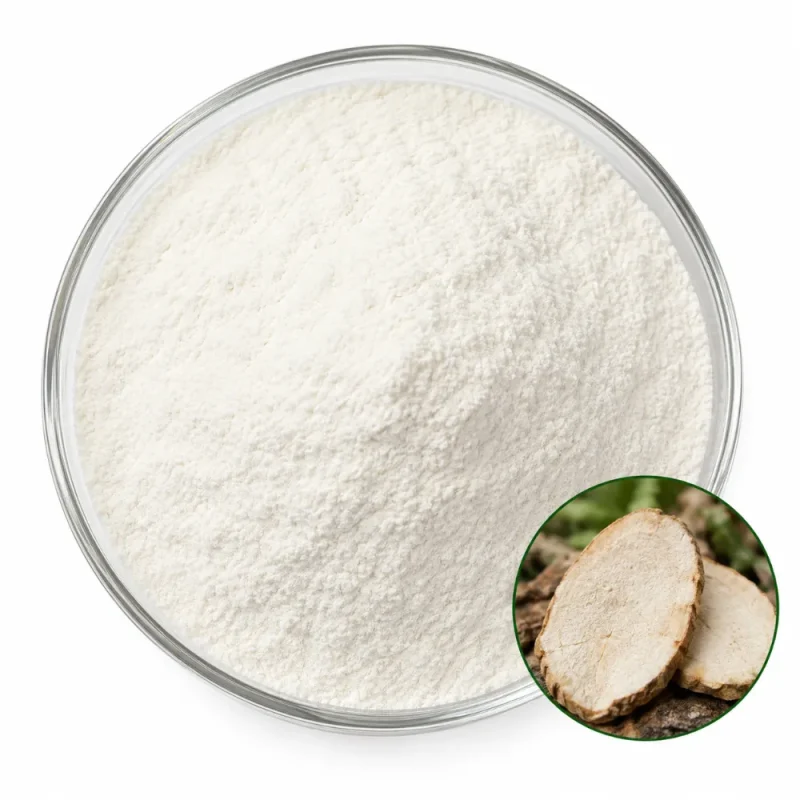
Alisol C 23-Acetate 98%

Alisma rhizome (Alisma orientale) holds alisol C 23-acetate, the acetyl ester of a protostane triterpenoid whose ring D carries a conjugated enone and whose side chain ends in an epoxide. It is isolated by ethanol extraction and purification and supplied as a white powder that is insoluble in water.

The Primary Grade is 98% alisol C 23-acetate by HPLC, in Food / Dietary Supplement Grade. The figure describes this acetate, not alisol C or a total of alisols. The identity values in the table apply to the acetate, which has two ketone groups.

Alisol C 23-Acetate Chemical Identity

Alisol C 23-acetate (C32H48O6, molecular weight 528.7) differs from alisol B 23-acetate (C32H50O5) by two hydrogens and one oxygen: it carries a second ketone, at carbon 16, next to a double bond in ring D. That arrangement forms a conjugated enone, which absorbs ultraviolet light more strongly than the saturated protostane skeletons of the A and B series. The side chain keeps the epoxide ring and an acetyl ester on carbon 23.

The raw material is the rhizome of Alisma orientale (Sam.) Juz. (Alismataceae). Current checklists treat the name as a synonym of Alisma plantago-aquatica, while the trade name stays in use.

Close relatives are Alisol C 98%, the more common marker Alisol B 23-Acetate 98% and the whole-rhizome products Alisma rhizome extract powder. Each has its own identifiers, and the 16-ketone is what separates this compound from the B series.

The conjugated enone makes this compound stand out in a chromatogram, and that is a useful identity aid: an alisol C acetate peak absorbs differently from the other alisol acetates at the same wavelength. Even so, identity rests on the CAS number 26575-93-9 and the InChIKey, not on UV behavior alone.

Typical Specifications

Specification ItemProduct Information
Natural SourceAlisma orientale rhizome
Plant PartRoot & Rhizome
ProcessingEthanol Extraction & Purification
Compound ClassTerpenoids
Chemical Name (IUPAC)[(1S,3R)-1-[(2R)-3,3-dimethyloxiran-2-yl]-3-[(5R,8S,9S,10S,11S,14R)-11-hydroxy-4,4,8,10,14-pentamethyl-3,16-dioxo-2,5,6,7,9,11,12,15-octahydro-1H-cyclopenta[a]phenanthren-17-yl]butyl] acetate
CAS Number26575-93-9
Molecular FormulaC32H48O6
Molecular Weight528.7 g/mol
PubChem CID14036813
InChIKeyKOOCQNIPRJEMDH-QSKXMHMESA-N
Purity98% (HPLC)
GradeFood / Dietary Supplement Grade
AppearanceWhite powder
Solubility / DispersibilityInsoluble in Water
Quality Parameters
Moisture (LOD)≤5.0%
Total Ash≤5.0%
Heavy MetalsLead ≤2 ppm · Arsenic ≤1 ppm · Cadmium ≤1 ppm · Mercury ≤0.1 ppm
MicrobiologyTPC ≤1,000 cfu/g · Yeast & Mold ≤100 cfu/g · E. coli Negative · Salmonella Negative/25 g
Shelf Life24 months in unopened original packaging, cool and dry storage

Alisol C 23-Acetate Purity & Related Substances

Alisol C 23-acetate 98% is a single-compound grade measured by HPLC. In the trace, acetate accounts for the stated share of detected peak area, while water, ash and non-absorbing residues sit outside the figure. The conjugated enone gives this compound a stronger UV signal than alisol A or B, which means detection near the enone maximum is practical, and the same wavelength should be used when two lots are compared.

The related substances are alisol C (the free alcohol), alisol B 23-acetate, alisol A 24-acetate and other minor oxidized protostanes. Because the 16-ketone adds polarity, alisol C 23-acetate and alisol B 23-acetate elute at different times, which makes their separation straightforward with a standard gradient. Hydrolysis of the ester returns alisol C, and epoxide opening creates diols, so a growing set of minor peaks on storage points to moisture or acid.

The route is ethanol extraction of the rhizome followed by purification, and no other route is described. A total alisol value from an extract cannot replace the single-compound figure.

For release, the chromatogram should show one dominant peak, and a diode-array spectrum of that peak should match the enone profile, which separates it from alisol B acetate. A water determination shows storage quality. A ratio of alisol C 23-acetate to alisol C that rises with time points to ester hydrolysis in the opposite direction, and it is monitored in aged lots.

Because the enone chromophore is stronger than in the other alisol acetates, a modest impurity can look larger at a detection wavelength chosen for the enone. Reading a purity figure therefore means asking which wavelength was used, and comparing certificates only when both quote the same one.

Alisol C 23-Acetate Solubility & Delivery

Alisol C 23-acetate is insoluble in water. The large triterpenoid framework, the acetyl ester and the epoxide leave little polarity, and the compound dissolves in ethanol, methanol and other organic solvents. In water the white powder floats or settles and needs a carrier.

The conjugated enone and the epoxide are both reactive, so neutral conditions suit aqueous premixes best. Strong acid opens the epoxide, while strong alkali hydrolyzes the ester and can attack the enone. Oil-phase dispersions, anhydrous co-solvent premixes, phospholipid complexes and micronized powders are the appropriate delivery approaches in principle.

The powder is fine and may be electrostatic. Closed containers, a dry weighing area and a dilution premix keep the dose accurate. Light exposure should be limited because conjugated enones can undergo photochemical change, and opaque packaging is a sensible precaution.

Light exposure during processing deserves attention. Conjugated enones can undergo photochemical change under strong UV, so yellow or amber lighting at the weighing station, covered hoppers and opaque transfer containers reduce the risk during production.

Application Areas

Hard capsules with neutral excipients

Alisol C 23-acetate is premixed with neutral excipients and filled in a dry room. Acidic and alkaline partners are avoided, and the capsules are packed in an opaque container with a desiccant to protect the enone from light and water.

Softgels with anhydrous fills

An oil-phase dispersion without free water suits the reactive groups. The tank is stirred during encapsulation, and the fill is sampled for uniformity, while the amber shell or opaque blister limits the light that reaches the enone.

Tablets at low inclusion

Tablets use neutral fillers and mild lubricant levels, and a coating limits humidity and light. A content uniformity check on tablets from the run confirms that the small dose is spread evenly across the batch.

Powder sticks near neutral pH

Dry sticks use a dispersant to keep the insoluble powder suspended, and the finished drink is kept near neutral pH. Foil packaging provides a light barrier for the enone through the shelf life, and the sachets are checked for seal integrity.

Reference-style blends

Alisol C 23-acetate can be combined with other alisol acetates in a defined ratio. Each component is assayed separately, and the finished blend is checked for the intended ratio so that the contribution of the acetate is known.

Packaging & Commercial Supply

Essencefield supports product evaluation, formulation trials, commercial orders, and ongoing ingredient supply. Packaging, storage, and shipping arrangements are determined by product characteristics, order quantity, stability requirements, and destination-market needs.

Supply ItemGeneral Information
SampleAvailable upon request for formulation, testing, and supplier evaluation
Order Quantities100 g · 1 kg · 5 kg · 25 kg · 100 kg · 500 kg · Bulk
Sample Lead TimeTypically 5–7 days after sample confirmation
Production Lead TimeTypically 15–30 days after order and specification confirmation
PackagingSuitable protective inner packaging with bags, cartons, drums, or other appropriate outer packaging
StorageStore in tightly sealed, suitable protective packaging in a cool, dry environment. Protect from moisture, heat, and direct sunlight. Specific storage conditions follow the approved product specification.
DocumentationCOA · Product Specification · TDS · SDS · Applicable declarations (as applicable)

Final order quantities, lead times, packaging, documentation, and shipping arrangements are confirmed according to the selected product and commercial requirements.

Request Ingredient Specifications & Quote

Share your target specification, application, quantity, and documentation needs. We’ll help confirm suitable options, samples, and commercial supply details.