Dihydroberberine Chemical Identity
Dihydroberberine has the molecular formula C20H19NO4 and a molecular weight of 337.4, one hydrogen more than the berberine cation. The quaternary nitrogen of berberine is converted to a tertiary amine by the addition of a hydride at the carbon beside it, which breaks the full aromatic conjugation of the isoquinolinium ring. The molecule keeps the dimethoxy and methylenedioxy substituents of the parent, so it is recognizably a protoberberine, but it is neutral and much more lipophilic.
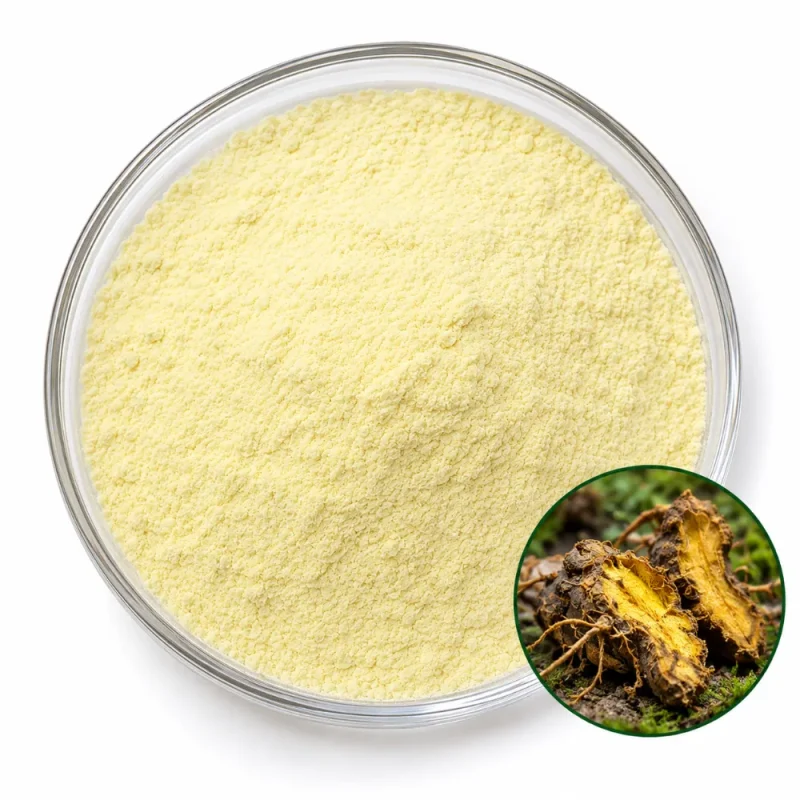
That relationship has practical consequences. Dihydroberberine is oxidized back toward berberine by air and light, and the yellow color of the powder reflects the more weakly conjugated system. It is formed in the plant only in trace quantities and is usually prepared by chemical reduction of berberine, so the source statement should be read with that in mind. The botanical origin tied to this record is the rhizome of Coptis chinensis Franch. Related materials are Berberine 98%, the mixed Coptis Extract 20–50% Berberine and the unstandardized Coptis Rhizome Extract Powder. Those contain the cationic alkaloid, not the reduced form.
Because the molecule is neutral, it is read differently from the salts of berberine. A salt dissociates in the mobile phase and elutes as the cation, whereas dihydroberberine elutes as itself and shows a different absorption maximum. The two should never be added together in a content figure, and a specification should state which form is being measured.