18-Beta-Glycyrrhetinic Acid 98%

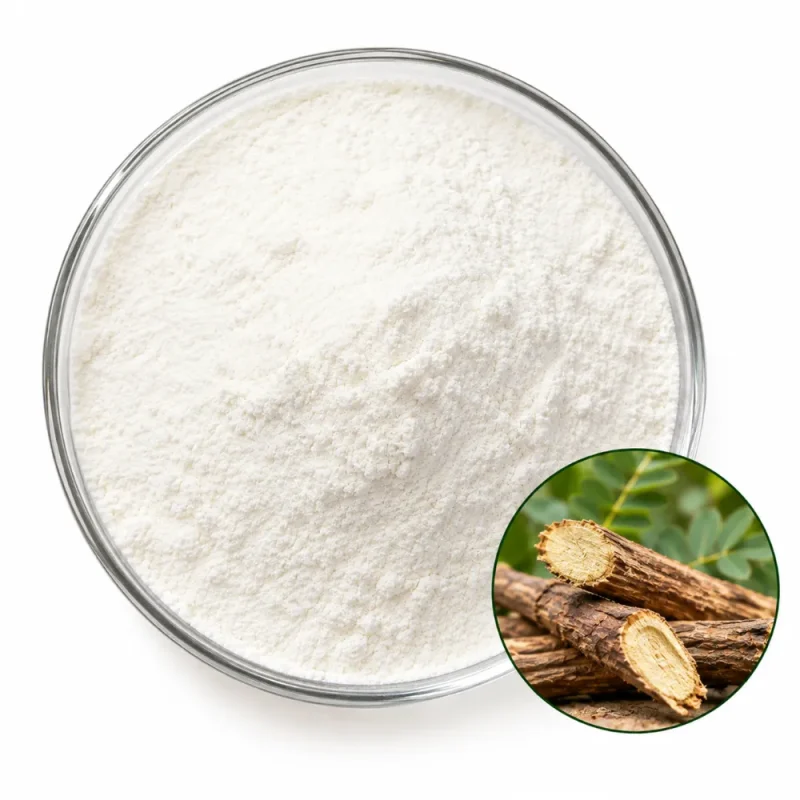
The main triterpenoid aglycone of licorice, 18-beta-glycyrrhetinic acid is isolated here from the root of Glycyrrhiza uralensis by ethanol extraction and purification. It is the natural, dominant epimer of glycyrrhetinic acid, released from the saponin glycyrrhizic acid when the sugar chain is cleaved.

The primary grade is 98% 18-beta-glycyrrhetinic acid by HPLC, in Food / Dietary Supplement Grade. Water does not dissolve this off-white powder. The beta descriptor is part of the identity, and it separates this product from the alpha epimer that shares its formula.

18-Beta-Glycyrrhetinic Acid Chemical Identity

18-Beta-glycyrrhetinic acid has the molecular formula C30H46O4 and the molecular weight 470.7. The skeleton is a pentacyclic triterpenoid of the oleanane series with a hydroxyl at C3, a ketone at C11 next to a double bond, and a carboxylic acid at C20. In 18-beta-glycyrrhetinic acid the hydrogen at C18 lies on the same face of the molecule as the angular methyl groups, which gives the trans ring junction found in the natural series. This shape produces a molecule that is rigid and relatively compact, with different crystal packing and retention from the alpha epimer.

Glycyrrhizic acid carries two glucuronic acid units on C3 and is the sweet principle of licorice. Cleaving the sugar chain by acid or enzyme gives the aglycone, so 18-beta-glycyrrhetinic acid is the downstream product of the saponin. The natural source is the root of Glycyrrhiza uralensis Fisch. ex DC., one of the licorice species of Chinese trade. Licorice is supplied in other forms: Licorice Extract 20% Glycyrrhizic Acid, the 10:1 Licorice Root Extract Powder and the milled Licorice Root Powder. The less abundant epimer is supplied as 18-Alpha-Glycyrrhetinic Acid 98%.

The trade uses several names for the aglycone, and registry numbers for the alpha and beta forms are sometimes swapped between listings. For that reason the stereochemical descriptor is given in the product name, and the identifiers in the table belong to the beta form.

Typical Specifications

Specification ItemProduct Information
Natural SourceGlycyrrhiza uralensis root
Plant PartRoot & Rhizome
ProcessingEthanol Extraction & Purification
Compound ClassTriterpenoids, Terpenoids
Chemical Name (IUPAC)(2S,4aS,6aR,6aS,6bR,8aR,10S,12aS,14bR)-10-hydroxy-2,4a,6a,6b,9,9,12a-heptamethyl-13-oxo-3,4,5,6,6a,7,8,8a,10,11,12,14b-dodecahydro-1H-picene-2-carboxylic acid
CAS Number471-53-4
Molecular FormulaC30H46O4
Molecular Weight470.7
PubChem CID10114
InChIKeyMPDGHEJMBKOTSU-YKLVYJNSSA-N
SMILESCC1(C2CCC3(C(C2(CCC1O)C)C(=O)C=C4C3(CCC5(C4CC(CC5)(C)C(=O)O)C)C)C)C
Purity98% (HPLC)
GradeFood / Dietary Supplement Grade
AppearanceOff-White powder
Solubility / DispersibilityInsoluble in Water
Quality Parameters
Moisture (LOD)≤5.0%
Total Ash≤5.0%
Heavy MetalsLead ≤2 ppm · Arsenic ≤1 ppm · Cadmium ≤1 ppm · Mercury ≤0.1 ppm
MicrobiologyTPC ≤1,000 cfu/g · Yeast & Mold ≤100 cfu/g · E. coli Negative · Salmonella Negative/25 g
Shelf Life24 months in unopened original packaging, cool and dry storage

18-Beta-Glycyrrhetinic Acid Purity Grades & Impurities

The 98% figure is an HPLC result that compares the 18-beta-glycyrrhetinic acid peak with the other detected peaks, with detection near the wavelength where the enone chromophore absorbs. It leaves out water, ash and anything without a response, so the moisture and ash limits in the table are read beside it. A single grade of 18-beta-glycyrrhetinic acid is listed.

The key related substance of 18-beta-glycyrrhetinic acid is the alpha epimer. It elutes close to the beta form and has nearly the same spectrum, so the method must resolve the pair, and the report should give the share of each. Because epimerization can occur when the material is heated in acid or base, a lot that was processed severely can carry a visible alpha peak. Optical rotation gives a supporting identity check, since the two epimers rotate polarized light differently.

Other triterpenoids from the root form the next group. Glycyrrhizic acid and the monoglucuronide, glycyrrhetinic acid 3-O-glucuronide, mark incomplete hydrolysis and elute earlier. Dehydro and 11-deoxo derivatives, as well as glabrolide, appear at trace level. The root flavonoids liquiritigenin and isoliquiritigenin, which give licorice extracts their yellow shade, are removed in purification, and a yellow tint on the powder points to carry-over.

A white to off-white powder indicates a clean lot. Moisture and ash are limited separately, since a rigid hydrophobic solid can trap solvent in its lattice, and loss on drying is read with that in mind.

18-Beta-Glycyrrhetinic Acid Solubility & Delivery

Water does not dissolve 18-beta-glycyrrhetinic acid, while ethanol, methanol, acetone and dimethyl sulfoxide do. With a high logP and a single carboxylic acid, it favors lipid and surfactant phases. The free acid forms salts with alkali, and the salts dissolve in water, but they are different chemical forms from the free acid supplied here.

For delivery of 18-beta-glycyrrhetinic acid the formulator relies on particle engineering. Micronization, wetting agents, oil suspensions, cyclodextrin and phospholipid complexes and solid dispersions are the approaches described in the literature. In liquid bases, a suspending agent holds the solid and a pH below the pKa keeps the acid un-ionized. In dry blends the powder is stable and not hygroscopic, but electrostatic charge makes small weights awkward, and anti-static scoops and a two-stage premix with a dry carrier give a more uniform result. Heat above moderate temperatures is avoided in solution, because acid or base with heat can drive epimerization of the C18 center.

Application Areas

Capsule Fills of the Beta Epimer

Capsules take 18-beta-glycyrrhetinic acid at low to moderate inclusion. The fine powder is electrostatic, so anti-static tools, a flow agent and a sieved premix give an even fill weight, and the lot record carries the epimer designation.

Softgel Suspensions

Softgels disperse milled 18-beta-glycyrrhetinic acid in oil with an emulsifier. Check settling in the tank before encapsulation, and keep the fill stirred, since the crystals are denser than the oil and sink within minutes of stopping the agitator.

Dissolution-Tested Tablets

Tablets press 18-beta-glycyrrhetinic acid with a dry binder, a lubricant and a wetting agent. The hydrophobic crystal must leave the tablet to dissolve, so a disintegration and dissolution trial on the full blend, repeated after a month of storage, is run before the formula is fixed.

Solid Dispersions

Solid dispersions with a polymer carrier are built to raise the dissolution rate of the rigid acid and to keep it amorphous. The dispersion is made in a solvent step, dried and milled, and the retained sample of each lot is compared for crystallinity and dissolution when the process is repeated.

Reference Standards for Epimer Separation

Analytical teams use the 98% 18-beta-glycyrrhetinic acid grade as the principal peak when they verify that a column resolves the beta and alpha epimers at the resolution their method requires. The standard is stored dry, and the retention-time pair is filed with every batch record for later audits and column checks.

Packaging & Commercial Supply

Essencefield supports product evaluation, formulation trials, commercial orders, and ongoing ingredient supply. Packaging, storage, and shipping arrangements are determined by product characteristics, order quantity, stability requirements, and destination-market needs.

Supply ItemGeneral Information
SampleAvailable upon request for formulation, testing, and supplier evaluation
Order Quantities100 g · 1 kg · 5 kg · 25 kg · 100 kg · 500 kg · Bulk
Sample Lead TimeTypically 5–7 days after sample confirmation
Production Lead TimeTypically 15–30 days after order and specification confirmation
PackagingSuitable protective inner packaging with bags, cartons, drums, or other appropriate outer packaging
StorageStore in tightly sealed, suitable protective packaging in a cool, dry environment. Protect from moisture, heat, and direct sunlight. Specific storage conditions follow the approved product specification.
DocumentationCOA · Product Specification · TDS · SDS · Applicable declarations (as applicable)

Final order quantities, lead times, packaging, documentation, and shipping arrangements are confirmed according to the selected product and commercial requirements.

Request Ingredient Specifications & Quote

Share your target specification, application, quantity, and documentation needs. We’ll help confirm suitable options, samples, and commercial supply details.