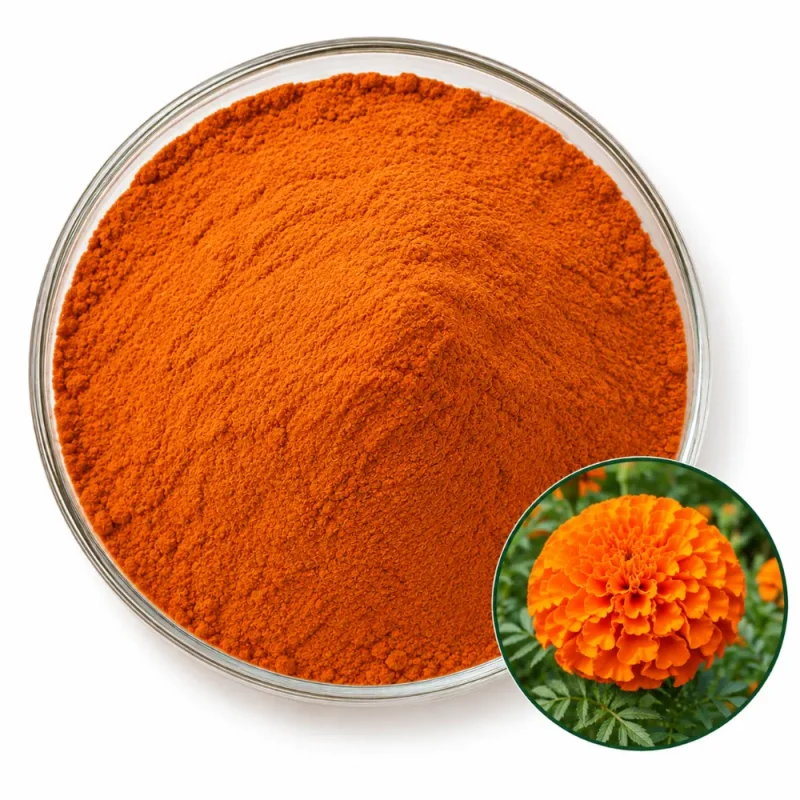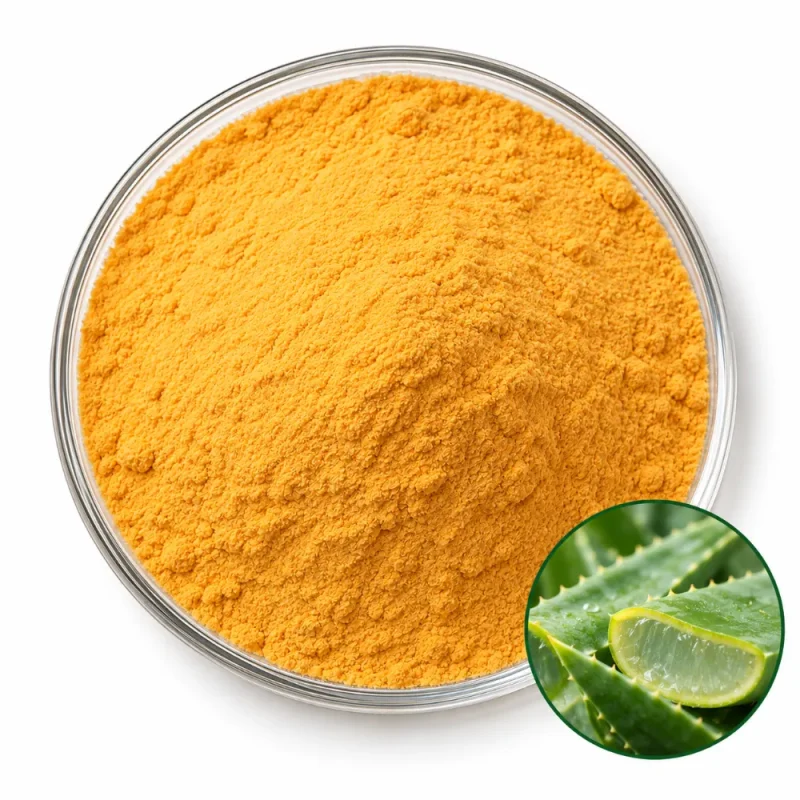
Aloe-Emodin 98%

Aloe leaf (Aloe vera) contains two very different fractions, the clear inner gel and the yellow latex under the rind, and aloe-emodin, an anthraquinone of the latex, is isolated here by ethanol extraction and purification. It is supplied as an orange-yellow, water-insoluble powder.

The Primary Grade is 98% aloe-emodin by HPLC, in Food / Dietary Supplement Grade. The figure describes this single anthraquinone, not total anthraquinones or aloin, and the identity values in the table apply to the free aglycone. Aloe gel products are a separate category with a different chemistry.

Aloe-Emodin Chemical Identity

Aloe-emodin (1,8-dihydroxy-3-(hydroxymethyl)anthraquinone, C15H10O5, molecular weight 270.24) is a tricyclic anthraquinone: a flat three-ring core with two ketone groups, two phenolic hydroxyl groups and a hydroxymethyl group. The chromophore is what gives the powder its orange-yellow color. The molecule is the aglycone of related glycosides such as aloin, and it is released when the sugar is removed.

In the plant, anthraquinones are held in the latex of the leaf rind, not in the inner parenchyma gel that is used for gel powders. The raw material for this product is the leaf of Aloe vera (L.) Burm.f. (Asphodelaceae). Gel-derived products are often decolorized to remove anthraquinones, which shows how different the two fractions are.

The same formula C15H10O5 belongs to emodin, apigenin and genistein, and aloe-emodin and emodin are isomers within the anthraquinone class, so mass cannot identify the compound. Neighbors in the catalog are aloe vera extract powder, aloe vera powder and aloe vera acemannan powder, each a different material from the anthraquinone.

Typical Specifications

Specification ItemProduct Information
Natural SourceAloe vera leaf
Plant PartLeaf & Herb
ProcessingEthanol Extraction & Purification
Compound ClassQuinones
Chemical Name (IUPAC)1,8-dihydroxy-3-(hydroxymethyl)anthracene-9,10-dione
CAS Number481-72-1
Molecular FormulaC15H10O5
Molecular Weight270.24 g/mol
PubChem CID10207
InChIKeyYDQWDHRMZQUTBA-UHFFFAOYSA-N
Purity98% (HPLC)
GradeFood / Dietary Supplement Grade
AppearanceOrange-Yellow powder
Solubility / DispersibilityInsoluble in Water
Quality Parameters
Moisture (LOD)≤5.0%
Total Ash≤5.0%
Heavy MetalsLead ≤2 ppm · Arsenic ≤1 ppm · Cadmium ≤1 ppm · Mercury ≤0.1 ppm
MicrobiologyTPC ≤1,000 cfu/g · Yeast & Mold ≤100 cfu/g · E. coli Negative · Salmonella Negative/25 g
Shelf Life24 months in unopened original packaging, cool and dry storage

Aloe-Emodin Purity & Related Substances

Aloe-emodin 98% is a single-compound grade measured by HPLC. Purity is reported as the area of the aloe-emodin peak relative to all detected peaks; water, ash and non-absorbing material fall outside it. Anthraquinones absorb strongly in the visible and UV range, so detection is straightforward, and the wavelength used should be stated when certificates are compared.

The related substances in aloe latex are aloin (barbaloin), which is the C-glycoside of aloe-emodin anthrone, as well as aloe-emodin anthrone, emodin, chrysophanol and other anthraquinones. Emodin is a structural isomer with the same formula and mass, so a method must separate it by retention time and not by mass. A figure for total hydroxyanthracene derivatives is a different measurement and cannot replace the single-compound purity.

Anthraquinones oxidize and photodegrade slowly, so a darkened powder or a growing set of minor peaks in an aged lot is a reason to retest. The compound is isolated from the leaf by ethanol extraction and purification, with no synthetic step described. Regulatory handling of anthraquinones differs by market and should be reviewed before the product is used in a finished food.

Release criteria for a colored anthraquinone combine HPLC with visual checks. The powder should be uniform orange-yellow, a brown or greenish tint points to oxidation or residual plant pigment, and the chromatogram should show one dominant peak with a defined area for emodin. Retesting before use is sensible for older lots because the compound is light sensitive.

Aloe-Emodin Solubility & Delivery

Aloe-emodin is insoluble in water. The planar tricyclic core and the intramolecular hydrogen bonds between the carbonyl groups and the neighboring hydroxyl groups reduce polarity, so the compound dissolves in ethanol, acetone and other organic solvents and in hot alkaline water as a colored phenolate. Alkaline solutions turn deep red, which is a handy identity indicator but also a stability warning.

Delivery in principle uses micronized powders, oil-phase dispersions, co-solvent premixes, phospholipid or cyclodextrin complexes and surfactant-assisted dispersions. Each one raises the apparent dissolution rate while the molecule stays unchanged. The orange-yellow color stains equipment, containers and hands, and cleaning between products is checked visually.

The dry powder is stable when closed, cool and protected from light. Photodegradation is the main long-term risk, and amber or opaque containers are standard. Because inclusion is low, premixing and weighing accuracy have more influence on content than the choice of capsule shell.

Powder behavior follows from the flat, colored molecule. The powder is fine, slightly cohesive and electrostatic, so it bridges in narrow hoppers and clings to scoops. Weighing in a low-light, low-humidity area and using amber containers keeps both flow and color stable, and a dilution premix improves dose accuracy at small inclusion.

Application Areas

Hard capsules in opaque shells

Aloe-emodin is dosed in small weights and is light sensitive, so opaque capsule shells and a premix with a free-flowing excipient give reliable, stable fills. Fill weights are sampled during the run and the powder is kept closed between weighings.

Softgels with lipid carriers

A micronized aloe-emodin dispersion in oil or a phospholipid carrier wets better than a dry fill. The tank is stirred during encapsulation and the fill is sampled for uniformity, while an opaque shell limits light exposure of the anthraquinone.

Coated tablets

In tablets the colored powder is diluted with filler and binder at low inclusion. A coating hides the orange tint and limits light and humidity contact, and a content uniformity check shows whether the small dose is spread evenly through the batch.

Light-protected stick packs

A dispersant or hydrocolloid holds the insoluble powder in suspension when a dry mix is stirred into water. The finished drink takes a yellow tint from the compound, and sticks are packed in foil to protect it from light until use.

Anthraquinone reference blends

Aloe-emodin is combined with other anthraquinones or with aloe powders in a defined ratio. Each component is assayed separately, and the finished blend is verified for the intended ratio of the compounds. The result is recorded for each production lot.

Packaging & Commercial Supply

Essencefield supports product evaluation, formulation trials, commercial orders, and ongoing ingredient supply. Packaging, storage, and shipping arrangements are determined by product characteristics, order quantity, stability requirements, and destination-market needs.

Supply ItemGeneral Information
SampleAvailable upon request for formulation, testing, and supplier evaluation
Order Quantities100 g · 1 kg · 5 kg · 25 kg · 100 kg · 500 kg · Bulk
Sample Lead TimeTypically 5–7 days after sample confirmation
Production Lead TimeTypically 15–30 days after order and specification confirmation
PackagingSuitable protective inner packaging with bags, cartons, drums, or other appropriate outer packaging
StorageStore in tightly sealed, suitable protective packaging in a cool, dry environment. Protect from moisture, heat, and direct sunlight. Specific storage conditions follow the approved product specification.
DocumentationCOA · Product Specification · TDS · SDS · Applicable declarations (as applicable)

Final order quantities, lead times, packaging, documentation, and shipping arrangements are confirmed according to the selected product and commercial requirements.

Request Ingredient Specifications & Quote

Share your target specification, application, quantity, and documentation needs. We’ll help confirm suitable options, samples, and commercial supply details.